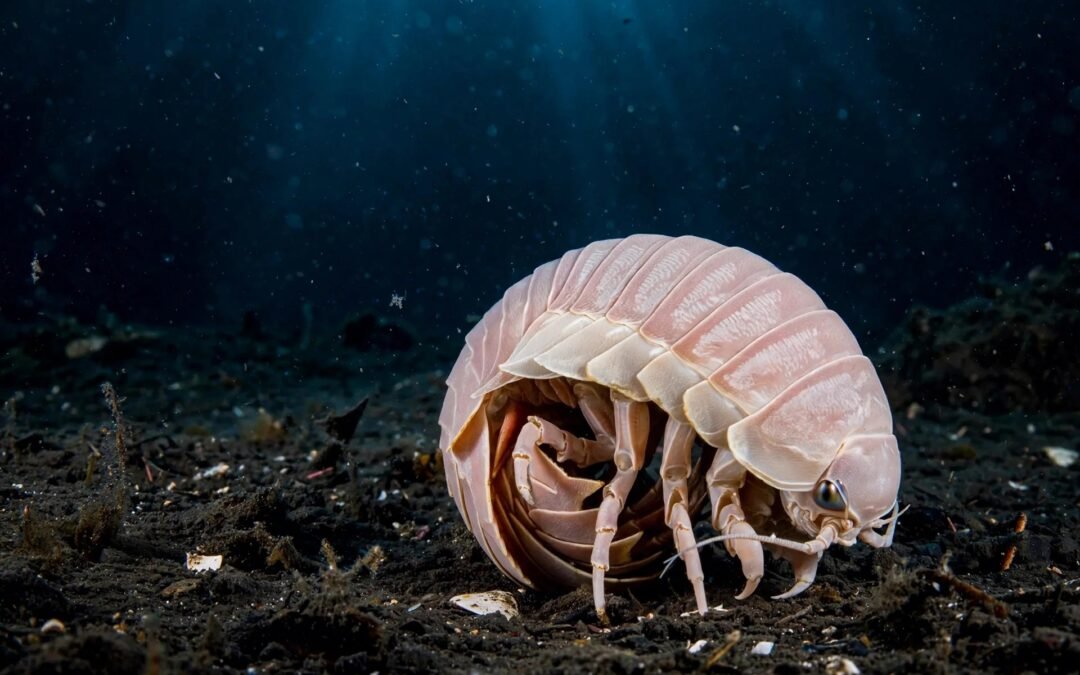
If you keep isopods at home, you already know the small thrill of watching a pill bug roll itself into a perfect little ball. Now picture that same animal — the same segmented shell, the same fourteen legs, the same defensive curl — stretched out to the length of a football. That is a giant isopod, and it is real.
Giant isopods live on the deep ocean floor, hundreds of metres below the sunlight, where they scavenge whatever the sea sends down. They are the most famous example of deep-sea gigantism, and they are also the source of one of the most common questions pet keepers hear: are they just enormous versions of the isopods in our tubs? The short answer is no — they are cousins, not twins. This guide covers the facts, the sizes, the famous five-year fast, and the one question everyone asks first: are giant isopods dangerous?
What Are Giant Isopods?
Giant isopods belong to the genus Bathynomus, a group of marine crustaceans in the order Isopoda — the same order as the woodlice and pill bugs in your garden, and the same order as every pet isopod species, from Dairy Cows to Giant Canyons. The family is Cirolanidae, and the best-known species is Bathynomus giganteus, described by the French zoologist Alphonse Milne-Edwards in 1879 from a juvenile male caught off the Dry Tortugas, near Florida. It caused a public sensation at the time, and honestly, it still does.
There are roughly 20 recognised Bathynomus species, and new ones are still being found — the most recent, Bathynomus vaderi, was only described in January 2025. The genus splits loosely into “giant” species and even larger “supergiant” species, and the supergiants are the ones that make headlines.
Anatomically, a giant isopod is exactly what it looks like: a pill bug scaled up. Its body is covered in overlapping calcified segments that flex as it moves and lock together when it curls into a ball, exposing only the tough shell. It has seven pairs of walking legs, two pairs of antennae for sensing food in the dark, and large, widely spaced compound eyes — each with around 4,000 facets — backed by a reflective layer called the tapetum, which bounces the faintest light back through the retina and effectively doubles what little light there is to see by. In photographs, that tapetum is why their eyes sometimes seem to glow.
Giant Isopods vs Pet Isopods: The Difference That Matters
This is the point most articles skip, and it is the one that matters most to a keeper. Giant isopods and pet isopods are relatives, but they are built for opposite worlds. A pet isopod breathes damp air through modified gills on its underside and needs the moisture gradient in your tub. A giant isopod breathes dissolved oxygen through feathery gills under its abdomen and needs cold, high-pressure seawater. One lives in a plastic tub on your shelf; the other would die within minutes at the surface.
| Giant isopod (Bathynomus) | Pet isopod (Porcellio, Armadillidium, Cubaris) | |
|---|---|---|
| Habitat | Deep ocean floor, 170–2,140 m down | Leaf litter, rotting wood, your enclosure |
| Size | Typically 8–15 cm; supergiants to ~50 cm | Usually 0.5–2 cm |
| Breathing | Gills in seawater | Modified gills in damp air |
| Temperature | Around 4 °C, near freezing | 18–26 °C, room temperature |
| Pressure | Up to 200+ atmospheres | Normal air pressure |
| Kept as pets? | No — only specialist aquariums | Yes, widely kept |
If you love the look of a big isopod, the honest route is a large terrestrial species. Our Porcellio expansus guide covers the Spanish giant, the biggest commonly kept pet isopod, and the Giant Canyon is another genuinely large option. Neither will ever reach football size, and that is fine — they are alive in your home, which is the whole point.
How Big Do Giant Isopods Get?
The number you see quoted everywhere is “up to 20 inches”, or about 50 cm. That figure is real, but it is also misleading, because it describes the extreme end of the largest species, not a typical animal. Most giant isopods a researcher pulls up are between 8 and 15 cm long — already enormous next to a garden pill bug, but nowhere near the record. Treat the 50 cm figure the way you would treat the tallest human ever recorded: true, and not representative.
| Species | Maximum size | Notes |
|---|---|---|
| Bathynomus giganteus | ~50 cm (20 in) | The classic giant; western Atlantic, described 1879 |
| Bathynomus jamesi | ~41.5 cm, over 2.6 kg | Supergiant of the Indo-West Pacific; the heaviest on record |
| Bathynomus vaderi | ~32.5 cm, ~1 kg | Described 2025 from Vietnam; the “Darth Vader” isopod |
| Typical Bathynomus | 8–15 cm | What most specimens actually measure |
| Garden pill bug | 1–2 cm | Your everyday comparison |
Weight matters as much as length. A large B. jamesi at over 2.6 kg weighs more than a bag of sugar, which is a strange thing to say about an animal that is, structurally, a woodlouse. The supergiant species are found mainly in the Indo-Pacific, while B. giganteus itself is the Atlantic species.
Where Do Giant Isopods Live?
Giant isopods live on the benthic zone — the ocean floor — of the Atlantic, Pacific, and Indian Oceans, usually at depths between 170 and 2,140 metres, with some records deeper still. Their preferred ground is cold, muddy or sandy seafloor in near-total darkness, where the temperature hovers around 4 °C and the pressure is 20 to 200 times what we feel at sea level.
They are not strong swimmers and they do not need to be. They walk the seafloor on their fourteen legs, antennae sweeping, waiting for food to arrive from above. That waiting is the whole story of their lives: in the deep sea, meals do not arrive on a schedule. A dead fish sinks. A whale carcass falls. Months or years can pass between feasts, and the isopod’s body is built around that uncertainty.
What Do Giant Isopods Eat?
Giant isopods are scavengers first and everything else second. Their diet is dead and decaying matter that sinks from the sunlit waters above: dead fish, whale carcasses, squid, crabs, marine worms, and the slow rain of organic particles called marine snow. When a whale fall is found, dozens of giant isopods can gather on it at once, feeding until their bodies are visibly swollen with food.
They are opportunists rather than hunters, but the line is not absolute. They have been observed eating slow-moving or weakened animals such as sea cucumbers and sponges, and when food is scarce enough, they will turn on each other. The feeding strategy is simple and brutally effective: gorge when food exists, then live off the reserves for as long as it takes. That is why their metabolism is so slow — every part of the animal is tuned for famine.
The 5-Year Fast: How Giant Isopods Survive Without Food
The most famous giant isopod in history never ate a single meal in front of anyone. A specimen at the Toba Aquarium in Japan, known simply as Number 1, was kept in captivity from 2007 and refused all food for 5 years and 43 days before dying in February 2014. It stayed healthy and active through most of that fast, which remains one of the longest documented fasting periods of any animal.
Keepers sometimes ask how that compares to pet isopods, and the honest answer is that it does not compare at all. A pet isopod that stops eating for a week is a colony in trouble — check your humidity and your food. A giant isopod that stops eating for five years is an animal doing exactly what evolution designed it to do. The difference is the environment: in the deep sea, a missed meal is normal, and the animal that cannot wait simply dies. The fast is not a party trick. It is the whole survival strategy, and it works because the cold water slows everything down — movement, digestion, growth, and the burning of stored energy.
Why Are Giant Isopods So Big? Deep-Sea Gigantism Explained
Giant isopods are the textbook example of deep-sea gigantism: the tendency of certain invertebrate groups to grow far larger in the deep ocean than their shallow-water relatives. The same pattern shows up in the Japanese spider crab, the colossal squid, and the giant sea spider. But why it happens is still genuinely debated, and any article that gives you one neat cause is overselling the science.
The leading explanations all point in the same direction. Cold water slows metabolic rates, which may favour larger bodies. The scarcity of food makes a large body a useful energy store — a bigger animal can carry bigger reserves through a longer famine. High pressure and low oxygen may also play a role, and larger size means a smaller surface-to-volume ratio, which loses heat and moisture more slowly. None of these is proven on its own, and the honest position is that several of them act together. What is certain is the result: the same basic body plan that gives you a 1 cm pill bug gives you a 50 cm deep-sea scavenger when the deep sea gets hold of it.
It is worth noting what gigantism is not. It is not a different kind of animal, and it is not evolution “trying” to make a monster. It is the same isopod blueprint, stretched by cold, pressure, and hunger over millions of years. Isopods as a group are ancient — the first isopod fossil is more than 300 million years old — and the giant forms are a reminder that the body plan has been working for a very long time.
Are Giant Isopods Dangerous?
No — not to you. Despite the intimidating size and the alien look, giant isopods are slow-moving, reclusive scavengers. They have no venom, no sting, and no interest in living humans. They eat dead things, and as the Ocean Conservancy puts it, they are not dangerous to humans — at least not to humans that are alive. You will also never meet one by accident: they live hundreds of metres down, far below any beach or dive site.
That said, “not dangerous” is not the same as “harmless to handle”. A giant isopod has powerful, hooked legs and strong mouthparts built for tearing dead flesh, and a frightened or hungry animal can grip and pinch. Researchers handle them with care, and so should anyone lucky enough to see one up close. They can also bite if cornered, and in extreme food scarcity they have been seen eating each other — but that is a famine behaviour, not aggression towards people. The sensible summary: dangerous to a dead whale, harmless to a living human, and best admired from a respectful distance.
Can You Keep a Giant Isopod as a Pet?
This is the question every pet isopod keeper eventually asks, and the answer is no — not in any normal home setup. A giant isopod needs water at around 4 °C, under crushing pressure, in total darkness, with a diet of deep-sea carrion. Reproducing even one of those conditions is a specialist engineering project; reproducing all of them is the job of a handful of public aquariums in the world, and even they struggle — remember the Toba Aquarium animal that refused food for five years.
There is also an ethical point worth stating plainly. Pulling a deep-sea animal out of its habitat to watch it slowly fail in a tank is not keeping, it is collecting, and the hobby does not need it. The pet isopod world already offers the experience honestly: large, beautiful, long-lived terrestrial species that thrive in a tub on your shelf. Start with our best isopod species for beginners guide, or read the complete beginner care guide before choosing. If size is the draw, Porcellio expansus and the Giant Canyon are the biggest animals you can keep well — and keeping them well is the part that counts.
Meet Bathynomus Vaderi: The Darth Vader Isopod
The newest giant isopod has the best story in the genus. Bathynomus vaderi was formally described in January 2025 by researchers Ng, Sidabalok, and Nguyen, from specimens bought in seafood restaurants and from fishermen in Quy Nhơn City, Vietnam. In Vietnam, giant isopods are fished and sold as food, and that seafood trade is what put the specimens in scientists’ hands — six of them turned out to be a species nobody had described.
It was named after Darth Vader because the shape of its head — the wide, rectangular clypeal region — resembles the Sith Lord’s helmet. The holotype measured 266 mm long, and the largest specimens reach about 325 mm and roughly 1 kg. It is the second supergiant species known from the South China Sea, after B. jamesi, and it lives in deep water off Vietnam near the Spratly Islands. The discovery is a useful reminder that the deep sea is still being catalogued, and that some of the newest science comes not from a research vessel but from a fish market.
Frequently Asked Questions
How big can giant isopods get?
The largest species, Bathynomus giganteus, can reach about 50 cm (20 inches) long. The heaviest, Bathynomus jamesi, has been recorded at 41.5 cm and over 2.6 kg. Most specimens, however, are between 8 and 15 cm.
Are giant isopods dangerous to humans?
No. They are scavengers with no venom, they live hundreds of metres below the surface, and they feed on dead animals. They can pinch or bite if handled roughly, but they pose no danger to a living person.
Can you keep a giant isopod as a pet?
No. They need cold, high-pressure, deep seawater and a diet of deep-sea carrion, which no home setup can provide. Only a few specialist public aquariums keep them, and even those struggle. Large terrestrial species like Porcellio expansus are the realistic alternative.
How long can giant isopods go without food?
Years. The best-documented case is the Toba Aquarium specimen that fasted for 5 years and 43 days. Their slow metabolism and huge energy reserves are adaptations to a deep sea where meals arrive unpredictably.
Are giant isopods related to pill bugs?
Yes. Both are in the order Isopoda, and giant isopods are essentially marine cousins of the woodlice and pill bugs in your garden. The family resemblance — segmented shell, fourteen legs, the defensive curl — is real, which is exactly why they look so familiar and so strange at the same time.
Why are giant isopods so big?
Deep-sea gigantism. Cold water, high pressure, low oxygen, and scarce food all appear to favour larger body size in the deep ocean, though scientists still debate the exact mix of causes. A bigger body stores more energy for surviving long periods without food.
References
The Sea — “Giant Isopod: Size, Diet & the 5-Year Fast” (thesea.org). Ocean Conservancy — “Meet the Giant Isopod of the Deep Sea” (oceanconservancy.org). BBC Wildlife / Discover Wildlife — “Meet this creepy, mysterious deep-sea giant” (discoverwildlife.com). Ocean Info — “Giant Isopod (Bathynomus giganteus)” (oceaninfo.com). Ng, Sidabalok & Nguyen (2025) — “A new species of supergiant Bathynomus from Vietnam”, ZooKeys 1223: 289–310.