
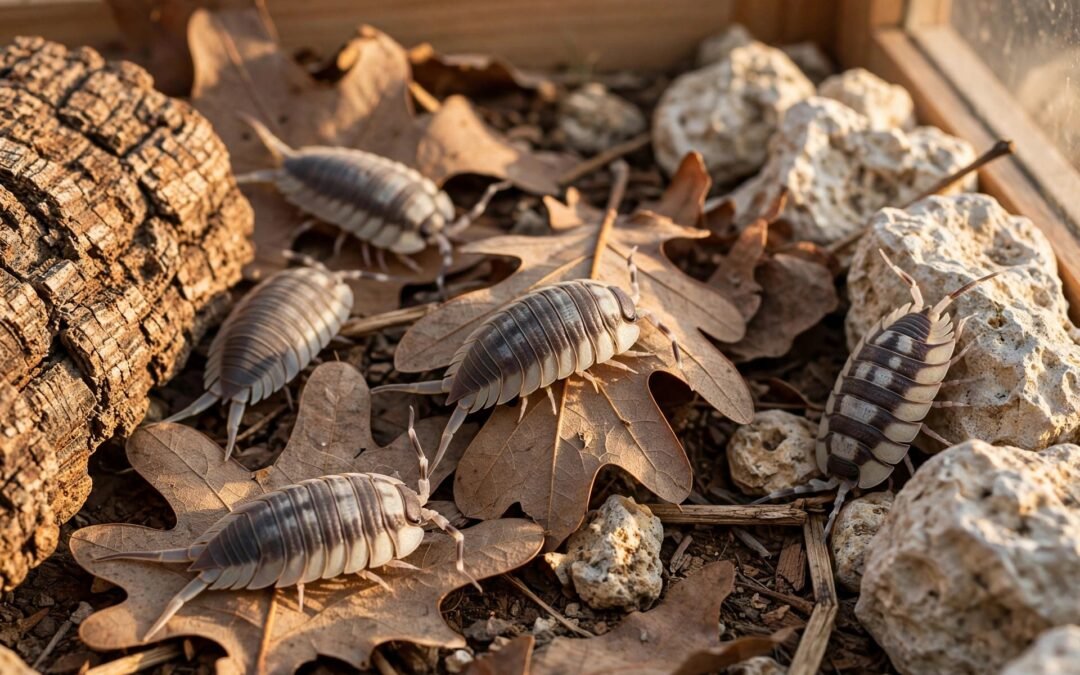
Porcellio Expansus Care: The Complete Spanish Giant Guide
Porcellio expansus care is simple once you accept one counterintuitive fact: this is a dry-climate isopod. Keep it mostly dry at 18–26°C and 45–55% humidity, with strong ventilation and a single damp corner, feed protein at least once a week, and give a starter group of 10–15 animals a tub of 17 litres or more. Do that, leave the colony alone, and you get one of the largest, longest-lived isopods in the hobby — animals that can reach 28 mm of body (40 mm with the uropods) and live 3–5 years. Treat it like a tropical Cubaris and the colony will mould, stall, and die. This guide covers the full setup, the varieties worth your money, the slow breeding timeline nobody warns you about, and the mistakes that actually kill colonies.
Porcellio Expansus Care at a Glance
| Care point | What expansus needs |
|---|---|
| Scientific name | Porcellio expansus, family Porcellionidae |
| Origin | Northeast Spain — rocky, mountainous Catalonia, Aragon and Castellón |
| Adult size | 28 mm of body on the largest male on record; about 32 mm in breeders’ figures; 40 mm including uropods |
| Lifespan | 3–5 years in good captive conditions |
| Difficulty | Intermediate — not a beginner species |
| Temperature | 18–26°C (64–79°F); normal room temperature is usually enough |
| Humidity | 45–55% overall, dry surface, one damp corner, strong ventilation |
| Enclosure | 17 litres or more for a starter group of 10–15; bigger as the colony grows |
| Substrate | Organic topsoil base, flake soil, crumbled decaying hardwood, limestone, leaf litter on top |
| Diet | Leaf litter and rotting wood always available; vegetables 1–2 times a week; protein at least weekly; calcium always available |
| Breeding | Slow — 30–80 mancae per brood, maturity at 8–12 months, colony established in 12–18 months |
| Behaviour | Nocturnal and crepuscular; active diggers; adult males can be territorial and display their uropods upright |
What Is Porcellio Expansus?
Porcellio expansus is a large terrestrial isopod from the dry, rocky mountains of northeast Spain. In the hobby it is sometimes called the “Spanish Giant”, and the name is earned: the largest male on record measured 28 mm of body, 40 mm including the uropods, and breeders quote around 32 mm of body. The famous La Sénia locality form is sold as exceeding 5 cm in total length once antennae and uropods are counted, which puts it among the largest isopods anyone keeps.
Two things about this animal trip up almost every new keeper. First, it cannot roll into a ball. “Pill bug” properly describes species that conglobate — Armadillidium and Cubaris — while Porcellio species have flatter bodies and escape danger by running, freezing, or wedging into crevices. If you buy expansus expecting a roly-poly, you bought the wrong genus. Second, it is not from France or Portugal, despite older articles claiming otherwise. It is endemic to northeast Spain, and that restricted, semi-arid mountain origin explains almost everything about its care: dry air, limestone, and a moisture gradient instead of a wet tub.
Adult males are easy to tell from females once the colony settles. Males carry longer uropods — the tail-like appendages — which they hold upright in display, a posture keepers call the “wanna-be scorpion” look. Females are wider and smoother. That display is not aggression in the usual sense, but mature males are territorial, and it is one of the reasons space matters more for this species than for the weedy beginner Porcellio.
The Varieties: Wild Type, Orange, La Sénia and Prades
Most of what you will see for sale falls into four forms. They are all the same species, so the care is the same — the differences are size, colour, rarity and price. That last point matters, because the price spread is wide and the most expensive form is not the best first colony.
| Form | Look | Size | Availability | Honest verdict |
|---|---|---|---|---|
| Wild type (standard) | Grey-brown, ridged back | Up to ~32 mm body | Less commonly stocked now | The real animal at the lowest price — if you can find it, buy it |
| Orange morph | Selectively bred warm orange | Similar, often quoted slightly smaller | Regularly available | Best value for most keepers; striking colour, more accessible price, slightly more forgiving |
| La Sénia locality | Broader skirts, subtle orange tint | Sold as the largest form, 5 cm+ total length | Rare, sells out fast | Paying for size and rarity, not different care — a second-colony purchase, not a first |
| Prades locality | Wild-type look, local form | Similar to wild type | Rare | Collector’s form; rated hard by sellers, and the price reflects scarcity |
There is also an “Autumnal Equinox” form in the trade, sold with the same dry-leaning care profile and a note that juveniles need a damp refuge. Treat every named form the same way: same temperatures, same gradient, same food. What changes is what you pay and how long you wait for stock.
My opinion, stated plainly: do not make La Sénia your first expansus. The premium buys you a bigger animal and a rarer label, and nothing about the care gets easier. If the colony crashes — and first colonies of an intermediate species sometimes do — you have lost the most expensive animals in the genus. Start with wild type or Orange, learn the gradient, and buy La Sénia once you have a colony that has bred.
Porcellio Expansus Care: Enclosure Setup
Give a starter group of 10–15 animals at least 17 litres, and go bigger as the colony grows — or split it across two tubs. This is not a species for a tight plastic box or a shallow starter bin. Large animals need floor space, and mature males need room to settle without constant confrontation. Space and well-spaced hides matter more here than with the weedy species.
Ventilation is the single most important structural choice. Drill generous vents on the sides and lid, or use a mesh-vented lid, and make sure air actually moves. Expansus does not tolerate stagnant, humid air — a sealed tub with a wet substrate is the fastest route to a dead colony. If condensation is sitting on the walls for days, you have too little airflow, not too little water.
Furnish it like a Mediterranean cliffside, not a rainforest floor:
- Multiple flat cork bark pieces — the flared body is built to clamp against flat bark, and several pieces let males hold separate territories.
- Decaying hardwood chunks — food and structure at the same time; white-rotted wood is preferred.
- Limestone pieces and rocks — matches the natural mountain habitat and doubles as a slow calcium source.
- Deep leaf litter on top — magnolia and oak leaves work well; keep dry litter available at all times.
- No tropical plants, no bromeliads — wrong climate, wrong moisture, and they rot in a dry setup anyway.
A modest springtail culture tucked into the damp corner is worth adding. It grazes the soft mould that appears around fresh food without needing the humidity to climb, which is exactly the trade-off this species demands.
Porcellio Expansus Care: Substrate and the Moisture Gradient
The substrate recipe is the standard Spanish Porcellio mix: an organic topsoil base, flake soil for extra nutrition, crumbled decaying hardwood worked through it, limestone pieces or calcium-rich rock, and a surface layer of leaf litter. Topsoil feeds the colony as it breaks down; that is one reason it beats inert alternatives.
Two ingredients are actively wrong here, and both are common in starter kits. Coco coir holds far too much water for this group — it stays wet, the surface never dries, and the colony pays for it. Peat moss is acidic, and woodlice are far more abundant on calcareous soils than acid ones. Use organic topsoil instead of either.
Substrate depth is one place where good sources disagree, and the disagreement is worth knowing about rather than hiding. General guidance says 5–8 cm; the Orange morph care notes say 4–6 cm so moisture cannot pool at the base; the Prades locality notes say 7–10 cm, deep enough to hold the gradient steady and to dig into. The honest reading is that depth is a tool, not a rule: a thinner layer dries faster and suits a warm room, a deeper layer holds the gradient longer and suits a keeper who waters less often. Either way, keep it deep enough to dig in — these are serious burrowers — and never so deep and wet at the base that it turns anaerobic.
The gradient itself is the whole game. One end of the enclosure damper, with moist substrate; the other end dry to slightly damp. Water by pouring into the damp corner, not by misting the whole tub. Daily whole-tub misting is the most overrated habit in isopod keeping and the single fastest way to kill this species — it wets the surface the animals need dry, and it does nothing a poured corner cannot do better. A light mist of the damp end only, every day or two as needed, is plenty.
One nuance the product pages get right and most care sheets skip: juveniles need more moisture than adults. Mancae are small, soft, and dry out fast, so the damp corner is not optional decoration — it is the nursery. Keep a pocket of damp sphagnum or damp leaf litter in that corner so the young have somewhere safe while the adults keep to the dry, airy zone.
Porcellio Expansus Care: Temperature and Humidity
Spanish mountain conditions translate to 18–26°C. A normal home sits inside that band for most of the year, so supplementary heating is only needed for cold rooms, or if you want to push breeding activity. They do not need the 22–26°C range associated with premium Cubaris. Cooler is fine; very warm is actively harmful for this species, especially combined with poor ventilation.
If you do heat, fix the mat to the side of the tub on a thermostat, never underneath. A mat under a dry substrate cooks the bottom layer, dries the damp corner from below, and gives the animals nowhere cool to retreat to. Most keepers in a heated home will never need a mat at all — and that is a feature, not a gap in the setup.
Humidity should sit around 45–55% overall, with a drier surface and one damp zone. Do not hold 75% or more throughout the tub: Spanish Porcellio want the drier conditions above, and a tub kept that wet grows mould, then loses animals. A hygrometer helps, but the squeeze test and your eyes are better instruments here — if the surface litter is dry and crinkly and the corner substrate holds together when squeezed, the gradient is working. Learn more about measuring and adjusting humidity in our isopod humidity control guide, and about airflow in our isopod ventilation guide.
Porcellio Expansus Care: Feeding
Large Porcellio are protein-hungry, and this is where expansus care differs most from the beginner species. Without consistent protein, they may opportunistically attack moulting individuals. That is not a horror story — it is a feeding schedule problem with a simple fix.
- Hardwood leaf litter — the dietary foundation, always available.
- Decaying hardwood — food and habitat structure; keep white-rotted wood in the tub at all times.
- Fresh vegetables — courgette, cucumber and sweet potato in small portions, once or twice a week.
- Protein, at least weekly — fish flakes, dried shrimp, freeze-dried bloodworm, or insect-based meals. This is a routine, not an extra.
- Calcium, always available — cuttlebone plus limestone or crushed eggshell in the substrate, since woodlice build a calcium carbonate cuticle.
Clear uneaten fresh food promptly — in a dry setup it dries out rather than rotting, but leftovers still attract mites. Do not feed peat moss, conifer wood or needles, eucalyptus, walnut, treated lumber, or kitchen scraps with salt, spices or oils. For the wider picture, see our protein sources for isopods and our calcium for isopods guides.
The underrated move here is fish flakes. Boutique protein blends get the attention, but plain fish flakes are cheap, easy to dose, and disappear fast enough to tell you the colony is eating. Offer a small pinch, watch it vanish overnight, and you have learned more about colony health than any supplement label will tell you.
Handling and Behaviour
Expansus are nocturnal and crepuscular, most visible at low light — but an established colony will show itself during the day, especially around food. They are faster movers than Armadillidium or Cubaris, and they dig visibly; burrows develop in suitable substrate, which is half the display value of the species.
Handle them as little as possible. They do not roll up, so a dropped animal has no armour to fall back on, and a 30 mm animal with a hard exoskeleton is more fragile than it looks. If you must move one, coax it onto a piece of bark or into a small tub rather than pinching it — the same gentle approach in our guide to handling isopods safely. Males displaying with upright uropods are showing off, not attacking you; leave them to it.
Watch the colony’s behaviour as a health signal. Animals clustered permanently in the damp corner are telling you the dry side is too dry or too hot. Animals never leaving the dry side are telling you the corner is too wet. A healthy expansus colony spreads across the gradient and uses the hides — if yours does not, the setup is wrong, not the animals.
Porcellio Expansus Care: Breeding
Here is the honest part, and the part that should shape your decision to buy. Expansus breed slowly compared with common species, and no amount of good care turns them into Powder Orange.
- Broods of 30–80 mancae per cycle — not the 200 figure some older sources still claim. That number is fiction; plan your expectations around 30–80.
- Females breed less frequently than smaller Porcellio, with broods relatively infrequent.
- Slower growth to sexual maturity — 8–12 months.
- Self-sustaining colony establishment takes 12–18 months in good conditions.
For successful breeding: keep the low-to-moderate humidity gradient steady, supply protein consistently, keep calcium available at all times, disturb the colony as little as possible, and start with a mixed-age group of 10–15 animals rather than a pair. A pair is a gamble; a group is a colony.
The real difficulty of this species is not the daily care — it is the waiting. Twelve to eighteen months to a self-sustaining colony is a long time to keep a tub undisturbed while nothing visibly multiplies. If you want fast colony growth, buy P. laevis or P. scaber instead and come back to expansus later. If you want a display animal you will still be watching in five years, expansus is the better buy. If your colony stalls, work through our isopod colony not breeding troubleshooting checklist before changing anything drastic — and remember that a moulting isopod is not a dying one, as explained in our molting vs dying guide.
Porcellio Expansus vs Other Large Porcellio
Expansus sits in a crowded group of large Spanish Porcellio, and the differences between them are small on paper and real in the tub. This table compares it against the species we have already covered on this site.
| Species | Size | Temperature | Humidity | Temperament / notes |
|---|---|---|---|---|
| P. expansus | 28–32 mm body | 18–26°C | 45–55%, dry + damp corner | Territorial males; slowest breeder of the group; 12–18 months to establish |
| P. ornatus | Large, yellow-marked | Warmer-leaning | Dry-leaning gradient | Males territorial too; striking morphs; intermediate |
| P. bolivari ‘Yellow Ghost’ | Large, pale yellow | Room temperature | 45–55%, dry limestone setup | Closest care match to expansus; same dry-climate logic |
| P. hoffmannseggii | Very large | 20–26°C | Dry-leaning gradient | Andalusian endemic; warmer than expansus, breeds better with some extra heat |
| P. dilatatus ‘Giant Canyon’ | Large, brown | Room temperature | Moisture gradient | More forgiving; better first large Porcellio than expansus |
If you already keep one of these, expansus will feel familiar — the same dry-with-a-damp-corner logic, the same protein and calcium routine. The differences are patience and space: expansus wants more of both. P. magnificus, another large Spanish species, runs warmer at 20–28°C and is the one to consider if you want the giant-Porcellio look with a heat mat already in use.
Common Problems and How to Fix Them
| Symptom | Likely cause | Fix |
|---|---|---|
| Mould spreading across the substrate | Whole tub too wet; poor ventilation | Stop misting the surface; pour water only into the damp corner; increase vents; remove mouldy food and litter |
| Animals dying after moulting | Not enough protein or calcium; moulting animals attacked | Offer protein at least weekly; keep cuttlebone and limestone in the tub at all times; add more hides so moulting animals can hide |
| Colony not breeding after a year | Normal for this species — or too much disturbance, or no gradient | Check the 12–18 month timeline first; then leave the tub alone for weeks, confirm the damp corner exists, and keep protein steady |
| Animals always hiding, never visible | Tub too bright, too hot, or too disturbed | Move the tub out of direct light, check the temperature stays under 26°C, and stop lifting hides daily |
| Males fighting, damaged animals | Too little space or too few hides | Move to a bigger tub or split the colony; add several flat cork bark pieces so males can hold separate spots |
| Mancae disappearing | Damp corner dried out; juveniles have no moist refuge | Restore a damp sphagnum pocket in the corner; keep it damp, not wet, and never let the whole tub dry out |
| White mites on food | Uneaten fresh food left too long | Remove leftovers within 24 hours; reduce portion size; keep the springtail culture in the damp corner |
Is Porcellio Expansus Right for You?
Expansus suits keepers who are ready for an intermediate species, who want an impressive large-bodied display animal, who already run a stable Mediterranean-style setup, and who are patient enough to wait a year or more for a colony to establish. It does not suit first-time keepers, anyone running a tropical high-humidity setup, anyone who wants fast colony growth, or anyone with a cramped enclosure.
The honest ladder is this: learn Porcellio on P. scaber or P. laevis first — both teach the same care principles at much lower stakes, and both forgive the mistakes expansus punishes. Then, if you still want the Spanish Giant, buy wild type or Orange, set the tub up dry with a damp corner before the animals arrive, and leave the colony alone for the first month. The species rewards patience and punishes fussing. That is the whole secret, and it is the part no product page will tell you.
If you are still deciding, start with our complete isopod care guide for beginners and our best substrate mix for isopods — then come back to expansus once the basics are second nature.
Frequently Asked Questions
How big do Porcellio expansus get?
The largest male on record measured 28 mm of body and 40 mm with the uropods, and breeders quote about 32 mm of body. The La Sénia locality form is sold as exceeding 5 cm in total length including antennae and uropods, making it one of the largest isopods kept in the hobby.
Can Porcellio expansus roll into a ball?
No. Like all Porcellio species, expansus has a flatter body and cannot conglobate. The pill bugs that roll up belong to other families — chiefly Armadillidiidae, which includes Armadillidium, and Armadillidae, which includes Cubaris. Expansus escapes danger by running, freezing, or wedging into crevices.
Where are Porcellio expansus from?
They are endemic to northeast Spain, particularly the rocky and mountainous areas of Catalonia, Aragon and Castellón. They are not found in France or Portugal, despite some older articles claiming otherwise.
Do Porcellio expansus need high humidity?
No. They prefer a Mediterranean-style enclosure with a clear moisture gradient: a predominantly dry surface with a small damp zone at one end, plus strong ventilation. High overall humidity causes mould, respiratory problems and colony decline.
How long do Porcellio expansus live?
Adults typically live 3–5 years under good husbandry, making them one of the longer-lived isopods in the hobby — considerably more than P. laevis at a year or two, or P. scaber at about two to three years.
Are Porcellio expansus suitable for beginners?
Not really. They have specific ventilation and moisture requirements, breed slowly, and are expensive enough that mistakes cost real money. Gain experience with Porcellio scaber or Porcellio laevis first — both teach the same care principles at much lower stakes.
What is the difference between standard expansus and La Sénia?
La Sénia is a locality form collected from the La Sénia region on the Catalonia–Aragon border. It is sold as the largest expansus variant — broader, longer, with a distinctive orange-tinted skirt — and it is rarer in the trade and commands a premium price. The care is identical to standard expansus.
References
PostPods — Porcellio expansus Care Guide (postpods.co.uk). TC Insects — Porcellio expansus product and care notes (tcinsects.com). PostPods — Porcellio expansus ‘La Sénia’, ‘Orange’ and ‘Prades’ care notes (postpods.co.uk). Vandel, A. (1951) — revision of Porcellio, largest male measurement of 28 mm body / 40 mm with uropods, cited in the PostPods care guide.