
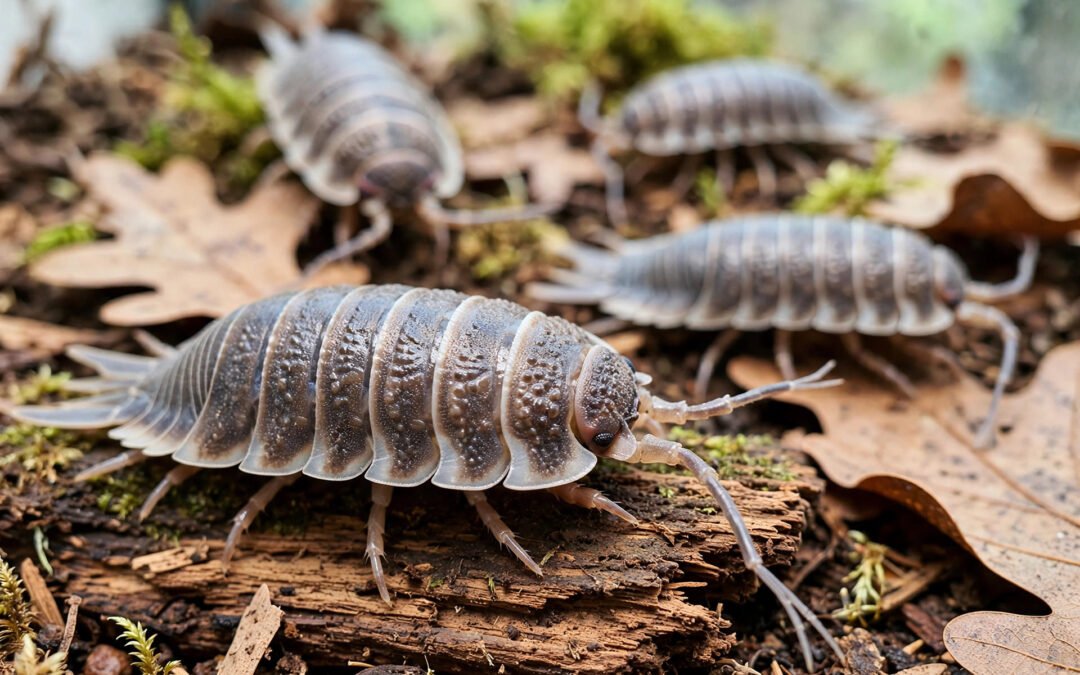
Hoffmannseggi Isopod Care: The Complete Titan Isopod Guide for Beginners
Porcellio hoffmannseggi, better known as the Titan isopod, is one of the largest isopods in the pet trade — a flat, wide, armour-plated giant from southern Spain that can reach 4 cm long. Hoffmannseggi isopod care is straightforward once you understand one thing: this species breaks the usual isopod rules. It wants a drier, airier home than most isopods, plenty of space, and — most importantly — it does not always play nicely with its own kind. Get those three things right and Titans are hardy, long-lived, and genuinely fascinating to watch.
This guide covers the full picture: enclosure size, the moisture gradient that makes or breaks a Titan culture, feeding, breeding, the territorial behaviour that stalls so many colonies, and the morphs worth knowing about.
Quick Facts: Porcellio hoffmannseggi at a Glance
| Scientific name | Porcellio hoffmannseggi (sometimes spelled hoffmannseggii) |
| Common names | Titan isopod, Hoffmannsegg’s isopod, giant Spanish isopod |
| Origin | Southern Spain and surrounding Mediterranean areas |
| Adult size | Up to 4 cm (about 1.6 inches) — among the largest in the hobby |
| Appearance | Flat, wide, bumpy carapace in grey-brown with a pale white to blue-grey skirted edge; long, noticeable antennae |
| Temperature | 20–26 °C (68–79 °F); comfortable at normal room temperature |
| Humidity | Drier than most isopods: a steep moisture gradient, not uniform dampness |
| Difficulty | Intermediate — forgiving for a giant species, but not a first-isopod pick |
| Breeding | Moderate pace, small to moderate broods, slow-growing young |
| Lifespan | Typically 2–3 years in captivity with good care |
Meet the Titan: What Makes Hoffmannseggi Different
Most beginner isopods are small, fast-breeding, and happy to pile on top of each other. Titans are the opposite in almost every way. They are big, deliberate, and slow — slow to grow, slow to breed, and slow to forgive a setup that ignores their preferences. That deliberate pace is part of the appeal: you can actually watch an individual Titan, follow it around the enclosure, and recognise it again the next day. You cannot do that with a tub of Powder Oranges.
They are also, by giant-isopod standards, the most forgiving of the Spanish giants. Keepers generally find them easier than Porcellio magnificus or Porcellio expansus, which is why Titans are a sensible first step into the large-species world — provided you are not expecting a beginner species in a bigger shell.
One honest warning up front: Titans are not great bioactive cleaners. Compared with frenzied eaters like Dairy Cows, their feeding response is relatively passive, and a Titan in a large reptile enclosure can itself become a snack. Buy them because you want to keep Titans, not because you want a cleanup crew — that distinction will save you disappointment. That combination of size, attitude, and specific needs is exactly what makes hoffmannseggi isopod care different from keeping common species.
Hoffmannseggi Isopod Care: Enclosure Size and Setup
For a starter culture of 10–12 Titans, a shoebox-sized tub is the absolute minimum, and honestly it is already too small for adults. A 25-litre tote is a far better starting point, and a colony that is actually growing will want more. The reason is not just body size — it is behaviour, which we will come back to below. Titans need room to establish separate territories and separate hiding spots, and a cramped tub removes that option entirely.
Ventilation matters as much as floor space. Drill generous air holes on the sides and lid, or use a mesh-vented container. Titans come from breezy Mediterranean cliffsides, and stagnant, stuffy air is one of the fastest ways to lose them. Our isopod ventilation guide explains how to balance airflow against moisture loss, and our isopod enclosure size guide covers the colony-size-to-tub-size maths in detail.
Substrate should be 3–4 inches deep: a mix of coconut coir or organic topsoil, plenty of decaying hardwood, and a thick layer of leaf litter on top. That depth matters because gravid females and juveniles spend much of their time down in the substrate, and shallow substrate dries out before the moisture gradient can establish itself. See our best substrate mix for isopods for ratios that work well here, and our best leaf litter for isopods ranking for the litter layer.
The Moisture Gradient: Why “Dry” Does Not Mean Desert
Here is the contradiction every new Titan keeper runs into. Some care sheets and sellers list 70–80% humidity for this species. Experienced keepers say the opposite: keep them dry, with plenty of ventilation. Both sides are describing the same animal badly. The truth is a steep moisture gradient.
In practice, that means roughly two-thirds of the enclosure stays dry — dry substrate, dry leaf litter, dry hides — while one corner holds a damp retreat, usually a pile of long-fibre sphagnum moss that you mist a few times a week. The isopods choose where to be. Males tend to hang out on the dry side. Gravid females and tiny juveniles stay deep in the moist zone, and that split is not optional: without adequate moisture, females can die after giving birth and very few of the brood survive.
This is the single most useful diagnostic in Titan keeping. If deaths are spread evenly across males, females, and young, the setup is probably too wet. If gravid females or juveniles are the ones dying, it is almost certainly too dry. That framing, borrowed from experienced giant-isopod keepers, beats any hygrometer reading — though our isopod humidity control guide will help you measure the gradient properly.
My blunt opinion: the “keep them at 70–80% humidity” advice is the most overrated guidance in Titan care, and it is probably behind a large share of the “my Titans keep dying” posts. A uniformly damp tub with poor airflow is a mould trap for this species. A dry tub with a damp corner is what they actually evolved for.
Temperature: Room Temperature Is Enough
Titans are comfortable at 20–26 °C (68–79 °F), which for most homes means no heating equipment at all. They breed best in that band and tolerate a cooler room, but breeding slows below about 15–16 °C and they should not sit below 15 °C for long stretches. They are more cold-sensitive than hardy temperate species like Porcellio scaber, but far less demanding than tropical Cubaris, which need real warmth.
If your room drops below 18 °C in winter, a heat mat on the side of the tub (never underneath the whole base) is enough to nudge them back into breeding range. Our isopod temperature guide gives the full species-by-species ladder if you keep several species.
What to Feed Titan Isopods
Titans are detritivores with a clear preference: decaying wood first, leaf litter second, everything else as a supplement. Keepers consistently report that they choose rotting hardwood over leaves when both are available, so a tub without a good chunk of soft, crumbling wood is missing their favourite food. Oak and other hardwood leaves still belong in the setup — they are shelter as much as food — but do not be surprised if the wood gets more attention.
On top of that base, Titans are heavy protein eaters for their size, and large species need more supplemental protein than small ones. Offer fish flakes, dried shrimp, or a quality isopod diet mix once or twice a week in small amounts, and remove anything uneaten within 48 hours before it moulds. Our protein sources for isopods guide ranks the options and explains the 48-hour rule.
Calcium is non-negotiable for an animal building a 4 cm armoured shell. Keep cuttlebone, crushed eggshell, or limestone in the enclosure at all times — see our calcium for isopods guide for sources and deficiency signs. Fresh vegetables such as carrot, squash, and sweet potato are welcome occasional extras, but keep portions small: Titans eat slowly, and a big piece of cucumber rotting in a dry tub is worse than no treat at all.
Breeding Hoffmannseggi Isopods
Breeding Titans is moderate in pace and refreshingly easy to sex. Males are noticeably larger and carry much longer uropods — the tail-like appendages at the rear — so checking that your starter culture actually contains both sexes takes about ten seconds. If nothing is happening in a healthy-looking culture, a missing male is the first thing to rule out. Our how to sex isopods guide shows exactly what to look for.
Sub-adults may start breeding before reaching full size, and broods are small to moderate rather than the explosions you get from Powder species. Growth is slow: juveniles take months to reach adult size, and a culture can look like it is standing still for long stretches. That is normal. Do not mistake slow growth for failure — judge the colony over months, not weeks. If you are worried your colony has stalled, our isopod colony not breeding checklist walks through the causes in likelihood order, and our isopod breeding basics guide covers the fundamentals.
One breeding-season wrinkle: females get fiercely protective of their young in the first few months, which brings us to the behaviour that defines this species.
The Territorial Problem Nobody Warns You About
This is the section most care sheets skip, and it is the one that explains the most failed Titan cultures. Hoffmannseggi are territorial — unusually so for isopods. Adults, and especially brooding females, will seriously harm each other in a crowded tub. Keepers who report poor survivability and stalled reproduction often have a social problem, not a humidity or temperature problem.
The fixes are practical, and they all amount to giving each animal somewhere else to be:
- Use a bigger container than feels necessary. A 25-litre tote for a starter culture is not generous — it is the floor.
- Provide many separate hides. Cork bark flats, branches, egg-carton sections — spread them out so no single hide is worth fighting over.
- Split aggressively. If one individual is bullying the rest, or if a culture is crowded, divide it into two or more smaller cultures of just a handful of animals each. Sometimes the simplest fix is literally removing the problem animal to its own tub.
- Do not overcrowd a display tank. Titans look spectacular in a planted terrarium, but a display crammed with adults is a fight waiting to happen.
Honest take: if you love the idea of a dense, writhing colony, Titans will frustrate you. If you like watching a few big, characterful animals with space to behave naturally, they are one of the best species in the hobby. Buy for the animal they are, not the colony you imagine.
Hoffmannseggi Morphs Worth Knowing
The standard Titan is a muted grey-brown with a pale skirt, but a few variants circulate in the hobby:
- Standard / wild type — grey-brown body, white to pale-blue skirt. The classic look and the hardiest option.
- “Black” — technically a locale rather than a morph, with a darker, more uniform block colour.
- “Brown” / “Chocolate” — lighter brown animals that can pop up in ordinary broods; one or two per brood is common.
- “White Out” — a rare, recently isolated pale form. Striking, but expect a premium price and a smaller gene pool.
For a first Titan culture, the standard form is the smart buy: it is the cheapest, the most widely available, and the least likely to carry the inbreeding quirks of a rare new morph. Our isopod morphs explained guide covers the morph-versus-species confusion that trips up a lot of buyers.
Common Hoffmannseggi Isopod Care Mistakes
- Keeping the whole tub damp. Uniform moisture plus poor airflow is the fastest route to mould and deaths. Build the gradient instead.
- Starting in a tiny tub. A shoebox works for a week, not for a colony. Size up early.
- Expecting Powder Orange breeding speed. Titans are slow growers with modest broods. Patience is part of the species.
- Skipping protein and calcium. Big shells and big bodies need both, consistently — not as an occasional treat.
- Ignoring aggression. If animals are losing legs or dying without an environmental cause, split the culture before you change anything else.
- Buying them as a cleanup crew. Their feeding response is too passive for heavy-duty cleaning, and in a reptile tank they may become food.
Are Titan Isopods Right for You?
Titans suit keepers who already have a colony or two under their belt and want something bigger, slower, and more watchable. They are a poor first isopod if you want fast results, and a poor cleanup crew if you want a hardworking tank janitor. But if you can offer a roomy, airy tub with a proper moisture gradient, regular protein and calcium, and the willingness to split a culture when tempers flare, Hoffmannseggi isopod care is genuinely rewarding — few isopods command a terrarium quite like a 4 cm Titan lumbering across the leaf litter.
Frequently Asked Questions
How big do Hoffmannseggi isopods get?
Adults commonly reach 3.5–4 cm (about 1.4–1.6 inches), making them one of the largest isopods available in the hobby. Males tend to be larger than females and have noticeably longer uropods.
Are Titan isopods good for beginners?
They are intermediate rather than beginner. They are the most forgiving of the giant Spanish species, but their territorial behaviour, slow breeding, and specific moisture-gradient needs make them a better second or third species than a first.
Do Hoffmannseggi isopods need high humidity?
No — not uniformly. They need a dry enclosure with a damp retreat (usually sphagnum moss) they can visit. A constantly damp, poorly ventilated tub harms them; a steep moisture gradient is the correct setup.
Can Titan isopods live with other isopod species?
Mixing is not recommended. Titans are territorial even with their own kind, and their size and protein appetite put smaller species at a disadvantage. Keep one species per tub.
How fast do Hoffmannseggi isopods breed?
Moderately and slowly compared with common species. Sub-adults can breed before full size, broods are small to moderate, and juveniles take months to grow up. Judge progress over months, not weeks.
References
- Terrarium Tribe — How to Care for Porcellio hoffmannseggi (The Titan Isopod)
- Smug Bug — Misconceptions in Giant Isopod Care
- PostPods — How Cold Is Too Cold for Isopods?
Care ranges vary between keepers and lines; treat the numbers above as starting points and adjust to what your own colony shows you. If animals are thriving, breeding, and moulting cleanly, your setup is right whatever a care sheet says.