
Yellow Ghost Isopod Care: The Complete Porcellio Bolivari Guide
Yellow ghost isopod care starts with a correction that most sellers will not make for you: the Yellow Ghost is not a Cubaris at all. It is Porcellio bolivari ‘Yellow Ghost’, a pale colour form of a large Spanish Porcellio from the dry limestone country around Alicante — and that single fact changes almost everything about how you keep it. The care sheets that get passed around for “yellow ghost isopods” are usually copied from Rubber Ducky guides: warm, humid, mist daily. Follow that advice with this animal and you will kill it. The Yellow Ghost wants the opposite — a dry tub, strong airflow, and one small damp corner it can visit when it chooses. This guide covers the real setup, the feeding and breeding that actually work, the buying traps, and the honest verdict on whether this collector’s isopod belongs in your collection at all.
Yellow Ghost Isopod Care at a Glance
| Care point | What the Yellow Ghost needs |
|---|---|
| Scientific name | Porcellio bolivari ‘Yellow Ghost’ (not a Cubaris) |
| Origin | Dry limestone country, Alicante, south-eastern Spain |
| Adult size | About 25 mm (trade listings quote up to 3 cm) |
| Temperature | 68–78°F (20–26°C), room temperature in most homes |
| Humidity | 45–55% overall, with one damp sphagnum corner |
| Ventilation | Strong cross-ventilation — non-negotiable |
| Substrate | Well-draining topsoil and flake soil with sand, limestone mixed through |
| Difficulty | Intermediate to advanced — not a first isopod |
| Breeding speed | Moderate and steady, not a boom species |
| Rolls into a ball? | No — a Porcellio, it runs and wedges into crevices instead |
| Price guide | Roughly £30 for a small culture in the UK; €25 for 12 in the EU; $70+ for 6 in the US |
What Is a Yellow Ghost Isopod?
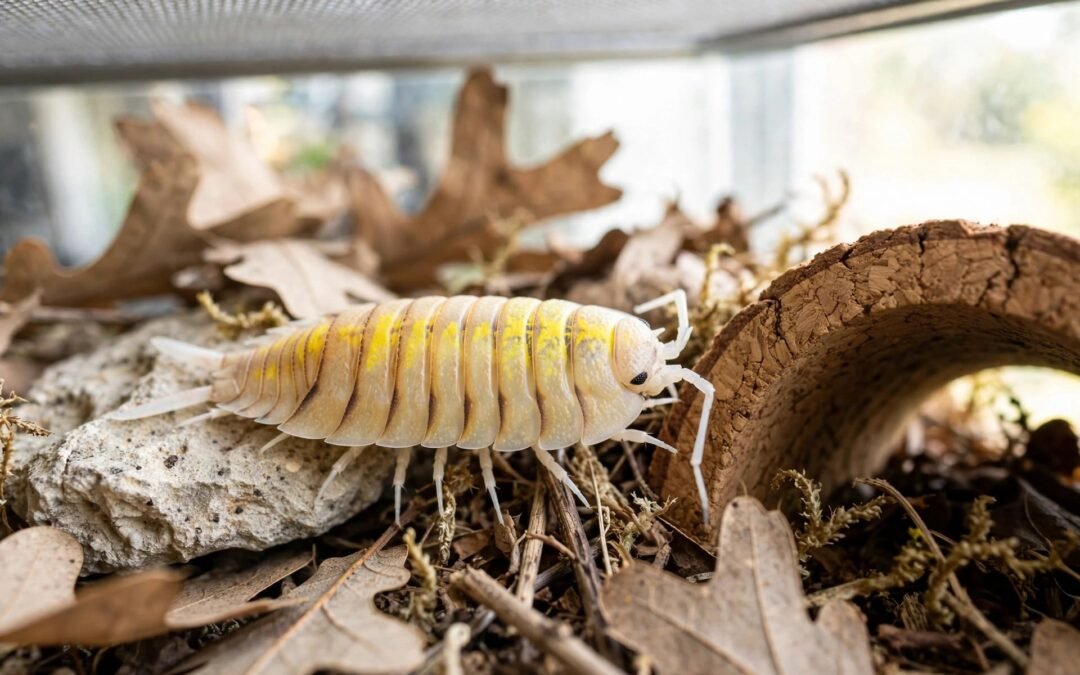
The Yellow Ghost is the pale colour form of Porcellio bolivari, a big, broad-bodied Porcellio described in 1892 by Dollfus from two animals collected near Villajoyosa in Alicante, on Spain’s south-eastern coast. Its body is washed out to a soft, pallid lemon-yellow, with a brighter band along the back that gives it a ghostly, almost translucent look — hence the name. The pale wash and the dorsal stripe deepen as the animal matures, so young stock looks softer and less defined than a settled adult. Do not panic if the animals you receive look washed-out and plain; that is what juveniles look like, and the colour comes in as they grow.
Two facts about its identity matter more than the colour. First, it is a Porcellio, not a Cubaris — so it cannot roll into a ball. When startled it relies on speed and on wedging itself into crevices, which is why cork bark with real gaps and rocky terrain matter more for this species than they do for a conglobating one. Second, it comes from dry country. Alicante’s limestone hills are hot, bright, and calcium-rich, and the animal is built for that: a tough cuticle, a tolerance for dry air, and a lifestyle built around finding dampness in cracks and under stones rather than living in it. Every part of its care follows from those two facts.
It sits beside a sister morph, the brighter Porcellio bolivari ‘Lemonade’, and among the other large Spanish Porcellio — the close relative P. nicklesi, described in the same 1892 paper, and the giant Porcellio ‘Titan’. If you see a seller listing “Yellow Ghost” under Cubaris sp., or under a Thai cave locality, that listing is wrong. It is not a scam in itself — the name gets copied and pasted across shops — but it tells you the seller does not know what they are selling, and you should buy from someone who does.
Yellow Ghost Isopod Care: The Dry Setup That Surprises Beginners
Here is the opinion most generic care sheets will not print: for the Yellow Ghost, the standard beginner advice to “keep it humid and mist daily” is not just unhelpful, it is the single most common way keepers kill this species. The Yellow Ghost wants low humidity — roughly 45–55% — with strong cross-ventilation, and it suffers badly in a constantly damp, stagnant tub. That is the opposite of what a Rubber Ducky or a Blonde Ducky needs, and it is exactly why the Cubaris care sheets floating around under this animal’s name are dangerous.
But “dry” does not mean bone dry, and this is where beginners make the second mistake — overcorrecting. An isopod breathes through its pleopods, the feathery gills under its belly, and those only work while they stay moist. A mostly dry setup still needs one reliable damp retreat: keep the bulk of the enclosure dry, with rocky terrain, dry leaf litter and curved cork bark, and hold moisture in a single sphagnum moss corner the colony can visit. The animals will do the rest themselves, moving between the dry side and the damp corner as they need to. If you find them all permanently huddled in the wet corner, the tub is too dry; if they never visit it at all, it is wet enough — and probably too wet.
Ventilation is the part you cannot compromise on. Drill or melt generous ventilation holes along the upper sides of the tub and in the lid, on both sides so air actually moves across, and cover them with fine mesh if the tub sits near other cultures. A dry tub with still air goes stale just as surely as a wet one, and stale air is the quiet killer that shows up as a colony that “just stopped breeding” and then “just died off” over a few weeks. For the mechanics of airflow in a tub, see our isopod ventilation guide, and for how to read and manage a gradient, our isopod humidity control guide.
Yellow Ghost Isopod Care: Enclosure Setup
A ventilated 6 US quart tub (about 5.7 litres) is the standard starter home for a culture of six to twelve animals, and a 12-quart tub suits an established colony. What matters is not the container but the structure inside it. Build the tub like a limestone hillside in miniature: a well-draining substrate of organic topsoil and flake soil with sand mixed in for drainage, limestone pieces or shell grit mixed through the substrate, dry oak or magnolia leaf litter across the floor, and curved cork bark flats that create real crevices to wedge into. Add a few pieces of limestone rock on the surface — the animals will graze them, hide under them, and use them as moulting shelter.
Substrate depth is one place this species forgives you: 2–4 inches (5–10 cm) is plenty, because the Yellow Ghost is not a deep burrower the way some Cubaris are. What matters is drainage, not depth. A deep tub of waterlogged soil is worse than a shallow tub of free-draining mix, so mix the sand in and do not pack the substrate down. Keep the substrate away from the top rim and keep the leaf litter from reaching up the sides — Porcellio are good climbers on rough surfaces, and a leaf ladder to the lid is an escape route. For the full recipe and ratios, see our best substrate mix for isopods guide, and for depth by species, our substrate depth guide.
Keep one corner damp and the rest dry. That corner holds a clump of sphagnum moss that you re-wet when it starts to dry out — pour a little water into it, do not mist the whole tub. A modest springtail culture concentrated in the damp corner grazes what little soft mould a dry tub produces, and it is worth adding from day one. Match temperate springtails to this setup rather than tropical ones, since the tub is far drier than a Cubaris enclosure. Our springtails vs isopods guide explains which springtails suit which tub.
Yellow Ghost Isopod Care: Temperature
Keep Yellow Ghosts at 68–78°F (20–26°C), which is ordinary room temperature in most homes for most of the year. They tolerate the warm end of that range happily — they come from hot Spanish hills, after all — but do not push them past 85°F, and do not let the tub sit below 60°F for long stretches. Cold slows them to a standstill and stops breeding; heat in a sealed tub with no airflow is lethal fast, even for a dry-climate species.
One practical note: because the tub is dry, it heats up faster in direct sun than a damp tub does, and a tub on a sunny windowsill can spike 10°F above room temperature in an hour. Keep the enclosure out of direct sunlight entirely — bright light stresses the animals, and the heat spike can kill them before you notice. A shelf in a bright room, never a windowsill, is the right spot. If your home drops below 65°F in winter, a low-wattage heat mat on one side of the tub (never underneath the whole tub) is enough; the animals will move toward or away from it as they need to. See our isopod temperature guide for the ranges other species need.
Feeding Yellow Ghost Isopods
The Yellow Ghost is an active scavenger, and its diet starts the same way every isopod’s does: a constant base of hardwood leaf litter and decaying white wood that never runs out. That base is the staple — it is food, shelter, and the surface the animals live on — so keep it topped up and never let the tub run bare. On top of that, add vegetables in small amounts: carrot, sweet potato, squash, or zucchini, a piece the size of your thumbnail, once or twice a week.
Offer protein once or twice a week, set on the dry side where it will not spoil — fish flakes, dried shrimp, or a quality isopod diet mix. This matters more for the Yellow Ghost than for many species, because a big, fast-growing Porcellio burns through protein when it is moulting and breeding, and a protein-starved colony is a colony that eats its own shed exoskeletons and then its own mancae. Keep a permanent calcium source going at all times: cuttlebone, crushed eggshell, or limestone pieces, always available. Woodlice build a calcium carbonate cuticle, and this species comes from calcium-rich rock — it uses more calcium than a temperate Porcellio scaber does, and a colony short on calcium shows it in failed moults first. For the full picture on calcium, see our calcium for isopods guide.
Lift uneaten fresh food within a day. In a dry tub this is less urgent than in a humid one — mould is slower to take hold — but a forgotten piece of squash left to rot in the damp corner becomes a mite magnet all the same, and mites in a dry tub have nowhere else to go. The rule is simple: if it is still there tomorrow, take it out.
Breeding Yellow Ghost Isopods
The Yellow Ghost breeds at a moderate, steady pace rather than a Porcellio-style boom. That surprises keepers who know Dairy Cows or Powder Oranges, which can double a colony in weeks — the Yellow Ghost builds its colony reliably once it has settled into the right dry conditions, but it will not explode, and you should not expect it to. Females carry their young in a brood pouch and release them live, still short of their last pair of legs, and the pale colour comes in as they grow. Give it warmth, the dry-with-a-damp-corner balance, strong airflow and constant calcium, and let it establish undisturbed.
The timeline is honest and unexciting, which is exactly why it is worth printing: a new culture typically takes two to three months to settle and start producing visible mancae, and six to twelve months before the colony looks properly established. The most common reason a new Yellow Ghost culture “never breeds” is not temperature or food — it is disturbance. A keeper who tips the tub up every week to count animals, or rehomes the colony into a prettier terrarium a month in, resets the establishment clock every time. Set the tub up properly on day one, then leave it alone except for feeding and watering the damp corner. The hardest skill in keeping this species is doing nothing, and it is also the most valuable. For the general mechanics of isopod breeding, see our isopod breeding basics guide.
Do not split a young colony. Wait until you are seeing mancae regularly and the adult count has clearly grown past your starting number before you take animals out to start a second tub. A culture of six animals split into two tubs of three is two cultures that may both stall; a culture of six left alone is one culture that will grow.
Yellow Ghost vs Lemonade vs Rubber Ducky: What You Are Actually Buying
The names are the trap. Three animals get confused under the “yellow ghost” umbrella, and they need three different tubs.
| Yellow Ghost | ‘Lemonade’ (sister morph) | Rubber Ducky | |
|---|---|---|---|
| Species | Porcellio bolivari | Porcellio bolivari | Cubaris sp. ‘Rubber Ducky’ |
| Origin | Alicante, Spain (dry limestone) | Alicante, Spain (dry limestone) | Thailand (limestone caves) |
| Colour | Pale lemon-yellow wash, brighter dorsal band | Brighter, more saturated yellow | Yellow head, dark brown body |
| Humidity | 45–55%, one damp corner | 45–55%, one damp corner | 70–80%, mostly moist |
| Temperature | 68–78°F | 68–78°F | 72–80°F |
| Rolls into a ball? | No | No | Yes |
| Breeding | Moderate, steady | Moderate, steady | Slow |
| Difficulty | Intermediate to advanced | Intermediate to advanced | Intermediate to advanced |
| Price | ~£30 per small culture (UK) | Similar to Yellow Ghost | $10–$30 per animal |
The practical takeaway: Yellow Ghost and Lemonade are the same animal in two colours, kept the same way, and a keeper who wants the bolivari look should buy whichever is available and cheaper. The Rubber Ducky is a different animal from a different continent that happens to share a yellow head — and its humid-tub care will kill a Yellow Ghost. If a shop lists a “Yellow Ghost” with Cubaris care parameters, walk away from that listing, not because the animals are fake, but because the seller has copied the wrong care sheet and you cannot trust anything else they tell you either.
Common Problems and How to Fix Them
| Problem | Likely cause | Fix |
|---|---|---|
| Animals dying over a few weeks, no obvious cause | Tub too wet, stagnant air | Stop misting entirely; dry the substrate out except the moss corner; add cross-ventilation holes on both sides |
| Failed moults — animals stuck half-shed, or dying mid-moult | Calcium shortage, or the damp corner dried out | Keep cuttlebone and limestone in the tub permanently; re-wet the moss corner and check it weekly |
| Colony never breeds after 3+ months | Too much disturbance, or tub too wet/cold | Leave the tub alone for a month; check the temperature is 68°F+; confirm the dry side is genuinely dry |
| Mould spreading in the tub | Food left too long, or the whole tub is wet | Remove uneaten food within a day; dry the tub out; add springtails to the damp corner |
| Animals always hiding, never visible | Too much light, not enough cover, or still settling in | Move the tub out of bright light; add more cork bark; give a new culture 6–8 weeks undisturbed |
| Mites on the food or the animals | Uneaten protein left in the damp corner | Remove all food, feed only on the dry side, let the tub dry a little more; springtails help |
One diagnostic worth learning early: a Yellow Ghost colony in trouble goes quiet before it dies. Healthy animals are out and about at night, grazing the leaf litter and visiting the damp corner. If you lift the bark at night and find every animal wedged deep in the driest crevice, the tub is too wet. If you find them all piled in the moss corner, the tub is too dry. The animals are telling you the answer — the keeper’s job is to look, and then to change one thing at a time.
Is the Yellow Ghost Isopod Right for You?
The Yellow Ghost suits the experienced keeper who has kept dry-climate Porcellio before, and the collector building a bolivari set or a wider Spanish Porcellio shelf. It is not a first isopod, and it is a poor fit for anyone who tends to over-water or cannot give it real ventilation. That is not snobbery — it is the species’ own requirement, stated plainly by the sellers who breed it.
If you are starting out, learn Porcellio first on a forgiving species. Dairy Cow isopods teach you the moisture gradient on an animal that tolerates mistakes, and Porcellio ornatus teaches you what a large, impressive Porcellio looks like at a fraction of the price and fuss. Come back to the Yellow Ghost second, when a dry tub with a damp corner feels obvious rather than frightening. And if you do buy it, buy a culture of at least six to twelve animals from a seller who can tell you the species name — Porcellio bolivari — without hesitating, and who shows you photos of their actual stock. A pale, ghostly giant that costs real money deserves a keeper who knows what it is before the box arrives.
If you have never kept isopods at all, start with our complete isopod care guide for beginners — it covers the setup, the gradient, and the feeding routine that every species on this site builds on. The Yellow Ghost rewards patience and punishes fussing; set it up dry, ventilate it properly, and then let it be a ghost — quiet, pale, and mostly out of sight, doing exactly what it evolved to do on a dry Spanish hillside.
Frequently Asked Questions
Is the Yellow Ghost isopod a Cubaris?
No. The Yellow Ghost is Porcellio bolivari ‘Yellow Ghost’, a pale colour form of a large Spanish Porcellio. Listings that call it a Cubaris are wrong, and their care advice — usually copied from Rubber Ducky guides — is wrong with them. It cannot roll into a ball, and it needs a dry setup, not a humid one.
How big do Yellow Ghost isopods get?
Dollfus described the species in 1892 from animals measuring 25 by 12 mm. Trade listings usually quote up to 3 cm, but that figure is not published and may or may not count the uropods. Either way, it is a large, broad-bodied isopod with real presence next to a Dairy Cow or a Powder Orange.
What humidity do Yellow Ghost isopods need?
About 45–55% overall, with strong cross-ventilation and one damp sphagnum moss corner the colony can visit. The bulk of the enclosure should stay dry. A constantly damp tub is the most common way keepers kill this species.
Are Yellow Ghost isopods good for beginners?
No. They are an intermediate-to-advanced species because they need a dry setup with real airflow, they breed at a moderate pace rather than booming, and they punish over-watering and disturbance. Start with Dairy Cows or Powder Oranges, then move up to the Yellow Ghost.
How much do Yellow Ghost isopods cost?
Expect roughly £30 for a small culture in the UK, around €25 for twelve in the EU, and $70 or more for six in the US. Prices vary with availability — the species is frequently out of stock — so buy from a reputable breeder when stock appears rather than chasing the cheapest listing.
Do Yellow Ghost isopods roll into a ball?
No. As a Porcellio, the Yellow Ghost cannot conglobate. When startled it runs and wedges itself into crevices, which is why cork bark with real gaps and rocky terrain matter so much in its enclosure. If you want a rolling isopod, look at Armadillidium species such as the Zebra or the Magic Potion instead.
References
PostPods — “Yellow Ghost Isopods (Porcellio bolivari)” product and care page, postpods.co.uk. Isopod.com — “Caresheet”, isopod.com (genus-level Cubaris and Porcellio parameters). Dollfus, A. (1892) — original description of Porcellio bolivari, from specimens collected near Villajoyosa, Alicante.