
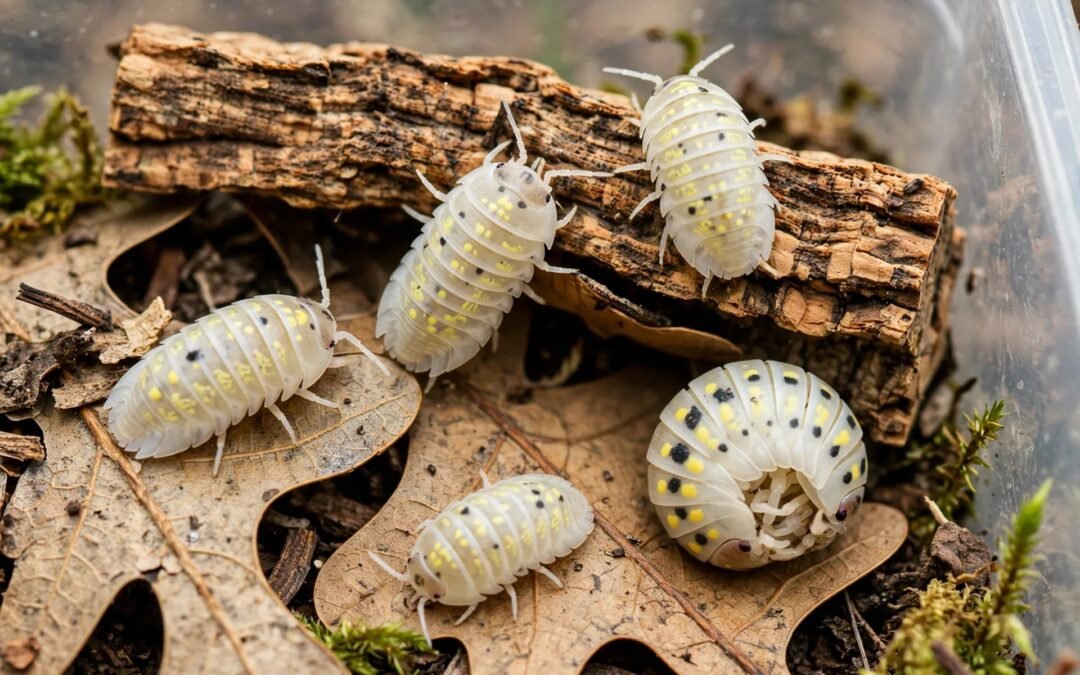
Magic potion isopod care is easier than the price tag suggests. These cream-coloured pillbugs, speckled with yellow and black, look like a collector’s prize — but underneath the pattern they are Armadillidium vulgare, the same tough common pillbug you probably turned over under a log as a child. That is the whole secret of this morph: you get a display animal that behaves like a beginner species. Keep them drier than a tropical isopod, give them a real moisture gradient, never let them run out of calcium, and they will breed, burrow and roll into neat little balls for years.
This guide covers the two bloodlines on the market, the honest disagreement about temperature and humidity, and the mistakes that actually kill Magic Potion colonies — including the one most care sheets skip, which is buying the wrong line for your patience level.
Magic Potion Isopod Care at a Glance
| Care point | What to aim for |
|---|---|
| Scientific name | Armadillidium vulgare ‘Magic Potion’ |
| Adult size | 1.5–1.8 cm — one of the larger, more visible isopods |
| Temperature | 18–24°C (65–75°F); normal room temperature usually works |
| Humidity | 50–70%, with a moisture gradient — one damp end, one drier end |
| Enclosure | 10–20 litre tub with a ventilated lid for a starter colony of 15–20 |
| Substrate depth | 7–10 cm of nutritious mix, plus leaf litter on top |
| Diet | Leaf litter and rotting wood daily; vegetables and protein as supplements |
| Calcium | Permanent source at all times — cuttlebone, limestone or eggshell |
| Breeding | Sexual; gestation roughly 4–8 weeks; prolific once settled |
| Lifespan | 2–3 years per animal; the colony replaces itself indefinitely |
| Difficulty | Easy — a great first or second isopod |
What Are Magic Potion Isopods?
A Magic Potion isopod is a selectively bred colour morph of Armadillidium vulgare, the common pillbug. The pattern comes from the “dalmatian gene” — the same gene behind several spotted isopod morphs — expressed as a pale, almost translucent cream base splashed with irregular yellow and black spots. No two animals are quite alike: some are mostly cream with a few dark flecks, others are heavily spotted, and the pattern keeps developing as a young isopod grows. Newborn mancae start out pale and colour up over their first months, so a starter culture always looks plainer than the adults in the seller’s photos. That is normal, not a sign you were sold the wrong morph. If the whole idea of morphs is new to you, our guide to isopod morphs explained covers how a morph differs from a species — and other spotted Armadillidium on this site include the zebra isopod and the Giant Canyon isopod.
Like all A. vulgare, Magic Potions conglobate — they roll into a tight ball when disturbed. It is a genuine defence behaviour, not a party trick, and it is part of why they are so popular as a display species: a tub of them on leaf litter, with a few curled into spotted marbles, is simply more interesting to look at than a tub of grey woodlice. They are also active in the open more often than many shy species, especially in the evening, which makes them a good choice if you actually want to see your isopods rather than just know they are in there somewhere.
American vs Japanese Line: Which Magic Potion Should You Buy?
Here is the detail most care sheets mention in one sentence and then abandon: there are two lines of Magic Potion, and they do not behave the same.
| Trait | American line | Japanese line |
|---|---|---|
| Size | Bigger, up to 1.8 cm | Slightly smaller |
| Pattern | Bolder, higher contrast | More subtle, softer spotting |
| Breeding | Can be slow to start; colonies sometimes struggle to build | Well known for breeding readily and producing large broods |
| Best for | Patient keepers who want maximum visual impact | Beginners, and anyone who wants a colony fast |
My honest opinion: if this is your first Magic Potion culture, buy the Japanese line. The American line is prettier in photos, but a first colony that sits at ten animals for six months is discouraging, and a slow start is exactly what pushes beginners into overfeeding and over-misting — the two mistakes that then finish the colony off. The Japanese line forgives you by breeding. Once you have a thriving colony and know the species, the American line is a fine second culture. Ask the seller which line they keep before you pay; if they cannot tell you, that is itself an answer about the seller. Mislabelled and mixed-line cultures circulate, and a “Magic Potion” that breeds into mostly grey offspring was probably never a pure line at all.
Price is the other thing nobody warns you about. Magic Potions cost several times what wild-type A. vulgare costs, because you are paying for years of selective breeding, not for a harder animal to keep. That is a fair price for a display morph — just do not let it fool you into thinking they need expensive care. They need the same leaf litter, rotting wood and cuttlebone as a five-dollar culture.
Magic Potion Isopod Care: Enclosure Setup
A shoebox-sized tub is enough to start a culture of 15–20 animals, and a 10–20 litre tub will comfortably hold a colony of 20–50 before you need to split it. Use a clear plastic tub or a glass tank with a secure, well-ventilated lid. Ventilation is not optional decoration here: Magic Potions are a Mediterranean species, and stagnant air is the fastest route to mould and bacterial problems in their tub. Our isopod ventilation guide covers how much airflow is enough — if you are converting a sealed tub, drill or melt a generous row of small holes along the upper sides and lid, and cover them with fine mesh if you keep the tub near fruit flies or fungus gnats.
Furnish simply. A couple of cork bark flats give them hides and a surface to graze on, and cork lasts for years without rotting away. Add a patch of long-fibre sphagnum moss at the damp end and a thick layer of leaf litter across the whole floor. Avoid any wood, bark or leaves treated with pesticides, preservatives or perfume. Keep the tub out of direct sun and away from radiators; a sunny windowsill can turn a small tub into an oven by midday.
Magic Potion Isopod Care: Substrate and the Moisture Gradient
For an isopod, substrate is food as much as flooring — they eat it as it breaks down. Build the mix around nutrition, not just moisture holding: a base of flake soil, white-rotted hardwood and organic topsoil, with oak, beech or magnolia leaf litter worked through it and layered thickly on top, plus a little sphagnum moss for moisture. Our best substrate mix for isopods recipe follows the same principle. Aim for 7–10 cm of depth. Magic Potions burrow, and shallow substrate is one of the quiet reasons colonies breed poorly — a gravid female wants depth to feel secure.
One opinion worth stating plainly: coco coir is overrated as a substrate base for this species. It holds water well, which is why it appears in nearly every generic recipe, but it is nutritionally empty — and an animal that eats its substrate deserves a substrate worth eating. Flake soil and rotten hardwood do the same moisture job while actually feeding the colony.
The moisture gradient is the single most important concept in Magic Potion isopod care. Mist only one end of the enclosure every few days and let the other end stay drier, so the animals can walk to the moisture level they want. Our isopod humidity control guide explains how to measure and adjust it. A cheap hygrometer takes the guesswork out of it while you learn the tub’s rhythm. If you find the whole colony permanently huddled in the damp corner, the dry end is too dry; if nobody ever visits the damp end, you are misting too much. Watch where the animals sit — they will tell you what the numbers cannot.
Magic Potion Isopod Care: Temperature and Humidity
Here is something most guides will not admit: the published numbers disagree. PostPods recommends 18–24°C and 50–70% humidity; The Bio Dude lists 72–80°F (22–27°C) and 45–65%; Terrarium Tribe allows a broad 15–27°C; one European seller lists 20–26°C and 60–80%. That spread is not sloppy writing — it is what happens when a hardy Mediterranean species tolerates a wide range and different keepers report the range they keep. The honest conclusion is that Magic Potions are forgiving, and that stability matters more than hitting one magic number.
My recommendation: keep them at 18–24°C (65–75°F) and 50–70% humidity, which is normal room temperature in most homes for most of the year. No heat mat is needed unless your room drops below about 15°C in winter, and if you do use one, stick it to the side of the tub on a thermostat — never underneath, where it can cook the substrate. Sudden cold snaps will slow breeding and activity, but a stable cool tub is far safer than a tub that swings between hot and cold. Remember that the gradient matters more than the average: a tub at 60% humidity with a genuinely damp end and a genuinely dry end will outperform a tub held at a flat 70% every time.
Magic Potion Isopod Care: Feeding and Calcium
The foundation of the diet is already in the enclosure: leaf litter and decaying wood, topped up as it is eaten. On top of that, offer small amounts of vegetables — carrot, courgette, cucumber or sweet potato — and the occasional piece of fruit such as apple or banana. Our isopod feeding guide covers the full diet in detail. Remove anything uneaten within a day or two before it moulds. A little protein once or twice a week supports breeding and healthy mancae: fish flakes, dried shrimp or an insect-based food all work. Go easy, though — protein left sitting is a magnet for mites and mould, and overfeeding fresh food is the most common self-inflicted problem in this hobby. If the vegetables are still there tomorrow, you offered too much.
Calcium is non-negotiable. An isopod’s exoskeleton is calcified, and they moult throughout their lives, so every new shell has to be hardened with calcium. Keep a permanent source in the enclosure at all times — cuttlebone, crushed limestone or eggshell — and you can forget about dusting food. See our calcium for isopods guide for every source and schedule. There is also a persistent keeper observation worth passing on: Magic Potions seem to colour up best with calcium-rich substrate, and mixing a little crushed limestone into the soil is a cheap way to provide it continuously. It will not turn a pale manca into a show animal overnight, but a colony that is never short of calcium moults cleanly, breeds better, and shows its pattern at its best.
Magic Potion Isopod Care: Breeding
Breeding follows the standard A. vulgare pattern. It is sexual, so you need both males and females, and females carry their fertilised eggs in a pouch under the body — the marsupium — until they hatch as mancae, miniature isopods that are still short of their last pair of legs and feed independently straight away. Gestation runs roughly four to eight weeks depending on temperature. The young start out pale and develop their spots as they mature, so do not judge a colony’s pattern by its babies. Our isopod breeding basics guide covers the full cycle for beginners.
To encourage breeding, keep conditions in the low twenties, make sure food and calcium are always available, give gravid females deep substrate to feel secure in, and resist disturbing the enclosure. Start with at least 15–20 animals for a healthy sex ratio and genetic diversity. One warning from the research is worth repeating: in the A. vulgare pairs that have been timed, warmth into the mid-twenties sped broods up, but two months at 28°C cut the share of pairs that went on to breed from about two in three to under one in three. Hotter is not better. A colony kept at a steady 20–22°C will out-breed a colony kept at 28°C, and it will do it with fewer failed moults.
Once established, the colony becomes effectively self-sustaining, quietly replacing its own losses. That is also when a new problem appears: overpopulation. A thriving Magic Potion tub will eventually hold hundreds of animals, and a crowded tub breeds more slowly and fouls its substrate sooner. Split the colony into a second tub before it gets there — take a scoop of substrate with animals of mixed sizes, set up the new tub identically, and you have both a backup culture and room to grow. Never release extras outdoors.
Magic Potion Isopods in Bioactive Terrariums
Magic Potions make an excellent bioactive clean-up crew, working alongside springtails to break down waste and cycle nutrients. Their moderate humidity needs suit a far wider range of setups than tropical isopods do, which is why they turn up in planted terrariums and dart frog vivariums as well as in dedicated culture tubs — including setups like the isopods for crested gecko tanks we cover on this site. Two cautions apply. First, keep a dedicated separate culture as well as the terrarium population — a backup tub means you can re-seed the display if the terrarium population crashes, and it is especially worth doing with the slower American line. Second, in reptile enclosures use larger adults so they establish before being snacked on, and check that any frogs in the setup are not small enough to eat them. They will also nibble soft live plants occasionally, so do not plant your rarest cutting in a tub full of hungry adult vulgare.
Your First Week With Magic Potions
New colonies fail more often from attention than from neglect. When your culture arrives, set the tub up before the animals do, tip them gently onto the leaf litter, put the lid on, and then leave them alone for two to four weeks. Do not dig through the substrate looking for mancae, do not lift the bark every day to count heads, and do not rearrange the furniture. A settling colony needs darkness, moisture and quiet more than it needs you.
During that first week, check only three things: the damp end is still damp, the dry end is still dry, and the cuttlebone is in place. Offer a small piece of vegetable on day two or three and remove it the next day. If a few animals die in the first days, do not panic and do not overhaul the setup — shipping stress claims a small number of animals in most cultures, and a stable tub recovers faster than a tub you keep “fixing”. The sign that the colony has settled is boring and wonderful: animals out in the open at dusk, eating, and ignoring you.
Common Magic Potion Isopod Problems and How to Fix Them
| Problem | Likely cause | Fix |
|---|---|---|
| Colony always hides, never seen | Too bright, too dry, or still settling | Dim the light, check the damp end, give them 2–4 undisturbed weeks |
| Animals dying after moulting | Calcium shortage | Add cuttlebone and crushed limestone immediately; check the substrate is not exhausted |
| Mould spreading across the surface | Too wet, too much fresh food, poor airflow | Stop misting the whole tub, remove uneaten food, increase ventilation, add springtails |
| Breeding stalled for months | Too hot, too shallow, or an American-line slow start | Drop to 20–22°C, deepen substrate to 7–10 cm, be patient — or start a Japanese-line culture alongside |
| Pattern fading in offspring | Mixed lines or interbreeding with other vulgare morphs | Keep Magic Potions in their own tub; never house them with other A. vulgare morphs |
| Tiny white mites everywhere | Overfeeding protein or fresh food | Stop all supplements for a week, remove food, let the dry end dry out properly |
Are Magic Potion Isopods Worth It?
Yes — with one condition. They are worth it if you want a display colony that is genuinely easy to keep, and you buy a pure line from a seller who can tell you which line it is. They are not worth it if you expect a rare tropical jewel that needs special care, because they do not, and they are not worth it as a first isopod if the price makes you nervous about every animal. In that case, start with wild-type Armadillidium vulgare or a cheaper morph, learn the moisture gradient on an animal you can afford to lose, and buy Magic Potions second. The gradient is the same, the calcium is the same, and the colony you build afterwards will be better for it.
Kept the way this guide describes — drier than tropical, ventilated, deep nutritious substrate, permanent calcium, and a keeper who mostly leaves them alone — Magic Potions are one of the most forgiving display isopods in the hobby. They ask for very little and give back a tub full of spotted, ball-rolling animals that breed themselves into a self-sustaining colony. That is a fair trade.
Frequently Asked Questions
Are Magic Potion isopods good for beginners?
Yes. As a hardy Armadillidium vulgare morph they are beginner-friendly — a touch less bombproof than a plain Porcellio scaber, but far easier than any tropical species. They make a great first or second isopod, and the Japanese line is the safer first buy because it breeds faster.
Do Magic Potion isopods need high humidity?
No. As a Mediterranean morph they prefer moderate humidity, around 50–70%, with a drier, well-ventilated side and just a damp retreat. A wet, sealed setup will harm them — stagnant humidity is one of the fastest ways to lose a colony.
How big do Magic Potion isopods get?
Adults reach 1.5–1.8 cm, making them one of the larger and more visible isopods — part of why they work so well as a display species. The American line tends to run slightly larger than the Japanese line.
Can Magic Potion isopods live with other isopods?
Not with other Armadillidium vulgare morphs. If they interbreed, the distinctive Magic Potion pattern can be hidden or muddied in the generations that follow. Keep them in their own tub, and share a bioactive setup only with a different species, such as springtails.
How fast do Magic Potion isopods breed?
Readily and in good numbers once settled — the Japanese line especially so. From a starting group of 15–20 in stable conditions, expect the first mancae within a month or two, and a colony that takes a year or more to become fully established and self-sustaining.
References
- PostPods — Magic Potion Isopod Care Guide
- Terrarium Tribe — The Magic Potion Isopod: Care Secrets All Spell-ed Out
- The Bio Dude — Magic Potion Isopod Care Sheet
Isopod care guidance varies by climate and setup — what works in a cool, dry house may need adjusting in a warm, humid one. Use this guide as a starting point, watch where your animals choose to sit, and adjust from there. Never release pet isopods outdoors.