
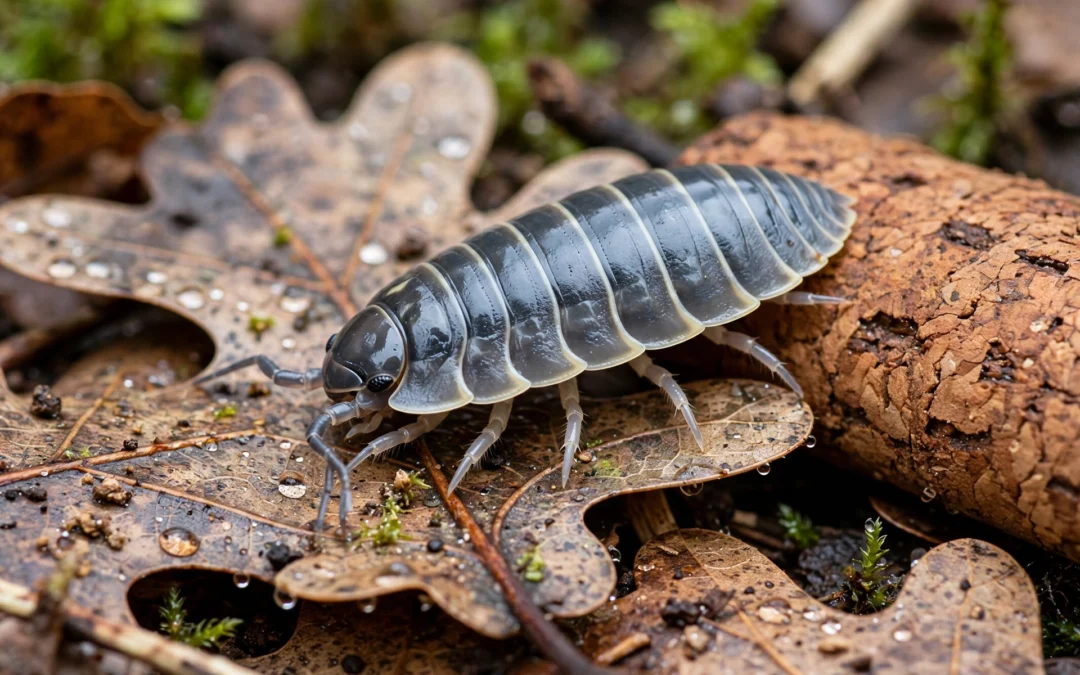
Oniscus Asellus Care: The Complete Common Shiny Woodlouse Guide
Oniscus asellus care is refreshingly simple — until summer arrives. This is the common shiny woodlouse, the flat, glossy-grey isopod you have probably already seen under a log in the garden, and it is one of the most underrated beginner species in the hobby. It asks for very little: a cool room, damp leaf litter, rotten wood, and to be left mostly alone. What it does not forgive is heat. Keep it cool and damp and it will breed steadily for two to three years; park it on a warm reptile shelf and the colony quietly stops breeding, then dies.
That one fact explains most of the conflicting advice online. Some sellers list this species as happy up to 90°F (32°C). That number is wrong, and following it is the fastest way to lose a colony. This guide gives you the honest version: the real temperature limits, the moisture setup that actually works, what to feed, how breeding works, and the morphs — including the famous Mardi Gras — worth your money and the ones that are not.
Oniscus Asellus Care at a Glance
| Care point | What works |
|---|---|
| Scientific name | Oniscus asellus Linnaeus, 1758 |
| Common names | Common shiny woodlouse, skirted woodlouse |
| Adult size | 1.2–1.8 cm (16–18 mm) — one of the largest European woodlice |
| Lifespan | 2–3 years |
| Difficulty | Beginner — if your room stays cool |
| Temperature | 15–22°C (59–72°F); danger above 24–25°C |
| Moisture | Most of the substrate damp, one small drier corner; never waterlogged |
| Enclosure | 30 × 20 × 15 cm ventilated tub for a starter colony |
| Substrate depth | At least 6 cm (2–3 inches) of soil, leaf mould and rotten wood |
| Staple food | Deciduous leaf litter and soft rotten hardwood, always available |
| Supplements | Vegetables and protein weekly; limestone, oyster shell or cuttlebone always in the tub |
| Breeding pace | Moderate — steady once settled, not explosive |
| Lighting | Indirect room light only; no UVB needed |
What Is Oniscus Asellus? Meet the Common Shiny Woodlouse
Oniscus asellus is a terrestrial isopod native to Europe and long since introduced to North America and other temperate regions, where it is now one of the most frequently encountered woodlice in gardens, woodland, parks and glasshouses. In the wild it lives under stones, bark and deep leaf litter in moist places. That habitat tells you almost everything about its care: cool, damp, and full of dead leaves.
Three features identify it at a glance. First, the shine: its cuticle is smooth and glossy, unlike the rough, granular shell of a pillbug. Second, the shape: it is wide and flat, with broad pale-edged side plates that stick out like a skirt — hence the second common name, the skirted woodlouse. Third, and most useful for a beginner, it cannot roll into a ball. A startled Armadillidium curls into a perfect sphere; an Oniscus can only hunch loosely. If your “pillbug” will not roll up, and it looks polished, you are probably holding Oniscus asellus.
It is also big. At 16–18 mm, an adult is noticeably larger than a zebra isopod and roughly twice the length of a dwarf white. That size is part of its charm: you can actually watch it eat, moult and carry a brood pouch without a magnifying glass. For a first colony, visibility matters more than most guides admit — a species you can see is a species you will learn from.
There is a quiet snobbery in the hobby about common species, and this one suffers from it. Keepers chase rare Cubaris morphs while the woodlouse under their own garden wall gets ignored. That is a mistake. A common species is common for a reason: it is tough, adaptable and forgiving of beginner errors — as long as you respect the one thing it cannot tolerate, which is heat.
Oniscus Asellus Care: Enclosure Setup
A 30 × 20 × 15 cm ventilated plastic tub suits a starter colony of ten to fifteen animals, and a 12-quart (roughly 11-litre) tub is a comfortable step up that you will not outgrow quickly. A glass terrarium works too, but a lidded tub holds humidity more reliably and costs almost nothing, which is the right call for a species whose whole appeal is simplicity.
Ventilation is the part beginners get wrong in both directions. Too little and the tub goes stagnant, mould takes over and the colony crashes. Too much and the substrate dries out within a day. The fix is cross-ventilation on the dry side of the tub, with fine mesh over every vent. A 35-micron mesh keeps mancae and springtails in and fungus gnats out — and yes, the mancae of this species are small enough to walk through a coarse screen, so check your mesh before you blame escapes on a bad lid. Our isopod ventilation guide covers the vent patterns that work across species.
Furnish the tub the way the animal lives in the wild: broad, flat hides. Cork bark flats and pieces of bark laid flat on the substrate beat upright decorations, because this is a flat animal that wants to press itself under something wide. Add a moss patch on the damp side — it holds moisture, gives mancae a hiding place, and tells you at a glance whether the damp corner is still damp. A few pieces of limestone tucked under the bark do double duty as decoration and as a slow calcium source.
One warning about lids: this species is a capable climber on damp plastic and will explore the lid seam at night. A gasket-sealed tub, or a lid with a tight snap fit, is worth it. If you are setting up your first colony, our beginner isopod care guide walks through the same tub step by step.
Oniscus Asellus Care: Substrate and the Moisture Gradient
Use pesticide-free topsoil mixed with deciduous leaf mould and generous amounts of soft rotten hardwood, at least 6 cm deep. Two to three inches is the minimum, not the target — depth is what lets the colony regulate its own moisture, with damp wood and soil below and drier litter on top. The substrate is not just bedding for this species; it is half the diet, so build it from ingredients the animals can actually eat.
The moisture gradient is where the sources disagree, and the disagreement is worth stating plainly. Herpeton Academy’s caresheet recommends keeping about two-thirds to three-quarters of the substrate damp, including moist rotten wood, with only a small ventilated sector left merely lightly moist. Springtails US, a working breeder, runs a simpler 50% moist / 50% dry split and waters about once a week. Both work, because both keep the same rule intact: most of the tub stays damp, and no part of it ever sits waterlogged.
Here is the method I actually use, and the one I recommend over daily whole-tub misting: pour water into the damp corner and under the bark, not over the whole surface. Misting the entire tub every day is the most overrated habit in isopod keeping. It wets the leaf litter the animals eat, which then moulds; it spikes humidity and drops it again within hours; and it teaches you nothing about what is happening down in the substrate. Pouring water into one corner soaks the soil and rotten wood where the animals actually live, leaves the surface litter dry enough to stay edible, and lasts days instead of hours. Check the corner with a finger, not a gauge: if the soil a centimetre down is dark and cool, you are fine. Our best substrate mix for isopods gives the exact ratios this setup is built on, and the humidity control guide explains why a hygrometer reading matters less than the moisture at animal level.
Cover most of the surface with leaf litter — oak, beech or maple, in a thick layer. Leaf litter is the staple food, the hiding place and the moisture buffer all at once, and this species lives under it more than it lives in the open. Keep the litter deep enough that you cannot see bare substrate. When the litter layer thins, top it up; do not wait for it to vanish.
Oniscus Asellus Care: Temperature — the Cool Rule That Matters Most
This is the section that decides whether your colony lives or dies, so here it is without hedging: keep Oniscus asellus at 15–22°C (59–72°F), give it a cooler retreat of 12–18°C if you can, and treat sustained warmth above 24–25°C as an emergency.
The sources agree on the safe range and disagree only at the edges. Herpeton Academy gives 15–22°C with a 12–18°C cool retreat, and notes that laboratory colonies have been maintained and fed at 10, 15 and 20°C — this is a cool-temperate animal through and through. TC Insects, selling the Mardi Gras morph, targets 65–75°F (18–24°C) and warns that prolonged heat above 80°F (27°C) stresses the colony and slows breeding sharply. Isopedia, the community database, is blunter still: 65–70°F, and above 80°F the species “will completely stop breeding and will lead to an eventual crash.”
Then there is the outlier. One major shop lists the temperature requirement as “approx. 60 to 90 degrees” and adds that extreme cold and heat can be lethal. That 90°F figure is the single most dangerous line a beginner can follow for this species, and I am naming it as wrong rather than letting it stand as a difference of opinion. At 32°C a colony of Oniscus asellus does not merely breed slowly — it stops breeding, stops feeding properly, and dies, often within days in a stagnant tub. If a care sheet tells you this cool-climate woodlouse is fine at tropical temperatures, that care sheet is copy-pasted, not tested.
Practically, this means: do not put this tub on a warm reptile rack, do not put it near a radiator, and do not put it on a sunny windowsill. A north-facing room, a basement, a cool shelf away from heat sources — these are the right homes. In summer, the colony’s biggest enemy is a heatwave combined with stagnant air, and the fix is to move the tub somewhere cooler and improve airflow, never to flood the substrate to compensate. Heat is a more common danger than cool nights; a colony that drops to 12°C overnight will simply slow down, while one that sits at 28°C will die. If your room runs warm all summer and you cannot cool it, this is not the species for you — and that is fine. A species that fails in your conditions is not a bad species, it is a bad match. Our isopod temperature guide puts this range in context against the tropical species, and the winter care guide covers the cold end of the year, which this species handles far better than most.
Oniscus Asellus Care: Humidity Without the Guesswork
Humidity numbers for this species look alarming on paper — Herpeton cites a 75–95% relative humidity reference — but the number on a hygrometer is the least useful thing in the tub. What matters is moisture at animal level: damp soil, damp rotten wood, and a damp corner the animals can retreat to. A tub can read 80% on the gauge and still kill isopods if the substrate itself is dry, because the gauge measures air and the animal lives in the soil.
Keep most of the substrate damp, let one small ventilated sector become only lightly moist, and never let the substrate sit waterlogged. Waterlogged soil goes anaerobic, smells sour, and breeds the mould and mites that finish a stressed colony. The pour-into-the-corner method from the substrate section is the whole technique: water the soil, not the air, and let the animals choose their spot on the gradient. If you see the whole colony crowded into the damp corner, the dry side has gone too dry. If they are all pressed against the lid or the vent, the tub is too wet or too warm — check temperature first, because heat is the more likely cause.
Springtails earn their keep here. A healthy springtail population grazes the mould that damp setups inevitably grow, and they are the cheapest insurance a beginner can buy. Our springtails vs isopods guide explains how the two work together as a cleanup crew.
Oniscus Asellus Care: Feeding
Leaves and soft rotten wood are the continuous staples — they should never run out. On top of that, offer mushroom, squash, carrot, dried nettle or a balanced isopod food two or three times a week, and add a modest protein portion weekly. Fish flakes are the underrated workhorse here: cheap, easy to dose, and the colonies that get them grow noticeably faster than the ones fed leaves alone. Boutique isopod blends are fine, but they are a convenience, not a requirement, and no blend replaces the leaf litter.
Two details from the research are worth passing on because they change how you read your colony. First, experiments confirm that temperature and leaf species influence how much this species eats, so a drop in appetite is not automatically illness — check the thermometer and the leaf type before you panic. Second, remove wet leftovers within 24–36 hours and never feed faster than the colony processes food. A tub full of rotting squash is a mite farm, not a buffet. Our protein sources guide and calcium guide cover the two supplements in depth, but the short version is: keep limestone, oyster shell or cuttlebone in the tub at all times, even though this species tolerates relatively calcium-poor habitats better than most. It still needs calcium to moult, and a colony without a calcium source will show it in failed moults long before it shows it anywhere else.
Oniscus Asellus Care: Breeding and Mancae
Breeding is moderate and steady rather than explosive. Females carry developing young in a brood pouch (marsupium) and release them as tiny white mancae, which grow through a series of moults to adult size. Springtails US rates the reproduction rate at 6 out of 10 — a healthy colony grows, but it will not overrun your shelf the way a dairy cow colony does, and sub-adults can begin breeding before they reach full size.
The timeline is the part beginners underestimate. A new culture needs weeks to settle before you see mancae, and a colony kept too warm will simply never start. If your colony has been in place for two months with no babies, check the temperature before you change the food or the substrate: a tub sitting at 26°C is the most common cause of a stalled colony in this species, and no amount of protein will fix it. Once the colony is breeding, the mancae need what the adults need — damp wood, deep litter, and a fine mesh over the vents, because they are small enough to wander through gaps an adult cannot. If breeding has stalled for other reasons, the diagnostic order in our colony not breeding guide still applies, with temperature first for this species.
One honest note on sexing: males are slightly smaller and slimmer than females, and a gravid female’s brood pouch is visible from underneath, but you do not need to sex this species to breed it. Put ten or more animals together in the right conditions and nature handles the rest. If you do want to learn, our guide to sexing isopods uses the clear-tub method, which works well on a large, slow species like this one.
The Mardi Gras Morph and Other Colour Forms
The wild type is a handsome slate-grey animal with pale edges. The hobby has also produced a designer colour morph called Mardi Gras — a striking patterned form with bold contrasting markings, selectively bred by TJ Ombrelle and now sold by most of the big isopod shops. It is a genuine morph of Oniscus asellus, not a separate species, and its care is identical to the wild type: same cool temperatures, same damp leaf litter, same food.
Two things are worth knowing before you pay the premium. First, Mardi Gras is a designer colour morph, not a fixed species trait. Pattern expression varies between individuals, and offspring can drift toward darker or lighter forms over generations if the breeder does not keep selecting. A colony bought as Mardi Gras will not necessarily stay as sharply patterned as the listing photo. Second, the premium buys the pattern, not easier care. A Mardi Gras colony kept too warm dies exactly as fast as a wild-type colony kept too warm. If you love the look, buy it — but buy it for the look, and buy from a breeder who shows photos of their own colony rather than a single perfect specimen.
Other named forms circulate in the trade, including Orange Mardi Gras, BC Maple, Ontario Maple, Nichie’s Pied, Mocha and Pink Petals. Treat every named form the same way: ask for colony photos, check the price against the wild type, and remember that a name on a listing is a claim, not a guarantee. Our isopod morphs guide explains how morphs are made and why some hold their pattern and others do not.
Oniscus Asellus in a Bioactive Terrarium
This species shines in temperate bioactive setups and struggles in tropical ones — a distinction that matters more than the generic “cleanup crew” label. A cool temperate terrarium with leaf litter, rotten wood and good airflow is its natural habitat, and it will process leaf litter, dropped food and waste steadily for years. A warm tropical vivarium at 26–28°C is a slow death sentence, however, and this is where beginners lose colonies they thought were “cleanup crew” and therefore indestructible.
If you are building a bioactive enclosure for a temperate reptile or amphibian, Oniscus asellus is one of the best choices available: large enough to see working, hardy, and genuinely effective at breaking down leaf litter. Pair it with springtails and a deep litter layer, and keep the warm end of the enclosure away from the isopod zone. If the enclosure runs warm throughout, pick a tropical-tolerant species instead — our guide to isopods for crested gecko tanks covers which species suit warmer vivariums.
Oniscus Asellus Care: Common Problems and How to Fix Them
| Problem | Likely cause | Fix |
|---|---|---|
| Colony stops breeding | Temperature above 24°C | Move the tub to a cooler room; check with a thermometer, not a guess |
| Deaths during summer | Heat plus stagnant air | Reduce room temperature, improve airflow; do not flood the substrate to compensate |
| Animals crowded at the lid | Tub too wet or too warm | Check temperature first; then let the dry side dry out |
| Animals all in the damp corner | Dry side gone too dry | Pour water into the damp corner and refresh the litter layer |
| Mould on food or litter | Overfeeding wet food; whole-tub misting | Remove leftovers within 24–36 hours; pour water, do not mist the surface; add springtails |
| Failed moults | No calcium source; substrate too dry | Keep cuttlebone or limestone in the tub permanently; check substrate moisture a centimetre down |
| Mites on the animals | Overfeeding; damp, stale food | Stop wet food for a week, remove leftovers promptly, improve ventilation |
| Mancae disappearing | Coarse vent mesh; dry substrate surface | Fit 35-micron mesh; keep the damp corner genuinely damp |
One more problem deserves its own paragraph, because it is specific to this species: wild-collected animals. Oniscus asellus is so common that many keepers start with animals collected from their own garden, and that can work well — but only with quarantine. Wild animals can carry mites, nematodes and other hitchhikers, and a collected culture should be quarantined for 60 days before it goes anywhere near your other colonies. Collect only where it is legal, only from pesticide-free ground, and never from a nature reserve. And never, ever release a culture — even within the species’ apparent native range. Captive lineages, pathogens and companion organisms may not be local, and a release is how hobby problems become wild problems. Our quarantine guide gives the full 60-day routine.
Oniscus Asellus vs Porcellio Scaber vs Armadillidium Vulgare
| Oniscus asellus | Porcellio scaber | Armadillidium vulgare | |
|---|---|---|---|
| Common name | Common shiny woodlouse | Common rough woodlouse | Common pillbug |
| Size | 16–18 mm | Up to 17 mm | Up to 18 mm |
| Rolls into a ball? | No — humps loosely | No | Yes — perfect sphere |
| Shell | Smooth, glossy | Rough, granular | Smooth, arched |
| Temperature | 15–22°C, cool only | 18–26°C, more tolerant | 18–26°C, more tolerant |
| Moisture | Mostly damp | Gradient, drier-tolerant | Gradient, drier-tolerant |
| Breeding pace | Moderate | Fast | Moderate |
| Best for | Cool rooms, temperate bioactive | First colony, any room | Kids, display, pill-rolling charm |
The honest summary: if your room is cool, Oniscus asellus is the most interesting of the three — bigger, glossier, and with the Mardi Gras morph as a genuine showpiece. If your room runs warm, pick Porcellio scaber instead; it forgives the heat this species cannot. The pillbug wins on charm alone, but charm does not keep a colony alive in a heatwave.
Should You Keep Oniscus Asellus? The Honest Verdict
Yes — with one condition. If you can keep the tub at 15–22°C, this is one of the best beginner isopods there is: cheap or free to start, big enough to watch, steady breeding, a two-to-three-year lifespan, and a morph in Mardi Gras that genuinely turns heads. It is the species I recommend to anyone with a cool room who wants a real colony rather than a display piece, and it is badly underrated precisely because it is common.
If you cannot keep it cool, do not buy it and hope. Hope is not a cooling strategy. A colony that spends a summer at 27°C will not bounce back in autumn, and no food, supplement or misting schedule will save it. That is not a flaw in the species — it is a cool-temperate woodlouse doing exactly what cool-temperate woodlice do. Match the animal to your room, not your room to the animal, and this common little woodlouse will reward you for years. For a sense of how long that actually is, our isopod lifespan guide breaks down longevity by species, and if you want the broader picture first, start with the best isopod species for beginners.
Frequently Asked Questions
Is Oniscus asellus a good beginner isopod?
Yes, with one condition: your room must stay cool. At 15–22°C it is hardy, forgiving and easy to feed. In a warm room above 25°C it stops breeding and dies, so it is a beginner species for cool rooms, not for warm reptile racks.
Can Oniscus asellus roll into a ball?
No. Unlike pillbugs (Armadillidium species), Oniscus asellus has a flat body and cannot conglobate into a sphere. It can only hunch loosely when disturbed. The flat shape, glossy cuticle and wide pale side plates are the quickest way to identify it.
What temperature do Oniscus asellus need?
Keep them at 15–22°C (59–72°F) with a cooler retreat of 12–18°C if possible. Sustained warmth above 24–25°C is dangerous, and temperatures above 27°C can kill a colony. Ignore any care sheet that claims they are fine up to 90°F.
Do Oniscus asellus need high humidity?
They need damp substrate more than humid air. Keep about two-thirds to three-quarters of the substrate damp, with a small drier corner, and water by pouring into the damp corner rather than misting the whole tub. A hygrometer reading of 75–95% is a rough reference, not a target to chase.
How long do Oniscus asellus live?
Two to three years in captivity with proper care. Adults reach 1.2–1.8 cm, making them one of the largest European woodlice, and sub-adults can begin breeding before reaching full size.
What is the Mardi Gras morph?
Mardi Gras is a designer colour morph of Oniscus asellus with bold contrasting markings, selectively bred by TJ Ombrelle. Its care is identical to the wild type. Pattern expression varies between individuals, and offspring can drift darker or lighter over generations, so buy for the look from a breeder who shows photos of their own colony.
References
Herpeton Academy — Common Shiny Woodlouse fact sheet and caresheet, academy.herpeton.net (temperature 15–22°C, substrate depth, 60-day quarantine, never release). TC Insects — Oniscus Asellus ‘Mardi Gras’ care page, tcinsects.com (65–75°F target, heat above 80°F, morph origin). Reptanicals — Oniscus asellus ‘Mardi Gras Dalmatian’ product page, reptanicalshop.com (breeding notes, diet). Springtails US — Isopod Care Sheet, springtails.us (container size, 50/50 moisture gradient, reproduction rate 6/10). Isopedia — Community Bioactive Database, isopedia.crestedcritters.com (65–70°F, breeding stops above 80°F, morph list).