
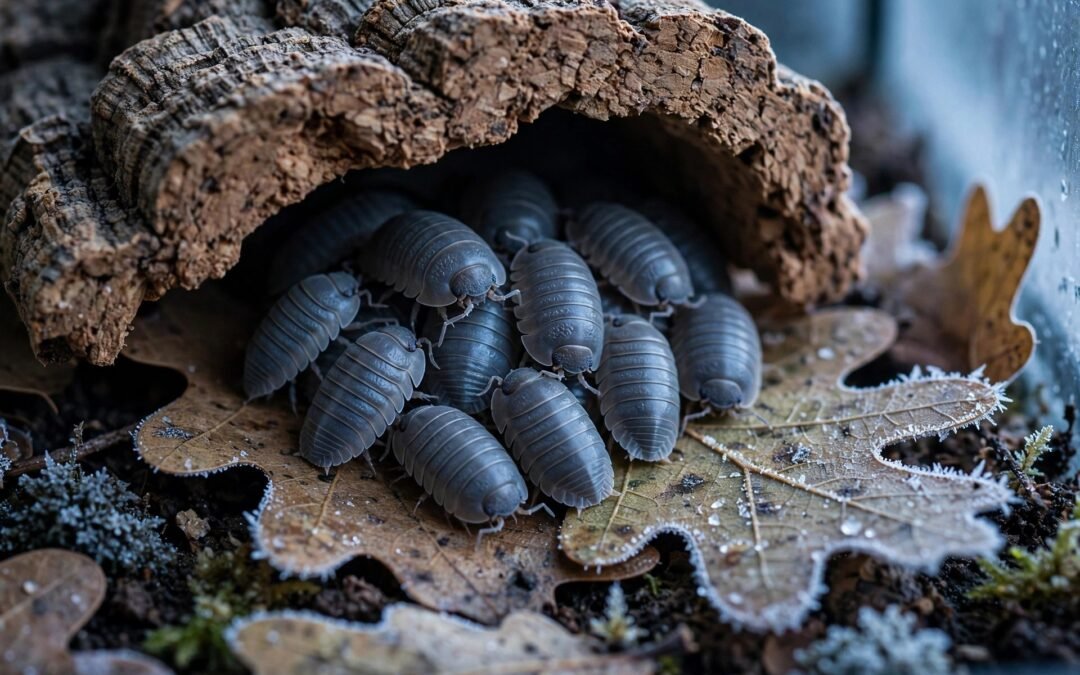
Do Isopods Hibernate? Winter Behaviour Explained
Do isopods hibernate? Not in the way most keepers picture it. A wild temperate isopod does not curl up in September and sleep until April like a bear. What it does instead is slow down — dramatically. Feeding drops, breeding stops, and the animals spend weeks tucked under bark and leaf litter, barely moving, running on a fraction of their summer metabolism. Scientists call this winter dormancy, and for the pet species in your tubs, the difference between “hibernating” and “dormant” is more than a word game: it decides whether you leave the colony alone, warm it up, or throw away animals that are still alive.
This guide explains what isopods actually do in winter, which species slow down and which ones just suffer, how to tell a dormant isopod from a dead one, and the five mistakes keepers make every cold season.
Do Isopods Hibernate? The Short Answer
Do isopods hibernate in the strict, biological sense? No. True hibernation is a controlled, deep sleep with a big drop in body temperature and a specialised physiology for surviving months without food — think hedgehogs and bats. Isopods do not do that. They are ectotherms, which means their body temperature follows the air around them, and their winter slowdown is a passive response to cold, not a planned sleep.
What field researchers actually observe is a hibernation period in the loose sense: in temperate regions, terrestrial isopods spend the winter inactive, sheltered deep in soil and leaf litter, with feeding and reproduction paused until spring (Gupta, 1963; Radu and Tomescu, 1981). So the honest answer to “do isopods hibernate” is: they enter winter dormancy, which looks like hibernation from the outside but works very differently on the inside.
That distinction matters for one practical reason. A hibernating mammal is hard to disturb and harder to kill by accident. A dormant isopod is still breathing through its gills, still losing moisture, and still vulnerable to drying out, freezing, or a keeper who mistakes stillness for death and throws the colony away. Dormant does not mean switched off.
Do Isopods Hibernate or Go Dormant? Why the Word Matters
Keepers use three words for winter slowdown — hibernation, dormancy, and diapause — and they are not interchangeable. Getting them straight stops most winter panic.
Hibernation is the deep, regulated sleep of warm-blooded animals. Body temperature drops on purpose, heart rate falls, and the animal wakes on a schedule. Isopods never do this.
Dormancy is what isopods actually do. It is a general slowdown driven by falling temperature: metabolism drops, movement stops, feeding and breeding pause. Nothing is scheduled or regulated — warm the enclosure by a few degrees and the animals wake up and start foraging again, sometimes within hours. That reversibility is the key test. If a “hibernating” isopod wakes up because the room warmed up, it was dormant, not hibernating.
Diapause is a hormonally triggered pause in development, common in insects, where the animal will not resume activity even if conditions improve until a specific trigger (usually day length) releases it. There is no good evidence that pet isopods use diapause. Their winter behaviour tracks temperature and moisture, not the calendar.
So when someone online says their isopods are hibernating, they almost always mean dormant. Use the right word and the right care follows: a dormant colony needs stable moisture and to be left alone, not a “do not disturb until spring” sign and not a rescue warming either.
What Happens Inside an Isopod When It Gets Cold
An isopod is a land crustacean, and that one fact explains almost everything about its winter. It still breathes through gills — the feathery pleopods on its underside — which only work when they stay moist. Cold does not change that requirement. A dormant isopod in dry air is a dying isopod, however cold it is.
As temperature falls, an isopod’s metabolism slows in step. Laboratory work on the common rough woodlouse, Porcellio scaber, shows the cost of getting this wrong: both freezing and chilling injure the animals, and the temperature that kills half a test group falls from about −1.4°C in August to about −4.6°C in December as the animals acclimate to the season (Tanaka & Udagawa, 1993). The whole-body supercooling point — the absolute limit of freeze avoidance — sits near −7°C all year. In plain language: isopods can survive a cold room, but they cannot survive freezing, and even temperatures just below zero are dangerous.
Three things change inside a dormant isopod. First, movement stops, because muscle activity costs energy the animal is not replacing — it is not eating. Second, moulting pauses; growth tracks metabolic rate, so a cold colony simply does not grow. Third, breeding shuts down entirely. If your colony stops breeding in winter, cold is the first suspect and usually the only one.
The other winter change is behavioural. Cold isopods aggregate — they pile together under bark and in leaf litter. Research going back to Allee (1926) found that isopods cluster more tightly in unfavourable cold conditions, because a huddle loses moisture more slowly than a lone animal and the centre of the pile stays a fraction warmer. A colony that has vanished under the cork bark is usually a healthy colony doing exactly what evolution taught it.
Do Isopods Hibernate in the Wild?
In the wild, temperate isopods spend winter in the most sheltered microclimate they can find: deep under logs, inside rotting wood, and buried in the damp layer at the bottom of leaf litter. The soil surface may freeze, but a few centimetres down, under a blanket of leaves, the temperature stays just above freezing and the humidity stays high. That is the whole trick — they do not survive winter by being tough, they survive it by hiding somewhere winter barely reaches. They feed heavily in autumn and build up fat reserves, and the cold tolerance of Porcellio scaber measurably improves from summer to December. But there is no true preparation like a mammal fattening for hibernation: an isopod that goes into winter thin, dry, or already stressed is an isopod that may not come out of it.
They also stay within a few centimetres of the surface, in the damp zone. That is why a hard freeze with no snow cover kills more wild isopods than a long, mild, snowy winter: snow insulates, bare frozen ground does not.
Do Isopods Hibernate Indoors? What Pet Colonies Actually Do
Most keepers see the same pattern every year: sometime in late autumn, the colony goes quiet. Food sits untouched for days. The night-time rustling under the bark stops. No new mancae (baby isopods) appear. And the keeper, quite reasonably, starts to worry.
Here is what is actually happening at each temperature band, for the species most people keep:
- Above 20°C (68°F): business as usual. Feeding, breeding, and moulting continue. Most tropical species need to stay here all winter.
- 15–20°C (59–68°F): the slowdown begins. Temperate species eat less and breed less; tropical species stop breeding and start to struggle if it lasts.
- 10–15°C (50–59°F): real dormancy for temperate species. They cluster, hide, and barely move. Tropical species are now in danger.
- Below 10°C (50°F): deep dormancy for hardy temperate species only. Everything else needs heat, and now.
- Below 0°C (32°F): lethal territory for every pet species. Freezing injures and kills; no pet isopod safely survives a frozen enclosure.
The practical rule from our winter care for isopods guide still holds: if your room stays at 18°C or above all winter, most colonies need no heating at all. Below that, the question is not “are they hibernating” but “which species is this, and what does it need”. That is where most winter losses happen — not from cold itself, but from treating every species as if it were the same animal.
Which Isopods Slow Down Most? Winter Behaviour by Species
Not every isopod experiences winter the same way. A temperate pillbug and a tropical Cubaris are different animals with different evolutionary histories. The table below is the honest version — including the species that do not slow down gracefully at all.
| Species group | Winter behaviour | Safe winter room temperature |
|---|---|---|
| Armadillidium vulgare (common pillbug) | Full dormancy. Clusters tightly, stops feeding and breeding, wakes fast in spring. | 10–22°C; brief dips to 2–4°C tolerated |
| Armadillidium maculatum (zebra isopod) | Strong slowdown, similar to vulgare. Hides for weeks at a time. | 15–22°C |
| Armadillidium nasatum | Dormant in the cold, but less hardy than vulgare. Keep it above 15°C. | 15–22°C |
| Porcellio scaber (rough woodlouse) | Dormant below ~15°C. Best-studied cold tolerance of any pet isopod. | 15–22°C; brief dips near 0°C survivable |
| Porcellio laevis (dairy cow, smooth) | Slows and stops breeding below ~16°C, but does not truly go dormant — it just gets sluggish and vulnerable. | 18–24°C |
| Porcellionides pruinosus (powder blue / powder orange) | Feeding and breeding stall below ~15°C. No real dormancy, just a stressed standstill. | 18–24°C |
| Cubaris species (rubber ducky, panda king, clown, blonde ducky) | No dormancy at all. Below 20°C breeding stops; below 18°C for long they weaken and die. These are the colonies winter actually kills. | 20–26°C, never below 18°C for long |
| Trichorhina tomentosa (dwarf white) | Slows down but keeps going at room temperature. The most forgiving species in a cool room. | 18–26°C |
The pattern is simple once you see it: temperate European species evolved with winter, so they have a dormancy response. Tropical Asian species never evolved one, so cold does not switch them into a safe low-power mode — it just damages them slowly. That is the single most underrated fact in isopod winter care, and it is why “do isopods hibernate” has no one-word answer. For the full numbers behind this table, see our isopod temperature guide.
Dormant or Dead? How to Tell the Difference
This is the section that saves colonies. Every winter, keepers throw away dormant isopods because they look dead — and leave genuinely dead ones in the tub because they assume dormancy. Here is how to tell.
| Sign | Dormant (alive) | Dead |
|---|---|---|
| Body shape | Firm, compact, curled or rolled tight, legs tucked | Limp, soft, flattened, legs splayed or falling off |
| Touch test | Stays rigid; may uncurl slightly or twitch a leg when gently touched | Stays limp; no response at all |
| Colour | Normal colour, perhaps slightly duller | Often fades, darkens, or goes greyish and translucent |
| Smell | No smell | Sweet, rotting smell after a day or two |
| Warming test | Placed in a warm (not hot) spot, starts moving within hours | Nothing changes, ever |
| Position | Tucked in a cluster under bark or in the damp corner | Often out in the open, on the surface, alone |
The warming test is the most reliable, but do it gently. Move the animal to a spot at normal room temperature — around 20°C — and wait a few hours. Never put a cold isopod on a heat mat or under a lamp; a sudden jump in temperature is a shock, and a dormant animal that is warmed too fast can die of the rescue. If it is alive, it will stir. If it does not move after a full day at room temperature, it is almost certainly dead.
One more rule: never judge the whole colony by one animal. In a dormant colony, some individuals will always look worse than others. If most of the colony is clustered, firm, and tucked away, the colony is fine — even if two or three individuals on the surface are dead. For the wider picture on telling the two apart, our guide to isopod moulting vs dying covers the same tests in more detail, including the tricky case of an isopod that is mid-moult and looks dead.
5 Mistakes Keepers Make With “Hibernating” Isopods
Most winter colony losses are not caused by winter. They are caused by well-meaning keepers doing the wrong thing to a dormant colony. These five are the ones I see every year.
1. Assuming a quiet colony is a dead colony
The most expensive mistake on this list. A keeper lifts the bark in January, sees no movement, and empties the tub. If you cannot see movement, use the tests above — firmness, the gentle touch, the slow warming test — before you make any decision. A colony that is quiet in winter is a colony behaving normally.
2. Warming the whole tub to “wake them up”
Dormancy is not a problem to fix. A temperate colony at 12°C is not suffering; it is resting. Heating the whole enclosure back to summer temperatures in midwinter forces the animals back into full activity when their food supply, moisture cycle, and breeding rhythm are all tuned to winter. Heat only the species that need it — the tropical ones — and heat them from the side, never from underneath the whole tub.
3. Misting daily like it is summer
This is the mistake I would ban if I could. Cold air holds less moisture, cold substrate dries more slowly, and a dormant colony drinks almost nothing. Daily whole-tub misting in winter keeps the substrate wet and cold — the exact combination that causes moulting failures and bacterial problems. In winter, mist less, and pour water into the damp corner instead of spraying the whole surface. The substrate should be damp to the touch, never dripping. See our humidity control guide for the squeeze test, which matters more in winter than in any other season.
4. Feeding like it is summer
A dormant colony eats almost nothing, and uneaten food in a cold, damp tub is a mould farm. Cut feeding back hard in winter: a small piece of leaf litter and a pinch of fish flakes every week or two is plenty for a temperate colony. Remove anything uneaten after a few days. Overfeeding a dormant colony is how you get a mould outbreak that finishes what the cold started.
5. Digging through the colony to “check on them”
Every time you lift the bark and dig through the substrate in winter, you break the cluster, let out the trapped humidity, and stress animals that have no energy to spare. Check on them by looking, not by digging. Lift one piece of bark, glance, put it back. If the colony is clustered and firm, that is your answer. Leave the rest alone until spring.
How to Help Your Colony Through Winter
Winter care for a dormant colony is mostly about what you do not do. But a few small, deliberate steps make the difference between a colony that wakes up strong in spring and one that limps out of winter with half its numbers.
- Keep the moisture gradient. One damp corner, one dry side, all winter. The damp corner is where dormant isopods breathe; the dry side is where they escape excess moisture.
- Add extra leaf litter before the cold sets in. A thick leaf layer insulates the substrate, holds humidity, and gives the colony food and shelter without you opening the tub. Do this in late autumn, not in January.
- Move tropical species, not temperate ones. If a room gets cold, move the Cubaris and other tropical tubs to the warmest room in the house. Leave the Armadillidium and Porcellio where they are — they are built for this.
- Check the room, not the tub. A cheap thermometer on the shelf tells you more than daily tub inspections. If the room is 12°C and the species is Armadillidium vulgare, everything is fine. If the room is 12°C and the species is a panda king, you have a problem.
- Do not clean the tub in deep winter. A full substrate change in January destroys the microclimate the colony has settled into. Spot-clean only, and save the deep clean for spring.
When Do Isopods Wake Up? The Spring Return
Isopods do not wake up on a date. They wake up when the temperature rises and stays up. For a temperate colony in a normal home, that usually means late February to April. The signs come in order: first movement under the bark at night, then feeding — leaf litter starts disappearing again — then moulting, and finally, a few weeks later, the first mancae.
Do not rush it. If you heat the room in February to force an early wake-up, the colony will burn energy before spring food and moisture conditions are ready, and the first brood often fails. Let the season do the work. The most useful thing a keeper can do in spring is also the simplest: put fresh leaf litter in, top up the cuttlebone, and wait. A colony that went into winter healthy almost always comes out of it — breeding usually resumes within a few weeks of temperatures climbing back into the species’ range, and how long isopods live is decided far more by what happens in the active season than by the winter pause.
Do Isopods Hibernate? Frequently Asked Questions
Do isopods hibernate in winter?
Not true hibernation, but they do enter winter dormancy: less movement, less feeding, and paused breeding. Think of it as a cold-season power-saving mode, not a full shutdown. They resume on their own as temperatures rise.
Do pet isopods hibernate indoors?
It depends on the temperature of the room. In a heated home at 20°C or above, most colonies stay active all winter. In a cool room at 10–15°C, temperate species go dormant while tropical species just suffer — they need steady warmth and do not have a dormancy response at all.
How long do isopods stay dormant?
For a temperate colony in a cool room, dormancy typically lasts from late autumn until temperatures rise again in late winter or early spring — roughly two to four months. The exact length tracks temperature, not the calendar.
Can isopods survive freezing temperatures?
Not safely. Research on Porcellio scaber found that temperatures below zero injure the animals, with half the test group dying around −1.4°C in summer-acclimated animals and −4.6°C in winter-acclimated ones. No pet isopod should ever be left in a freezing enclosure.
Should I heat my isopods in winter?
Temperate species (Armadillidium, Porcellio scaber, Porcellio laevis) usually need no heat if the room stays above 15–18°C. Tropical species (Cubaris, rubber ducky, panda king) need steady warmth above 20°C all winter — use a side-mounted heat mat, never one under the whole tub.
Do isopods eat during winter dormancy?
Almost nothing. A dormant colony may nibble leaf litter occasionally but will ignore fresh food. Cut feeding back to a small offering every week or two, and remove anything uneaten after a few days to prevent mould.
References
Gupta, M. (1963). Hibernation in terrestrial isopods in temperate areas. Cited in Reptile Knowledge, “What is too cold for isopods?”
Radu, V. G. & Tomescu, N. (1981). Hibernation of terrestrial isopods in Romania. Cited in Reptile Knowledge, “What is too cold for isopods?”
Tanaka, K. & Udagawa, T. (1993). Cold tolerance of the terrestrial isopod Porcellio scaber: freezing and chilling injury at subzero temperatures. Cited in Reptile Knowledge, “Can isopods get too cold?”
Allee, W. C. (1926). Studies in animal aggregations: causes and effects of bunching in land isopods. Journal of Experimental Zoology.
PostPods. “How Cold Is Too Cold for Isopods?” — species cold-tolerance ranges and heat-mat placement guidance.
The Environmental Literacy Council. “Can Isopods Get Too Cold?” — cold-stress physiology and supercooling limits.