
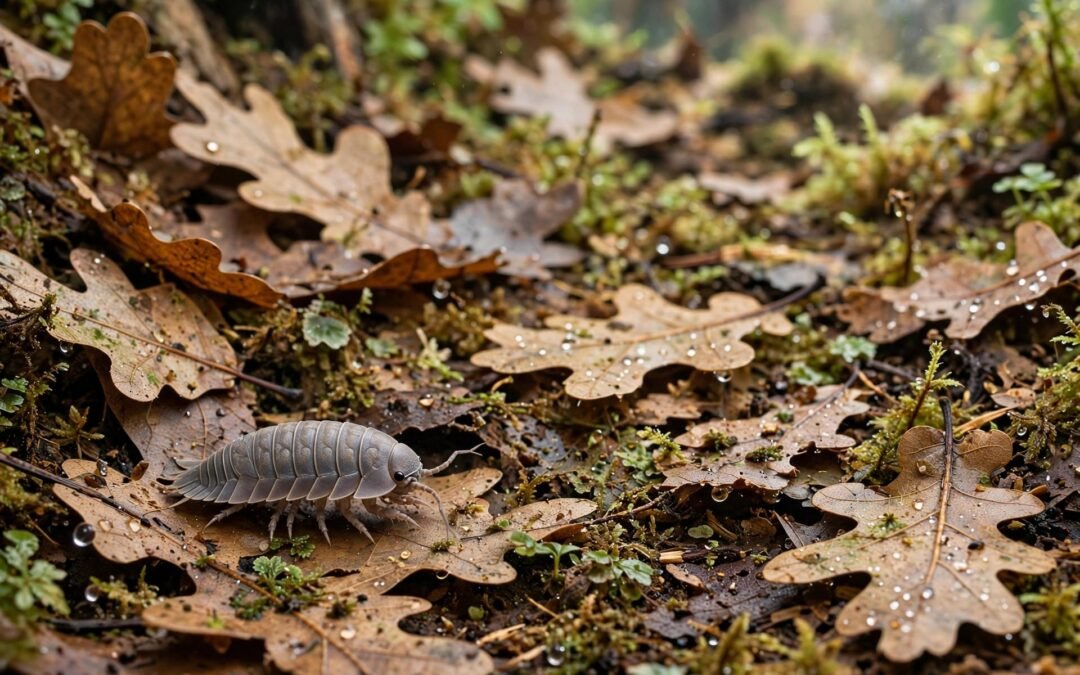
How Do Isopods Breathe? Gills, Pseudotrachea & Why Moisture Matters
The short answer to how do isopods breathe is simple: through gill-like organs called pleopods, flat limbs tucked under the tail end of their body. In land isopods, some of those pleopods carry tiny branched air tubes called pseudotrachea — sometimes described as “pleopodal lungs” — that pull oxygen from damp air. The catch, and the reason this matters to every keeper, is that these breathing organs only work while they stay moist. Let the enclosure dry out and an isopod does not die of thirst first — it suffocates.
That single fact explains more about isopod care than almost any other piece of biology. The moisture gradient, the ventilation holes, the misting routine, the wet and dry sides of the tub — all of it is really about keeping a set of tiny gills wet enough to breathe through, without drowning the animal that owns them. So, how do isopods breathe, exactly — and what does the answer change about your setup? Once you understand it, the rest of the setup starts to make sense.
How Do Isopods Breathe? The Short Answer
Isopods are crustaceans, not insects — close cousins of crabs, shrimp and lobsters. Like their marine relatives, they breathe through gills. On a land isopod, those gills are the pleopods: five pairs of thin, flattened limbs on the underside of the abdomen (the pleon), the segmented tail section at the rear of the body.
Oxygen passes across the thin, moist membrane of the pleopods and into the isopod’s body, while carbon dioxide passes out the same way. There is no nose, no mouth-breathing, no windpipe. The whole system depends on a film of water on the breathing surface — gas exchange happens through moisture, so a dry pleopod is a useless pleopod. If you remember one sentence about how do isopods breathe, make it this one: gas exchange happens through a film of water, so a dry pleopod is a useless pleopod. That is why isopods hide under damp logs and leaf litter in the wild, and why a bone-dry enclosure is a silent killer even when food and temperature are perfect.
Where Are an Isopod’s Breathing Organs?
Flip a woodlouse over — gently, and only if you must — and you will see the breathing setup. The abdomen has six segments. The first five each carry a pair of pleopods, and the sixth carries the uropods, the little tail prongs that have nothing to do with breathing.
In aquatic isopods, the pleopods are straightforward feathery gills, and they double as paddles for swimming. In land isopods, the same limbs have been remodelled for air. Some pleopods stay flat and plate-like, covered in a thin sheet of moisture. Others carry the pseudotrachea. In several common pet species you can even see the evidence with the naked eye: look at the underside of the tail of a Porcellio or an Armadillidium and you will spot two pairs of small white patches. Those white patches are the pleopodal lungs, visible through the shell.
A hand lens or a phone macro photo makes this a genuinely fun thing to check on your own colony — and a useful one. If you can see the white patches clearly on a healthy adult, you are looking at the exact organ that decides whether your setup works. It is also the easiest way to show a friend how do isopods breathe without a textbook: point at the white patches.
Pseudotrachea: The “Lungs” That Let Some Isopods Breathe Air
The pseudotrachea are the isopod’s big evolutionary trick. Each one is a bundle of fine, branching air tubes inside a pleopod, opening to the outside through a tiny pore. Air enters the tubes, and oxygen diffuses across their thin walls into the body fluids. They work like a lung, just built out of a modified gill instead of a separate organ — which is why you will see them called “pleopodal lungs” in care guides.
Not every species has them equally developed. Porcellio and Armadillidium species typically carry two pairs of pleopods with pseudotracheae, which is part of why they are among the most forgiving pet isopods: they can pull oxygen from merely damp air, not just from wet surfaces. Species in the pill-bug family also have a protective cover, the operculum, over the breathing limbs, which slows drying when they roll into a ball.
Other species are less well equipped. Many Cubaris species, for example, cope poorly with dry air and are famously humidity-hungry in captivity — their breathing setup simply demands a wetter environment. This is the real reason behind the hobby’s “Cubaris need it wet” rule: it is not fussiness, it is anatomy. Matching the humidity to the species starts with knowing which breathing equipment that species brings to the table.
How Do Isopods Breathe? Step by Step
Gas exchange in an isopod is a quiet, passive process, but several small mechanisms keep it working:
- Moisture film: A thin layer of water coats the pleopods and pseudotrachea. Oxygen from the air dissolves into this film, then diffuses across the membrane into the body.
- Water transport: Isopods can draw water from their surroundings along fine grooves on the underside of the body, between the leg joints, and direct it toward the pleopods. In dry conditions they actively shuttle water to the breathing organs.
- Abdomen lift: When they need more air, isopods bend the tip of the abdomen upward, exposing the pleopods to the maximum amount of fresh air.
- Rolling up: Species that conglobate (roll into a ball) seal the moist breathing surfaces inside, cutting water loss while they wait out dry conditions.
- Brood-pouch breathing: Even the babies get the aquatic treatment — a mother isopod carries her eggs in a fluid-filled brood pouch (marsupium) under her body, so the young develop in water she carries with her.
None of this involves lungs filling and emptying. There is no breathing rhythm to watch for. That is worth knowing, because it means a struggling isopod does not gasp or pant — the warning signs are behavioural, and easy to miss if you do not know what to look for.
Why Dry Air Suffocates Isopods
Here is the point most care sheets get backwards: a dried-out isopod is not mainly dying of thirst. It is suffocating. The pleopods dry, the moisture film breaks, and gas exchange stops. The animal can have a full water dish a centimetre away and still die, because drinking does not re-wet the breathing surface fast enough — and because a stressed, drying isopod often stops moving toward water at all.
Isopods are especially vulnerable to drying because they never evolved the waxy, waterproof cuticle that insects have. Their underside in particular loses water fast. That is the trade-off of their evolutionary history: they came straight from the sea to the land around 300 million years ago, without ever passing through a freshwater stage, and they never fully solved the drying problem. This is why “how do isopods breathe” is the most useful question a new keeper can ask: the answer is also the answer to why a dry tub kills. Damp air is not a preference for them. It is the condition their breathing was built for.
In a colony, the first sign of a drying enclosure is rarely a dead isopod. It is behaviour: animals abandoning the dry side entirely, crowding onto the damp moss, clustering under the water dish, or climbing the tub walls at night looking for damper air. A colony that lives only on the wet side is telling you the dry side has become unbreathable.
How Do Isopods Breathe Underwater? They Don’t — Why They Drown
No — and this is the other half of the trap. Land isopods cannot breathe underwater. Submerge a land isopod and water floods the pseudotrachea, gas exchange stops, and the animal drowns, often within minutes. The irony is cruel: the same animal that suffocates in dry air also drowns in a water dish.
This is exactly how isopods die in bioactive vivariums. Drawn to moisture, they wander into the water dish, cannot climb the smooth sides, and drown. The fix is simple and non-negotiable: every water dish in a tank with isopods needs an exit ramp — a small stone, a piece of bark, or a sloping edge the animals can grip. If you keep isopods as a cleanup crew in a reptile or amphibian tank, check the water dish the way you would check it for a baby animal: if a tiny creature could fall in and not climb out, it will, eventually.
Aquatic isopods are different — their pleopods are true gills that extract dissolved oxygen from water — but no pet-store terrestrial species works that way. For the animals in your tub, water is for breathing through, not for breathing in.
How Do Isopods Breathe Differently by Species?
The honest answer to how do isopods breathe is that it depends on the species. Not all isopods breathe equally well on land, and the differences map neatly onto how forgiving each species is to keep:
| Group | Breathing setup | What it means for keepers |
|---|---|---|
| Porcellio (e.g. P. scaber, P. laevis, P. hoffmannseggi) | Two pairs of pseudotracheae; tolerant of drier air | The most forgiving pet isopods; handle a real moisture gradient well |
| Armadillidium (e.g. A. vulgare, A. maculatum) | Two pairs of pseudotracheae + protective operculum; conglobation seals in moisture | Dry-side tolerant; rolling into a ball is also a breathing defence |
| Cubaris (e.g. C. murina, panda king, rubber ducky) | Less developed air-breathing structures; heavily moisture-dependent | Keep wetter than Porcellio; a dry spell hits them first and hardest |
| Porcellionides pruinosus (powder blue/orange) | Efficient pseudotracheae; fast, active, heat-tolerant | Copes with warm, ventilated tubs; still needs a damp corner |
| Ligia (sea slaters) | Pleopods that must stay wet; semi-terrestrial shore dwellers | Specialist species — very high humidity and regular misting; not a beginner tub |
The pattern is simple: the better the pseudotrachea, the drier the air the species tolerates. When a care guide says a species “needs high humidity”, this table is usually the reason why.
Signs Your Isopods Are Struggling to Breathe
Because isopods cannot gasp, you have to read the colony instead of the individual. Watch for these signs together, not in isolation:
- Wall-climbing at night: Isopods scaling the tub walls after dark are usually hunting for damper air, not trying to escape.
- Wet-side-only living: If every animal is packed onto the damp moss and the dry side is empty, the gradient has collapsed into “wet or uninhabitable”.
- Lethargy and surface-sitting: Isopods sitting motionless on the surface in the open, instead of tucked under bark and leaves, are often too dry to move normally.
- Failed moults: Moulting needs a moist microclimate too — isopods stuck half out of an old shell, or dying mid-moult, often point to air that is too dry for the pleopods to work during the most vulnerable hours of their life.
- Sudden die-off after a ventilation change: If deaths follow a new lid, extra holes, or a move to a warmer room, suspect the air dried faster than the colony could adapt.
One dead isopod is normal. A pattern is a diagnosis. When several of these signs appear together, treat it as a breathing emergency: re-wet the moist side, mist the moss (not the animals), and cut ventilation on the dry side until the colony spreads out again.
How to Set Up an Enclosure So Isopods Can Breathe
Once you know how do isopods breathe, the setup writes itself. Everything in this section is really one idea: give the isopods a choice of air, and keep the breathing surfaces wet without flooding the tub.
Keep a real moisture gradient
One side damp, one side drier — this is the single most important feature of the enclosure. The damp side keeps the pleopods working; the dry side lets the animals regulate themselves and keeps mould down. A tub that is uniformly wet is almost as bad as a dry one: it suffocates the colony in a different way, through stagnant, oxygen-poor air. Read our isopod humidity control guide for the full method.
Ventilate, but on the dry side
Fresh air matters because a sealed tub accumulates carbon dioxide, which is heavier than air and pools along the bottom — right where the isopods live. But holes above the damp side dump your humidity straight out of the tub. Put the ventilation on the dry side, and keep the damp side mostly closed. Our isopod ventilation guide covers the balance in detail.
Mist the moss, not the isopods
Daily whole-tub misting is one of the most overrated habits in the hobby. A heavy spray soaks the substrate surface, collapses the gradient, and can flood the pseudotrachea of animals caught in the open. Far better: pour water into the damp corner and mist the sphagnum moss, so moisture wicks up slowly and the air stays humid without puddles. The substrate needs depth to hold that moisture — see how deep isopod substrate should be.
Give the water dish an exit
As above: a stone or bark ramp in every water dish, and keep the dish shallow. Isopods also get moisture from their food — fresh vegetables contribute — so a dish is a backup, not the main water source. See our vegetable feeding guide for moisture-rich options.
Watch the moult, not the calendar
Moulting is when breathing is hardest: the animal is soft, its pleopods are renewing, and it needs still, humid air. If you find stuck moults, raise the damp side’s moisture and leave the colony undisturbed for a few days. Our guide to isopod molting vs dying explains how to tell a moult from a death.
Common Mistakes That Hurt Isopod Breathing
Every mistake below comes back to the same fact about how do isopods breathe: the organs only work wet.
- Misting the whole tub every day: Collapses the gradient and risks flooding the pleopods. Water the damp side; mist the moss.
- Ventilation holes right over the wet side: Vents your humidity out within hours. Vent the dry side instead.
- A deep, smooth-sided water dish with no ramp: The classic drowning trap in bioactive tanks.
- Treating “dry” as the safe side: A dry side is for choice, not for living — if the tub’s dry side is desert-dry, it is unusable, and your gradient is really just one wet corner.
- Assuming all species breathe alike: A setup that suits Porcellio scaber can slowly suffocate a Cubaris colony. Match humidity to the species’ breathing equipment, not to a generic care sheet.
- Sealing the tub “to keep humidity in”: No airflow means CO2 pooling at the bottom and stale air over the pleopods. Humidity without fresh air is a different kind of suffocation.
Frequently Asked Questions
Do isopods have lungs?
Not lungs like ours. Land isopods have pseudotrachea — branched air tubes inside some of their pleopods, often called pleopodal lungs — that work like lungs but evolved from gills. Aquatic isopods have true gills instead.
How do isopods breathe underwater?
Land isopods cannot breathe underwater. Their pseudotrachea flood when submerged and gas exchange stops, so they drown. Aquatic isopod species breathe dissolved oxygen through gills, but the terrestrial pet species in your tub cannot.
Do isopods need air holes in their enclosure?
Yes — but placed thoughtfully. Isopods need fresh air to breathe and to clear carbon dioxide, which pools at the bottom of a sealed tub. Put the ventilation holes on the dry side so the damp side keeps its humidity.
Why do isopods die in dry setups?
Because their breathing organs only work while moist. In dry air the pleopods and pseudotrachea dry out, gas exchange stops, and the isopod effectively suffocates — even if it has food and water nearby.
How can I tell if my isopods are getting enough air?
A healthy colony spreads across the whole tub, feeds at night, and moults cleanly. If every animal is crowded on the wet side, climbing the walls, or dying mid-moult, the air is the first thing to check — before food, before temperature.
So, how do isopods breathe? Through gill-like pleopods and pseudotrachea that only work while moist — a leftover from a 300-million-year-old move from sea to land that they never fully finished. Give them damp air, a real moisture gradient, and a way out of the water dish, and the breathing takes care of itself.
References
- NOAA Ocean Exploration — What is an isopod? oceanexplorer.noaa.gov
- PostPods — Why Isopods Need Damp Air: From Sea to Land. postpods.co.uk
- AnimalFact — Isopod: Types, Size, Anatomy, Lifespan, Habitat, Diet & Pictures. animalfact.com
Disclaimer: This guide shares general isopod-keeping experience and published biology. Species vary, and local conditions matter — observe your own colony and adjust humidity and ventilation to what its behaviour tells you.