
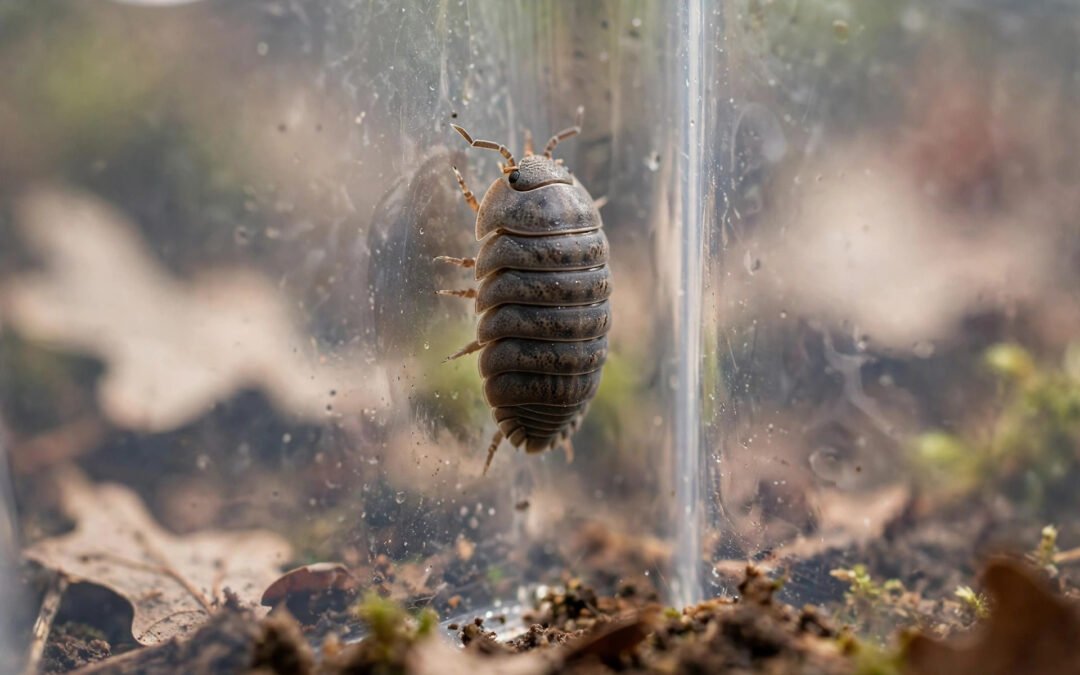
Preventing Isopod Escapes: Lids, Barriers & Setup Tips
Preventing isopods from escaping comes down to three things: a lid that actually seals, ventilation holes or mesh too small for the tiniest mancae, and keeping the substrate an inch or two below the rim. Healthy isopods cannot climb clean, smooth plastic or glass — so if yours are getting out, something specific in the setup has failed, and this guide walks through every failure point and how to fix it.
There is a second lesson hiding inside this topic. Escapes are almost never a lid problem alone. Isopods that are constantly massing at the lid and probing for a way out are voting with their feet: the conditions below them are wrong. This article covers both — the hardware that keeps them in, and what chronic escape attempts are telling you about your husbandry.
Can Isopods Really Climb Out? The Honest Answer
Ask ten keepers whether isopods can climb plastic and you will get ten confident answers, most of them contradicting each other. Here is the version that holds up. A healthy adult isopod cannot climb a clean, smooth, vertical plastic or glass wall. Their feet simply do not grip a truly smooth surface. That is the baseline, and it is why a basic tub with a snug lid is escape-proof for most species.
But that baseline has three realistic exceptions that explain nearly every escape story:
- Dirty walls are climbable walls. Mineral deposits, algae film, and dried substrate dust on the inside of the tub give their feet purchase. Keepers on Arachnoboards have noted that isopods which never climbed smooth plastic suddenly could once mineral buildup accumulated on the walls. A tub that was escape-proof in month one can stop being escape-proof in month six.
- Condensation is a climbing aid. A wet wall is not a smooth wall in practice — moisture changes how their feet contact the surface, and several keepers report climbing ability increases on damp walls.
- Bridges beat walls every time. Cork bark leaning against the side, a plant touching the wall, a substrate mound piled high near the edge — anything that reaches the top edge turns a vertical wall into a staircase.
So the rule is not “isopods can’t climb” — it is “isopods can’t climb clean smooth plastic unless you give them a way.” Every escape is either a wall problem, a bridge problem, or a lid problem.
Preventing Isopod Escapes: The 7 Methods That Actually Work
Ranked from most important to nice-to-have. The first three eliminate roughly 95% of escapes on their own.
1. Use a lid that seals — really seals
The lid is the single most reliable anti-escape device you own. But not all lids are equal:
- Gasket-sealed bins (best). Storage bins with a rubber gasket and latching lid — the kind Midwest Isopods recommends for the hobby — seal nearly airtight around the entire rim. They hold humidity better, keep mites and gnats out, and give even determined climbers like Powder Blues nothing to squeeze through. This is the most underrated upgrade in isopod keeping: one purchase fixes escape, humidity, and pest problems simultaneously.
- Snap-on Sterilite-style lids (good). A standard plastic storage tub with a press-fit lid works fine for most species as long as the lid actually sits flat. Check the corners — warped lids leave gaps big enough for a manca (baby isopod, roughly the size of a sesame seed) to walk through.
- Glass aquarium with a tight top (good). Aquariums work well because glass is the smoothest surface available. Use a proper screen or glass top, not a book balanced on top — the Arachnoboards escape stories almost always involve “it was just sitting there.”
The lidless trend deserves a blunt opinion: some keepers run dry-species setups without lids and report no escapes. It works right up until a tub gets knocked over, a lid was never the humidity problem anyway, and household hazards — cleaning sprays, curious pets, curious children — have an open door. For a beginner, a lid is not optional. Keep it on.
2. Manca-proof your ventilation
Ventilation holes are the second-most common escape route, and it is always the babies that find it. An adult Armadillidium cannot fit through a 2 mm drilled hole; a manca absolutely can.
- Drill small holes (1–2 mm) with a pin or small drill bit instead of large ones. More small holes beats fewer large ones for airflow per unit of escape risk.
- If you use mesh, use fine stainless steel mesh — fiberglass window screen is coarse enough that determined mancae can squeeze through it. The Environmental Literacy Council’s guidance on this is correct: the mesh must stop even the tiniest babies.
- Keep holes and mesh away from the substrate surface — upper walls and the lid, not down near the soil line. Our isopod ventilation guide covers placement in detail.
3. Keep the substrate 1–2 inches below the rim
This is the cheapest insurance in the hobby. When the substrate surface sits an inch or two below the top of the tub, isopods standing on the soil cannot reach the rim directly. They would have to climb the bare wall first — which brings us back to the smooth-plastic rule. Every tub I set up gets the two-finger test: two fingers’ width of clear wall between the substrate and the lid. It takes ten seconds when you are setting up and it costs nothing.
4. Eliminate bridges
Walk around your tub and look at it from an isopod’s perspective. Cork bark leaning on the wall, a leaf pressed against the side, a hide pushed into the corner touching the rim — these are all ramps. Push decor away from the walls, keep plants trimmed so nothing touches the sides, and do not pile substrate into a mound near the edge. The Environmental Literacy Council flags overhanging lips and bridges as the classic escape aid, and hobby experience backs that up completely.
5. Keep the walls clean and dry at the top
Two habits, both free. First, wipe the inside walls every few weeks to remove mineral film and substrate dust — this is the maintenance nobody does and everybody should. Second, keep a dry band at the top of the walls: mist the substrate, not the sides, so the upper wall stays dry. A dry, clean wall is the surface isopods cannot climb.
6. Petroleum jelly barriers — an honest assessment
You will see this advice everywhere: smear a thin ring of petroleum jelly around the top edge of the enclosure as a slip barrier. Here is the honest version. It does work — isopods cannot cross a fresh, continuous grease ring. But it is the most overrated escape method in the hobby:
- It collects dust and substrate particles, which eventually form a bridge over the barrier.
- It needs frequent reapplication — a dried, dusty grease ring is just a dirty wall.
- It is greasy to work with and can contaminate the substrate when you reach in.
Verdict: use it as a temporary measure (for example, right after setting up a new tub before the walls have settled) or for a notoriously climb-happy species — never as your only strategy, and never instead of a lid.
7. Lid discipline during maintenance
The escapes almost nobody plans for happen during maintenance. You lift the lid to feed, the phone rings, and twenty minutes later a Powder Orange is exploring the bookshelf. Multiple Arachnoboards keepers report their only escapes ever happened with the lid off. The rule: the lid comes off, the work gets done, the lid goes straight back on. If you are working with a species that bolts — Dairy Cows and Powder Blues are the classic offenders — work over a large tray or bathtub so anything that drops lands somewhere recoverable.
Choosing an Escape-Proof Container: What Works Best
For a deeper treatment of tub sizing, see our isopod enclosure size guide. For escape-proofing specifically, here is how the common options rank:
- Gasket-sealed latching bins — the gold standard. Airtight seal, best humidity control, zero rim gaps. Slightly more expensive than basic tubs.
- Standard snap-lid storage tubs (Sterilite-style) — perfectly adequate for Armadillidium species and most Porcellio. Verify the lid sits flat with no warped corners.
- Glass aquariums with fitted tops — excellent walls, but heavy and pricey at scale. Watch the sliding-door designs: the door tracks are escape gaps for small species.
- Deli cups and small containers for quarantine or dwarf species — fine short-term, but flimsy lids crack and warp; check the seal regularly.
Avoid textured-interior containers. If the inside of the tub feels rough to your fingertip, an isopod can climb it. Smooth interior walls are a hard requirement.
Which Species Are Most Likely to Escape?
Not all isopods are equally motivated or equipped to get out. Roughly, from highest escape risk to lowest:
- Porcellionides pruinosus (Powder Orange / Powder Blue) — fast, small, excellent climbers, and the mancae are tiny enough to exploit any vent gap. Midwest Isopods specifically warns that if you keep this species, you know exactly what escaping isopods look like. Give them gasket lids and fine mesh.
- Porcellio laevis (Dairy Cow) — large and active, decent climbers, and bold enough to test every edge. A solid snap lid with small vents is enough.
- Porcellio scaber and other mid-size Porcellio — moderate. Standard setups contain them fine.
- Armadillidium species (vulgare, maculatum, nasatum) — low escape risk. They are slow, poor climbers, and prefer to roll into a ball rather than flee upward.
- Cubaris species — low. Shy, slow, and moisture-dependent; they hide rather than climb.
New keepers should know: if you chose Powder Oranges or Dairy Cows as your first species — both excellent beginner choices for other reasons — spend the extra few dollars on gasket bins. The species’ climbing ability is the price of their hardiness.
When Isopods Keep Trying to Escape, the Setup Is Wrong
This is the most important section in this article. One escaped isopod is an accident. Isopods constantly massing at the lid — dozens clustered at the top corners, day after day — is a distress signal. They are not trying to be free. They are trying to get away from something:
- Too wet. The most common cause. Waterlogged substrate drives isopods upward away from the soggy bottom. If escape attempts cluster on the wet side of the tub, you are over-misting. See our isopod humidity control guide.
- Too hot. Heat speeds up everything in an isopod colony, including their urge to disperse. Check that temperatures are inside the species’ range — our isopod temperature guide has the numbers.
- Stale, ammonia-heavy air. Poor ventilation lets waste gases build up near the substrate. Pods climb toward fresher air at the vents. If they are clustered at the ventilation holes, the substrate air is the problem, not the vents.
- Overcrowding. A colony that has exploded past its tub’s carrying capacity disperses. It is the same logic as our isopod enclosure size guide: when the population outgrows the space, split the culture.
Before upgrading the lid, upgrade the conditions. A better lid keeps unhappy isopods in; better conditions remove the reason they were leaving.
Found an Escapee? How to Recover It
It happens to everyone eventually. A loose isopod in the house will do what isopods do in the wild: seek the nearest dark, damp place. Check under the tub, behind nearby furniture, in bathroom corners, and under sinks. Isopods dehydrate fast in dry room air — the clock is shorter than you think, especially for small species.
- Set a damp-paper-towel trap: a folded, damp paper towel on the floor near the tub, covered with an overturned bowl with a gap at one edge. Check it after a few hours — escaped pods often walk right in.
- Return it gently. Use a soft brush or a piece of cardboard to lift it, not your fingers — a dehydrated isopod is fragile.
- Quarantine first if it was out long. If the escapee was wandering the house for a day or more, keep it in a small holding cup with damp substrate for a few days to confirm it is healthy before returning it to the colony. Read our quarantining new isopods guide for the full method.
Preventing Isopod Escapes: Frequently Asked Questions
Do isopods need a lid?
Yes — especially beginners. A lid maintains humidity, keeps out household pests and chemicals, and is the single most reliable escape prevention. Lidless setups only work for experienced keepers with dry-tolerant species and controlled rooms.
Can baby isopods (mancae) escape through ventilation holes?
Yes, and they are the most common escapees. Mancae are about the size of a sesame seed. Drill small (1–2 mm) holes or cover vents with fine stainless steel mesh, not coarse fiberglass screen.
Will petroleum jelly really stop isopods?
A fresh, continuous ring works as a slip barrier, but it is a temporary measure: it collects dust, needs reapplication, and is no substitute for a sealing lid. Use it as backup, not as the plan.
Why are my isopods all climbing the walls?
They are signaling a problem below: usually too-wet substrate, too much heat, stale air, or overcrowding. Fix the conditions first — the climbing almost always stops on its own.
Can isopods climb glass?
Not a clean, dry glass wall — it is the hardest surface for them to grip. Dirty or wet glass is a different story, so keep the walls clean and the top of the walls dry.
What do I do if I find an isopod outside the tub?
Set a damp-paper-towel trap nearby, return it gently with a soft brush, and quarantine it briefly if it was out for more than a day before reintroducing it.
References
- Arachnoboards — “Do your isopods escape without a lid?” — keeper discussion on smooth-surface climbing, mineral buildup, and lidless setups: https://arachnoboards.com/threads/do-your-isopods-escape-without-a-lid.343972/
- Midwest Isopods — “Creating the Ideal Habitat for Isopods” — gasket-sealed bins and fine stainless steel mesh rationale: https://listed.to/@Midwest_Isopods/50964/creating-the-ideal-habitat-for-isopods
- Environmental Literacy Council — “Can isopods climb plastic?” — secure-enclosure guidance, Vaseline barriers, bridge avoidance: https://enviroliteracy.org/animals/can-isopods-climb-plastic/
- Environmental Literacy Council — “Do isopods need air flow?” — vent sizing and manca-proofing guidance: https://enviroliteracy.org/animals/do-isopods-need-air-flow/
- Bad Juju — Isopod Care Guide — vent-hole sizing and escape troubleshooting notes: https://www.badjuju.shop/copy-of-dermestid-care-guide
Note: Isopod care requirements can vary by species, enclosure conditions, temperature, humidity, ventilation, and colony size. The recommendations above are general husbandry guidance; always consider the requirements of the specific species you keep.