
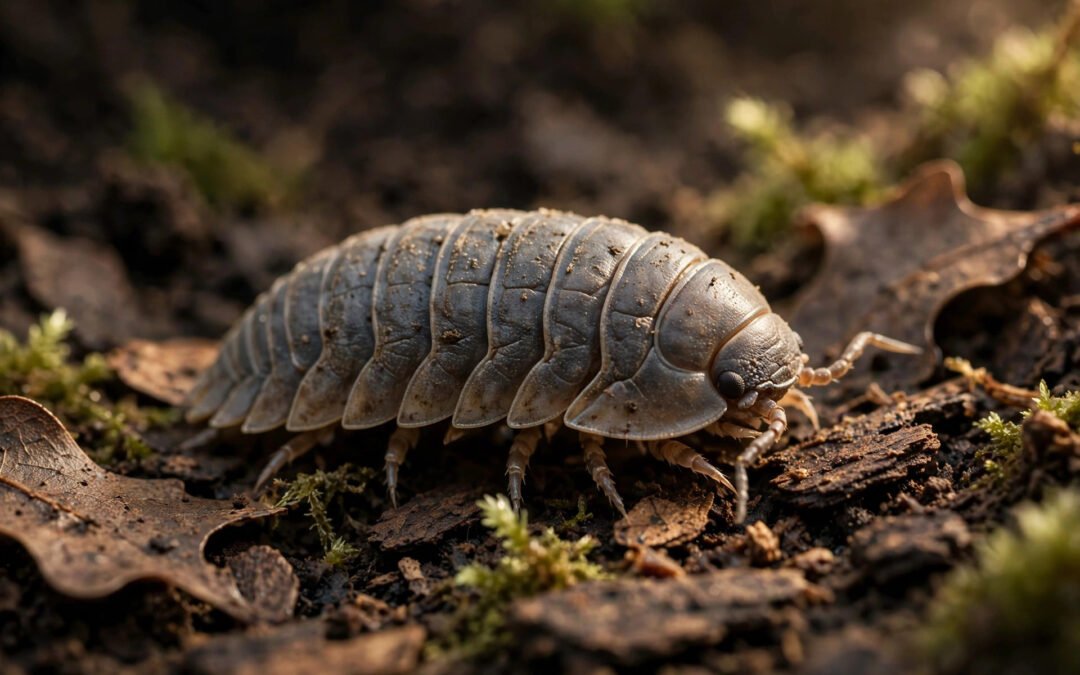
The Quick Answer: How Long Do Isopods Live?
Short version: most pet isopods live 18 months to 3 years. Fast-breeding species like Powder Oranges sit at the short end (1–2 years), while slow growers like Rubber Duckies and the big Spanish Porcellio can reach 3–4 years. However, one individual’s lifespan is the wrong thing to focus on. In fact, a healthy colony replaces its members faster than they die, so the colony itself can keep going for a decade or more.
Isopod Lifespan by Species
First, species sets the ceiling. These are the ranges experienced keepers report — estimates, not stopwatch readings, since tracking one unmarked animal among a hundred near-identical siblings is close to impossible.
| Species | Typical lifespan | Notes |
|---|---|---|
| Powder Orange / Powder Blue (Porcellionides pruinosus) | 1–2 years | Small, fast, famously prolific |
| Dairy Cow (Porcellio laevis) | 2–3 years | Hardy and forgiving |
| Common rough woodlouse (Porcellio scaber) | 2–3 years | One of the toughest beginners’ species |
| Zebra isopod (Armadillidium maculatum) | 2–3 years | Beginner-friendly roller — see our zebra isopod care guide |
| Common pillbug (Armadillidium vulgare) | 2–4 years | Well-kept colonies can push past 3 |
| Large Spanish Porcellio (P. expansus, P. magnificus) | 3–4 years | Slow to grow, but among the longest-lived hobby species |
| Rubber Ducky (Cubaris sp.) | 3–4 years | The slow lane: slow to establish, durable once settled |
| Dwarf white (Trichorhina tomentosa) | Under 1 year each | Short-lived individuals, but the culture persists through constant reproduction |
From Manca to Adult: How Fast Do Isopods Mature?
Isopods hatch as tiny replicas of the adults, called mancae, and grow through a series of moults. Most hobby species reach sexual maturity in roughly 2–4 months, after which females keep producing broods for the rest of their lives — from a few mancae in slow breeders like Cubaris to well over a hundred in prolific species like Dairy Cows. In other words, an individual that lives two years but starts breeding at three months can produce a dozen broods. Our isopod breeding basics for beginners walks through the full timeline.
What Shortens an Isopod’s Life: The Mistakes That Matter Most
Premature deaths in beginner setups almost always come down to a short list of avoidable problems:
- Failed moults from calcium shortage. Indeed, an isopod’s most dangerous moment is the moult, and they moult throughout their lives. Keep cuttlebone or crushed limestone permanently available — see our calcium for isopods guide for sources and deficiency signs.
- Keeping them too warm. As a result, warmth speeds up metabolism: they grow faster, breed faster, and die sooner. Cooler, steady conditions extend individual lifespan.
- Humidity swings. Because isopods breathe through modified gills, they need damp conditions. Our best substrate mix for isopods recipe is built around holding moisture evenly.
- Constant disturbance. In fact, daily digging, frequent handling, and full substrate tear-outs all take a toll. Check weekly and otherwise leave them alone.
- Contaminated leaf litter. For instance, pesticide-treated or roadside leaves can wipe out a colony. Collect from unsprayed areas and rinse well.
Temperature: The Lifespan Lever Most Keepers Underrate
Here is my sharpest opinion on this topic: most beginners keep their isopods warmer than they need to be. For example, people see “tropical species,” assume a heater is required, and run a Cubaris tub at 28°C — then wonder why the colony burns bright and fades fast. Warmer conditions buy you faster breeding, but you pay for it with shorter individual lifespans: a direct trade-off.
Overall, most temperate species are comfortable at ordinary room temperature (roughly 18–24°C), the sweet spot where they live longest. Our isopod temperature guide with ideal ranges per species type has the full breakdown: if breeding speed is your goal, warm them up; if longevity is your goal, let them be cool.
How Long Do Isopods Live in the Wild vs in Captivity?
Wild isopods face predators, drought, food shortages, and winter — few reach the top of their natural range. Captive isopods in a well-run enclosure are better off: no predators, a permanent calcium source, steady humidity, and food that never runs out, so they skew toward the upper end of the species’ range.
However, one exception is isopods kept as a bioactive cleanup crew in a reptile vivarium. There they are also food — often the whole point — so individual lifespan is academic for many of them.
How to Help Your Isopods Live Longer
The formula is boring, but works:
- Keep calcium permanently available — cuttlebone in the corner, always there.
- Feed a real base diet — deep leaf litter and decaying wood, topped up as eaten, plus varied extras. Our isopod feeding guide has the full safe-food list.
- Hold humidity steady with a moisture gradient (damp one side, drier the other).
- Ventilate well — stagnant substrate rots, and rotting substrate kills.
- Top up substrate instead of replacing it a few times a year — full tear-outs stress the colony.
- Leave them alone — they do best admired from a distance.
Signs an Isopod Is Nearing the End of Its Life
Eventually, old isopods slow down: they eat less, move less, and spend more time under cover. You may notice a slightly duller shell and a general reluctance to roll into a ball (in rolling species). A dying isopod often lies on its side or back and responds weakly when nudged.
Caution: a dying isopod looks a lot like a moulting one — check our isopod molting vs dying guide before intervening, since disturbing a mid-moult animal does more harm than the moult itself.
The Real Question: Your Colony Can Outlive Every Individual in It
Here is the reframe that matters: you are not keeping a pet with a fixed lifespan, the way you would a hamster. Instead, you are keeping a population. Because isopods breed readily, a healthy colony replaces its own losses continuously — a tub started today can still be going strong in a decade, having turned over many generations.
So the better question is not “how long do isopods live?” but “how healthy and self-sustaining is my colony?” Finally, keep calcium, leaf litter, and moisture steady, and the answer takes care of itself.
FAQs: How Long Do Isopods Live?
Which isopods live the longest?
The slow-growing ones: Rubber Duckies (Cubaris sp.) and the large Spanish Porcellio often reach 3–4 years; well-kept Armadillidium vulgare can get close to 4.
Do isopods live longer if kept cooler?
Generally, yes. Cooler conditions slow metabolism, so individuals live longer — but growth and breeding take longer too. Most temperate species live longest at steady room temperature.
How long do pillbugs live?
Pillbugs (Armadillidium vulgare and close relatives) typically live 2–3 years, with well-kept individuals reaching up to 4 years in captivity.
What about the giant deep-sea isopods that live for decades?
Those are Bathynomus — deep-sea relatives the size of a small dog, monitored in professional aquariums. Fascinating, but no guide to your enclosure animals.
References
- PostPods — “How Long Do Isopods Live? Lifespan by Species”: postpods.co.uk/blogs/isopods-useful-articles/how-long-do-isopods-live
- Chen et al. (2021) — “A comprehensive evaluation of the potential of semiterrestrial isopods, Ligia exotica, as a new animal food” (Scientific Reports): nature.com/articles/s41598-021-86561-z
Care requirements vary by species. Individual lifespans are estimates based on keeper experience — individuals in a colony cannot be tracked precisely.