
Isopods for Crested Gecko Tanks: Best Species, Setup & Care Guide
A bioactive crested gecko tank only works if something eats the mess. Your gecko drops food, sheds skin, and leaves droppings — and without a cleanup crew, all of that rots in the substrate. Isopods are the crew members that handle the big jobs: they shred leaf litter, break down droppings and leftover food, and aerate the soil as they burrow. Add springtails for the mold and the fine particles, and you have a tank that mostly looks after itself.
But not every isopod belongs in a crested gecko tank. Crested geckos live in a middle zone — humid, but not swampy; warm, but never hot — and your cleanup crew has to thrive in exactly those conditions while also surviving a predator that sleeps above them and hunts at night. This guide covers which species actually work, how many to add, and how to keep them alive long enough to do their job.
Why Isopods for Crested Gecko Tanks Matter
A crested gecko tank without a cleanup crew is a tank you clean by hand, constantly. Paper towel setups are fine for quarantine, but a planted bioactive vivarium needs its own recycling system. Isopods for crested gecko tanks do three jobs at once: they eat waste before it molds, they turn leaf litter into rich soil your plants can use, and their burrowing keeps the substrate from compacting into a sour, airless mat. The result is a tank that smells like forest floor, not like a reptile enclosure.
There is one catch that surprises new keepers: your gecko will eat some of them. That is normal, harmless, and even a small protein bonus for the gecko. The trick is choosing species that breed fast enough to outpace the losses — which rules out most of the fancy, slow-breeding species right away.
Best Isopods for Crested Gecko Tanks
Here is the honest ranking, from the species I would put in first to the ones that work only as a supplement.
1. Powder Orange Isopods (Porcellionides pruinosus)
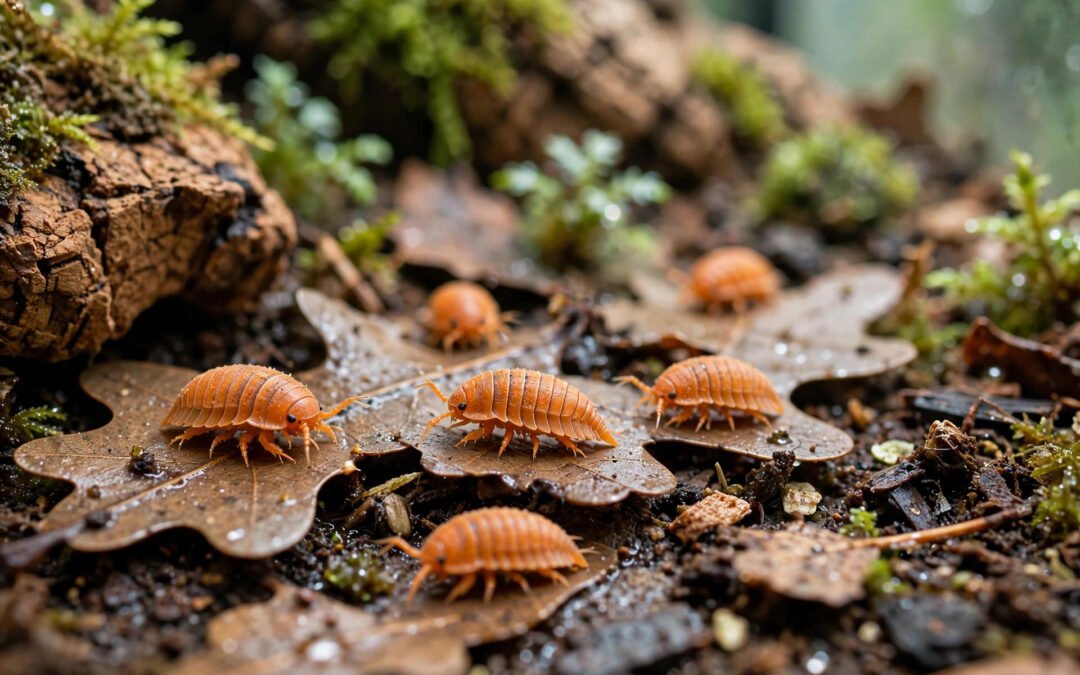
The workhorse of the crested gecko world. Powder oranges breed fast, tolerate the moderate humidity of a crestie tank, eat aggressively, and stay small enough that a gecko snacking on a few adults barely dents the colony. They are also cheap, so topping up the colony costs almost nothing. If you only buy one species, buy this one. Our Powder Blue isopod care guide covers their close cousin, which shares the same care.
2. Dwarf White Isopods (Trichorhina tomentosa)
Tiny, pale, and almost entirely subterranean — dwarf whites live inside the substrate, which is exactly where you want a cleanup crew member in a tank with a hungry gecko overhead. They reproduce parthenogenetically, so a handful becomes hundreds, and they handle the damp end of the moisture gradient beautifully. Their only weakness is size: they are too small to shred big pieces of leaf litter or a whole dropped cricket, which is why they pair best with a larger species like powder oranges.
3. Dairy Cow Isopods (Porcellio laevis)
Dairy cows are big, bold, and hungry — they will demolish waste faster than anything else on this list. The downside is that same appetite: Porcellio laevis are famously protein-hungry, and a starving dairy cow colony has been known to nibble on soft, shedding reptiles. In a well-fed crestie tank that risk is low, but it is real enough that I would never run dairy cows as the only crew species. Use them as a supplement, keep them fed, and read our Porcellio laevis care guide before committing. A well-fed colony is a safe colony.
4. Powder Blue Isopods (Porcellionides pruinosus “Powder Blue”)
Same species as the powder orange, different color morph, same virtues: fast breeding, hardy, and happy in crestie conditions. The only reason they sit below the oranges is availability — oranges are usually cheaper and easier to find in bulk. If blues are what your local shop stocks, buy them without hesitation.
Isopods to Avoid in a Crested Gecko Tank
Cubaris species (rubber duckies, panda kings, and friends). Beautiful, expensive, and completely wrong for this job. Cubaris breed slowly, cost a fortune per animal, and need consistently high humidity that a crestie tank does not provide. Put them in a gecko tank and you are serving an expensive dinner. Keep Cubaris in their own dedicated colonies.
Desert and arid species. Giant canyon isopods and other dry-climate species need a moisture regime your crestie tank should never have. They will hide in the driest corner and slowly die, contributing nothing.
Wild-caught isopods. Garden pillbugs carry pesticides, parasites, and unknown hitchhikers. A captive-bred starter culture costs a few dollars and protects both your gecko and your plants.
How Many Isopods to Add to a Crested Gecko Tank
For a standard 18 x 18 x 24 inch enclosure, start with 20 to 30 powder oranges plus a starter culture of dwarf whites. That sounds like a lot until you remember that half the population lives underground and the gecko will eat a few. Understocking is the single most common reason a new bioactive tank fails: ten isopods cannot process the waste of a gecko, and the colony collapses before it ever gets going.
Then — and this is the step most people skip — wait two to three weeks before adding the gecko. Let the crew settle, breed, and spread through the substrate first. A colony that starts ahead of the predator stays ahead of it. Dropping isopods and gecko into a fresh tank on the same day is asking the crew to establish itself while being hunted.
Setting Up the Crew’s Habitat Inside the Tank
Isopods for crested gecko tanks need the same three things they need everywhere, adapted to a vertical, planted enclosure:
- A moisture gradient. One end of the substrate stays damp (under the water dish or the misted side), the other stays merely humid. Isopods shuttle between the two as they need. Our humidity control guide explains how to read and adjust it.
- Deep leaf litter. Two to three inches of oak and magnolia leaves is both food and shelter. Leaf litter is where isopods hide from your gecko during the day, so skimping on it is the same as serving them up. See our substrate mix guide for the base layer underneath.
- Ground-level refuges. Cork bark flats, half-buried hides, and stacked bark pieces give the crew dark, damp hiding spots the gecko rarely bothers to investigate. The more refuges, the more of the colony survives each night.
- Vertical separation. Crested geckos live up high. Give them branches, vines, and ledges near the top, and the crew gets the ground floor to itself. The less time your gecko spends hunting at substrate level, the longer your colony lasts.
Feeding Your Cleanup Crew (So They Don’t Starve)
In a mature tank, leaf litter and gecko waste feed the crew. In a new tank, they do not — and a starving crew is a crew that stops breeding, then starts nibbling things you would rather it did not. Supplement weekly with a pinch of fish flakes, a dried shrimp, or a slice of blanched vegetable tucked under the leaf litter. Our isopod feeding guide covers safe foods and portion sizes. Feed the crew and it will feed your soil.
When Your Gecko Eats the Cleanup Crew
Do not panic. A crested gecko picking off an isopod here and there is normal enrichment, and isopods are a safe, calcium-bearing snack in small numbers. It only becomes a problem when the colony visibly shrinks: no isopods under the leaf litter at night, waste piling up, mold appearing. At that point, top up with another starter culture, add more leaf litter and cork bark, and check that you are actually feeding the crew. A colony that is fed breeds; a colony that is starving gets eaten into oblivion.
Signs Your Cleanup Crew Is Failing
- Mold spreading instead of receding. A healthy crew plus springtails keeps mold in check within days. Persistent mold means the crew is too small or the tank is too wet.
- Waste sitting untouched for a week. Droppings should be broken down within days in a warm, established tank.
- No isopods visible at night. Lift a piece of cork bark after lights-out. If nothing scurries, the colony is gone — restock before the substrate sours.
- Sour or ammonia smell. The crew has been overwhelmed. Spot-clean by hand, restock, and check ventilation with our springtails vs isopods guide to see which half of the team is missing.
Frequently Asked Questions
Can isopods hurt my crested gecko?
No, in a well-fed colony. The often-repeated worry is protein-hungry Porcellio nibbling a shedding gecko, which is why dairy cows should be a supplement, not the whole crew, and always kept fed. Powder oranges and dwarf whites pose no risk.
Do I still need springtails?
Yes. Isopods handle the big waste; springtails eat mold and fine particles isopods cannot. The two together are the full crew — neither replaces the other.
How long until the tank is fully bioactive?
Expect six to eight weeks from crew introduction to a self-sustaining system: two to three weeks of establishment before the gecko moves in, then a few more weeks for populations to balance. Patience here pays off for years.
Can I use the same isopods in a leopard gecko tank?
Only partly. Leopard gecko tanks are much drier, so dwarf whites and Cubaris struggle there. Powder oranges survive in a humid hide, but the crew system is different — do not copy this guide across species without adjusting for humidity.
The Bottom Line
Isopods for crested gecko tanks are not an accessory — they are the engine of the whole bioactive setup. Choose fast breeders, stock generously, give them deep leaf litter and ground-level hiding spots, feed them while the tank matures, and let them establish before the gecko moves in. Do that, and the tank largely cleans itself while your gecko hunts happily overhead. Skimp on the crew, and you will be back to hand-cleaning a planted tank — the worst of both worlds.
References: Holy Poly Isopods, “Best Isopods for Bioactive Enclosures”; Josh’s Frogs, “Crafting a Crested Gecko Paradise”; CB Reptile, “Crested Gecko Habitat Setup Guide”.
Disclaimer: This guide is general husbandry information, not veterinary advice. If your gecko shows signs of illness, consult a reptile veterinarian.