
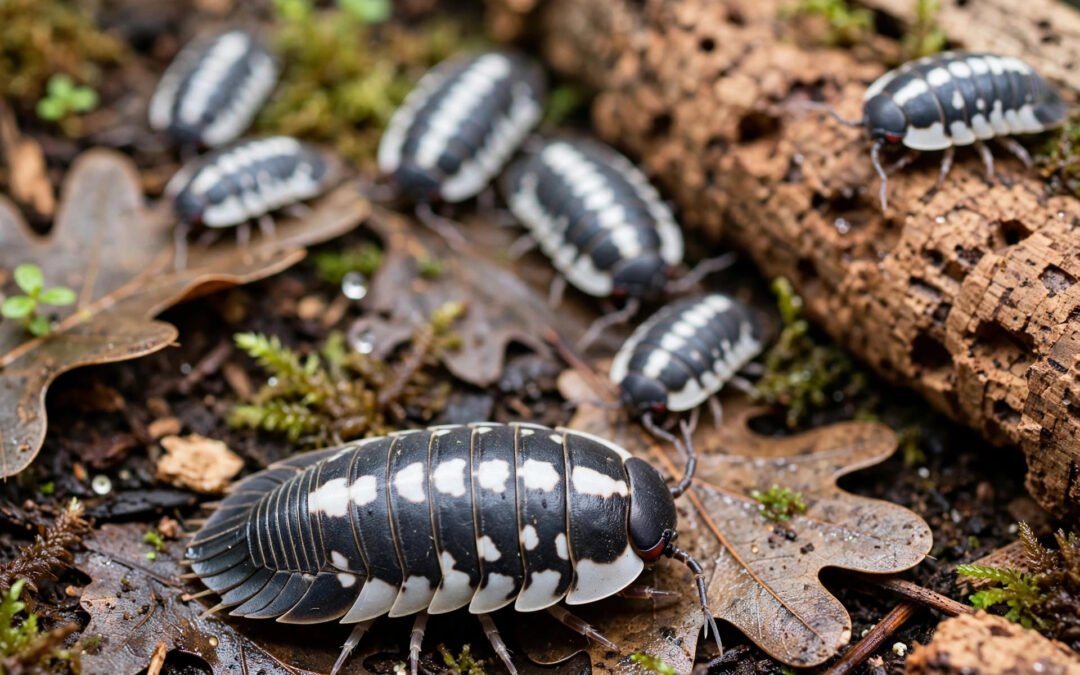
Dairy Cow isopods are the most popular beginner isopod in the hobby, and the reason is simple: they are big, bold, nearly impossible to kill, and they breed so fast that a starter culture of twenty can become hundreds within a few months. Dairy cow isopod care comes down to three things — a ventilated tub with a moisture gradient, a deep layer of leaf litter, and more protein than most care sheets admit. Get those right and the colony largely looks after itself. The one mistake new keepers keep making is treating Dairy Cows like any other isopod and feeding them like one. They are not like other isopods. They are hungrier, faster, and far more enthusiastic about food than anything else in the beginner range, and that appetite is both their best feature and the source of nearly every problem people report with them.
Dairy Cow Isopod Care at a Glance
| Scientific name | Porcellio laevis ‘Dairy Cow’ |
| Adult size | Up to 20 mm (about ¾ inch) — one of the largest beginner isopods |
| Temperature | 68–80°F (20–27°C); ordinary room temperature is fine |
| Humidity | 50–70% with a damp corner; never the whole tub wet |
| Difficulty | Beginner — hardy and forgiving |
| Breeding speed | Very fast — large broods, year-round |
| Lifespan | About 2–3 years per individual |
| Best for | First colony, bioactive cleanup crew, display tub |
What Are Dairy Cow Isopods?
Dairy Cow isopods are a selectively bred color morph of Porcellio laevis, a large, fast-moving woodlouse native to southern Europe and the Mediterranean. The wild-type laevis is a plain grey-brown animal; the Dairy Cow morph carries a piebald pattern of bold white patches over a dark body, so each animal looks a little like a tiny Holstein cow. No two individuals have exactly the same pattern, which is half the charm — a mature colony looks like a scattered herd. If you want the full species background, our Porcellio laevis care guide covers the wild-type animal; this guide focuses on what is different about the Dairy Cow morph in practice.
Two things set Dairy Cows apart from the rest of the beginner shelf. First, their size: at up to 20 mm they are roughly twice the length of a Powder Orange and far easier to see, count, and enjoy. Second, their appetite. Porcellio species eat more protein than Armadillidium species, and Dairy Cows sit at the hungry end of that range. They are surface-active, out in the open far more than most isopods, and they will swarm a piece of fish flake the way other species swarm a rotting leaf. That boldness is why beginners love them — and why a protein-starved colony can turn into a problem in a bioactive tank.
Dairy Cow Isopod Enclosure Setup
A starter culture of 20–30 animals is happy in a 6 qt ventilated plastic tub, and a mature colony appreciates a 12 qt or larger. Some care sheets recommend a 10-gallon tank as a minimum. That is overkill for a starter culture and, in my experience, a worse setup for a beginner: a big, mostly empty tank dries out unevenly and makes it harder to judge whether the colony is actually thriving. Start small, and let the colony tell you when to upgrade — when you lift the bark and find isopods wall to wall, it is time for a bigger tub or a split.
Ventilation should be moderate to high. Drill or melt a row of small holes along the upper sides of the tub, on two opposite sides if you can, so air moves across rather than just up through the lid. Dairy Cows tolerate drier air than tropical species, but stagnant, stuffy air plus damp substrate is how mold and mites take hold. A secure lid matters too: these are strong, active isopods, and a loose-fitting lid is an invitation. Add two or three hides — cork bark flats are ideal — and a thick layer of leaf litter on top of the substrate, which doubles as food and cover.
Substrate and Moisture Gradient for Dairy Cow Isopods
Use 2–3 inches of a nutritious best substrate mix for isopods — organic topsoil, well-rotted hardwood, leaf litter, and a little sphagnum moss — with a generous layer of oak or magnolia leaves on top. The leaf litter is not decoration. For Dairy Cows it is the staple food, and a colony this hungry will work through a thin layer in weeks. Keep topping it up rather than letting the tub run bare.
The moisture gradient is the single most important part of dairy cow isopod care. Keep about one-third of the tub damp — the moss corner — and leave the other two-thirds dry. Mist the damp side, never the whole tub, and let the isopods choose where to sit. A colony that clusters permanently in the damp corner is telling you the dry side is too dry; a colony that avoids the damp corner entirely is telling you the tub is too wet. That behavior test is worth more than any hygrometer reading, and it is how experienced keepers read a tub at a glance.
Dairy Cow Isopod Temperature and Humidity
Here is where the care sheets disagree with each other, and the disagreement is worth naming honestly. Some sources give 70–86°F, others 65–77°F. The truth is that Dairy Cows are a warm-temperate species with a wide tolerance: they breed fastest around 70–80°F (21–27°C), slow down below about 65°F, and start to suffer if they sit above 85°F for long. For most keepers that means ordinary room temperature, no heat mat, no thermostat, no fuss. If your room drops below 65°F in winter, a gentle heat source on one side of the tub — never underneath it — is enough. Our isopod temperature guide covers the species-by-species ranges in more detail.
Humidity should sit around 50–70% with that damp corner always available. Dairy Cows are far more forgiving of dry air than a Cubaris, but they still breathe through gills and they still die in a fully dry tub. The failure mode to watch for is not a number on a gauge, it is a colony that has gone quiet: fewer animals visible, no breeding, animals hiding deep under the bark. Nine times out of ten the damp side has dried out. Re-wet it, and the colony usually bounces back within days.
What Do Dairy Cow Isopods Eat?
Leaf litter and rotting hardwood are the staple — that is what their gut is built for, and it should always be available. On top of that, Dairy Cows need real protein two or three times a week, and this is where most guides understate the case. Fish flakes, dried shrimp, freeze-dried minnows, or a pinch of a quality isopod protein blend: offer a small amount, and watch how fast it disappears. A healthy colony will clear a pinch of fish flakes overnight. If protein sits uneaten for two days, you offered too much, or the colony is smaller than you think.
The reason protein matters so much is that a hungry Dairy Cow colony does not just sit there being hungry. Protein-deprived colonies have been known to nip at soft-bodied tankmates, chew on shed skin, strip seedlings, and eat live plant matter they would normally ignore. Our protein sources for isopods guide ranks the practical options, but the rule for Dairy Cows is simple: protein is not an occasional treat, it is part of the weekly routine, as regular as the leaf litter top-up. Vegetables are a useful supplement — carrot, sweet potato, squash, and zucchini are all taken readily — but they are a side dish, not the main course. Offer small pieces and remove anything that starts to mold. And keep a calcium source available at all times: a piece of cuttlebone in the damp corner covers molting needs for the whole colony.
Breeding Dairy Cow Isopods
Dairy Cows are among the fastest-breeding isopods in the hobby. Females carry their eggs in a marsupium — a brood pouch under the body — and release live mancae after a gestation of roughly three to four weeks. Broods are large, often twenty to sixty young, and females can breed year-round with no seasonal trigger. Young reach maturity in about three to five months, so a starter culture can become a self-sustaining colony within a single season. For the mechanics of isopod reproduction, see our isopod breeding basics guide.
That speed creates its own management problem, and it is one almost no care sheet warns you about: overpopulation. A Dairy Cow colony in a 6 qt tub will outgrow it. When you see isopods constantly on the lid, food vanishing within hours, and mancae everywhere, you have three honest options — move to a bigger tub, split the colony into two tubs, or sell and trade the surplus. What does not work is ignoring it. An overcrowded colony breeds less, not more, and the stress shows up as failed molts and a shrinking population. If your colony has stalled despite good conditions, our isopod colony not breeding checklist walks through the causes in likelihood order.
Mancae need no special treatment. They emerge as miniature adults and graze on the same leaf litter, but a pinch of crushed fish flake on the substrate surface for the first few weeks gives them the protein their fast growth demands. Do not move mancae to a separate tub — they are fragile, nearly invisible, and far safer left in the colony tub, where the adults ignore them completely.
Dairy Cow Isopods as a Bioactive Cleanup Crew
Dairy Cows are excellent cleanup crew for large, robust bioactive setups — enclosures for monitors, skinks, tegus, snakes, and bearded dragons, where their size and appetite are an asset. They process leaf litter, shed, and waste faster than almost any other beginner species, and their boldness means they are actually visible doing it.
But they are the wrong crew for delicate setups, and this is the honest part most sellers skip. In a planted dart frog tank they will eat seedlings, chew soft new growth, and disturb shallow-rooted plants. In a tank with small, slow, soft-bodied animals, a protein-hungry colony can nip. And because they breed so fast, a small starter group can become a large population that outcompetes smaller cleanup-crew species for food. If your priority is a gentle crew for a planted display, a smaller, slower species is the better choice. If your priority is a hard-working crew for a big reptile enclosure, Dairy Cows are hard to beat. Choose the crew for the tank you actually have, not the one in the product photo.
Buying Dairy Cow Isopods: What to Look For
Buy a starter culture of twenty to thirty animals, not ten. Ten is a false economy: with a small founder group a single bad week — a dried-out corner, a cold snap — can set the colony back months, while twenty or thirty gives you breeding redundancy from day one. Prices vary, but Dairy Cows are one of the cheapest isopods available, usually around a dollar or two per animal, which makes a proper starter culture affordable.
Two things to check before you buy. First, look at the pattern of the actual animals, not just the seller’s best photo. Juveniles are often mostly grey with faint white patches, and the bold black-and-white pattern develops as they grow. A culture of mostly juveniles is perfectly normal and healthy — but if you were expecting the striking adult pattern on day one, you will be disappointed. Second, ask how the culture is kept. A seller keeping Dairy Cows warm, damp on one side, and fed on leaf litter plus protein is selling you animals that will settle in immediately. If the seller cannot describe the setup, buy elsewhere.
Common Dairy Cow Isopod Problems
- Colony shrinking or hiding all the time: usually the damp side has dried out, or the room is too cold. Re-wet the moss corner and check the temperature before changing anything else.
- Not breeding: check protein first, then temperature. Dairy Cows that are warm and well-fed breed almost embarrassingly fast; a stalled colony is usually hungry or cold.
- Mold on food: you are offering too much fresh food at once, or the ventilation is poor. Offer less, remove leftovers within two days, and improve airflow. Springtails help here, and our mold and mites in isopod enclosures guide covers the cleanup.
- Mites in the tub: usually harmless soil mites arriving on leaf litter, but an explosion means overfeeding. Cut back fresh food and let the tub dry slightly on the dry side.
- Half-white individuals: not sick and not a new morph — isopods molt in two stages, back half first, so a two-tone animal is simply mid-molt. Leave it alone.
- Isopods climbing the walls and lid: normal for this active species in small numbers, but constant lid-climbing in a big group usually means the tub is overcrowded or the substrate is too wet. Check both.
Dairy Cow vs Other Beginner Isopods
| Species | Size | Speed of breeding | Protein need | Best for |
| Dairy Cow | Up to 20 mm | Very fast | High | Big bioactive tanks, display colonies |
| Powder Orange | Up to 12 mm | Fast | Moderate | All-round beginner crew |
| Zebra | Up to 18 mm | Moderate | Moderate | Display, slower colonies |
| Dwarf White | 3–5 mm | Very fast | Low | Small bioactives, frog tanks |
If you are choosing your first species, our best isopod species for beginners guide compares the whole starter range. Dairy Cows win on visibility and forgiveness; they lose on gentleness. That trade-off is the whole decision in one sentence.
Dairy Cow Isopod Care FAQ
Do Dairy Cow isopods bite?
No. They have no bite that matters to a person. They may nibble at soft, damp organic matter — including shed skin in a bioactive tank — but they cannot hurt you, and they are safe to handle.
Can Dairy Cow isopods live with other isopod species?
They can, but it is usually a bad idea. Dairy Cows breed fast, eat aggressively, and will outcompete slower species for food and space. One species per tub is the rule that keeps every colony healthy.
How fast do Dairy Cow isopods breed?
Very fast. A starter culture of twenty to thirty can reach hundreds within a few months at room temperature with regular protein. Expect large broods of twenty to sixty mancae per female, several times a year.
Do Dairy Cow isopods need light?
No special lighting. Room light on a normal day-night cycle is enough; direct sunlight is harmful because it overheats the tub. They are most active in the dark, so do not expect a daytime show.
Why are my Dairy Cow isopods mostly grey?
Juveniles are greyer than adults, and the white pattern strengthens with each molt. Pattern also varies between individuals — no two cows look alike — so a colony will always show a range from boldly patched to mostly dark.
References
Isopod Paradise — Dairy Cow care guide: https://isopodparadise.com/dairy-cow/
Crawler Island — Dairy Cow Isopod Care Guide: https://www.crawlerisland.ca/api/care-guides/dairy-cow-isopods-care/pdf
Moore & More Bugs — Your Complete Guide to Dairy Cows: https://www.mooreandmorebugs.com/blogs/care-guides/your-complete-guide-to-dairy-cows
iHeartBugs — The Best Facts and Care Sheet for Dairy Cow Isopods: https://iheartbugs.com/blogs/news/everything-you-need-to-know-about-dairy-cow-isopods
PostPods — Isopod care guides: https://postpods.co.uk/blogs/isopods-useful-articles
Disclaimer: This guide reflects general isopod-keeping practice and the author’s experience. Individual colonies can vary, and conditions such as room temperature, ventilation, and substrate quality can affect outcomes. When in doubt, observe your animals: their behavior is usually the most reliable guide to what needs changing.