
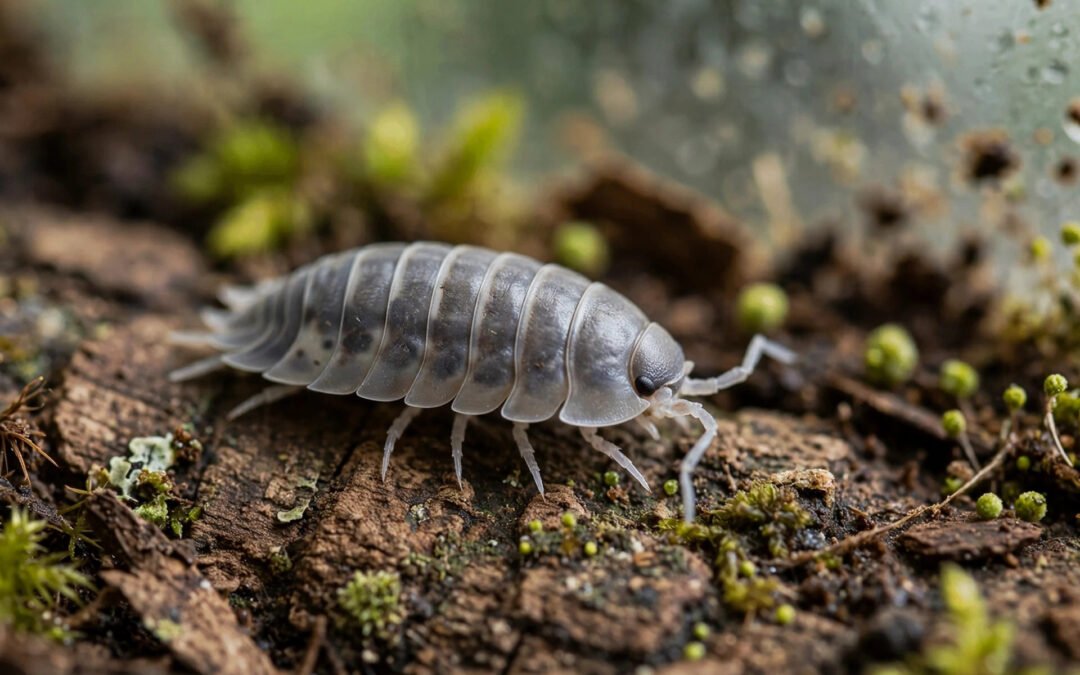
A beginner-friendly guide to Porcellio laevis care — the big, fast, endlessly hungry isopod that’s the wild-type cousin of the famous Dairy Cow.
The smooth isopod (Porcellio laevis) is the wild-type gray form of the same species as the beloved Dairy Cow morph — same easy care, same blistering breeding pace, just in classic smooth gray-brown instead of white spots. Nicknamed the “swift woodlouse” for its startling speed, it’s big, bold, and voracious: a great pick for beginners who want an active, fast-growing colony rather than a shy one. Like the wild type, the spotted Dalmatian morph of Porcellio laevis shares the same fast breeding, bold appetite, and easy care covered throughout this guide.
Quick Facts
- Scientific name: Porcellio laevis (wild-type)
- Common names: Smooth isopod, swift woodlouse, Dalmatian isopod
- Adult size: 15–18 mm (about 0.6–0.7 inches; suppliers list around 0.71 inches)
- Difficulty: Beginner
- Temperature: 65–80°F (18–27°C)
- Humidity: Moderate — around 50–60% ambient with a moist area (care guides cite 50–75%)
- Breeding speed: Very fast — prolific breeders
- Price tier: $ — affordable and widely available
- Lifespan: Around 2–3 years under typical care (consistent with our Dairy Cow page for the same species)
Appearance and size
Wild-type Porcellio laevis are among the larger beginner isopods at 15–18 mm — noticeably bigger than a common pillbug. The wild-type coloration is a smooth, glossy gray to brown (unlike the Dairy Cow morph’s white-on-dark spots), with a somewhat flattened body, long prominent antennae, and a streamlined look built for speed. One key difference from Armadillidium species: Porcellio cannot roll into a ball. When disturbed, they may curve their bodies like a shrimp and sprint for cover instead — which, given their speed, is usually effective. If you love the species but want spots, the Dairy Cow isopod is the same species in a striking spotted morph, and its care is essentially identical.
Porcellio laevis Care for the Dalmatian Morph
The Dalmatian isopod is a selectively bred spotted morph of Porcellio laevis — the same species as the smooth isopod, with identical care requirements. Commonly sold for its contrasting spotted patterning, it breeds just as quickly and thrives under exactly the conditions described in this guide: a moisture gradient, deep substrate, plenty of leaf litter, regular protein, and a lasting calcium source. Everything in this Porcellio laevis care guide applies equally to Dalmatian colonies — enclosure size, temperature and humidity targets, feeding frequency, and breeding expectations are all the same. Dalmatian isopods are just as hardy and forgiving of small husbandry mistakes, making them an excellent first morph alongside other beginner-friendly isopods. Choose the wild-type gray form for the classic look or the Dalmatian morph for spots; the husbandry is interchangeable. For background on the species’ taxonomy and wild habitat, see the Porcellio laevis article on Wikipedia.
Temperament and activity
“Swift woodlouse” is no exaggeration — these are the sprinters of the isopod world, exploding into motion when startled and covering ground fast. They’re bold, active, and often visible out in the open, which makes them entertaining to watch. They’re also famously voracious and protein-fixated: a dedicated P. laevis care guide notes they can injure soft-bodied or molting tankmates, so they should be housed thoughtfully — they’re best as a standalone display colony rather than cleanup crew in enclosures with delicate animals. Within their own colony they’re peaceful detritivores, just enthusiastic ones.
Porcellio laevis Enclosure Setup
Because they’re large, active, and like to dig, give smooth isopods generous floor space: a 6-quart bin suits a starter colony, but plan on a 16-quart (or larger) bin as the colony grows — and it will grow fast. Provide ventilation holes along the upper sides and a secure, tight-fitting lid; these are quick, curious explorers. Furnish with cork bark flats and deep leaf litter for cover. Since they burrow, hides that sit on the substrate surface work better than buried ones. Not sure what size to start with? The Enclosure Size Calculator can help you match container volume to your colony size.
Substrate
Go deep: 3–4 inches of substrate, since P. laevis likes to dig and burrow. Use a moisture-retentive base of coconut fiber or organic topsoil mixed with abundant decaying leaf litter and rotting hardwood chunks. Because they breathe through gill-like structures, the substrate must stay moist — not waterlogged, but consistently damp. Add a long-lasting calcium source such as cuttlebone or oyster shell pieces, which suppliers specifically recommend for this species. Keep leaf litter topped up; a hungry laevis colony can demolish it faster than you’d expect. Use the Substrate Calculator to figure out exactly how much mix your enclosure needs.
Temperature and humidity
Smooth isopods do well from about 65–80°F (18–27°C) — normal warm room temperature is ideal, and many keepers succeed without supplemental heat. Dedicated care guides cite humidity around 50–75%; a practical approach is moderate ambient humidity with a moisture gradient — mist one side of the bin so there’s always a damp zone, and let the other side stay drier. The critical point is that the substrate itself should stay moist, since their gill-like breathing structures depend on it. Avoid letting the entire bin dry out, and avoid soggy, airless conditions that invite mold. Some keepers run the damp zone toward the higher end of the range (70–90%), since P. laevis is slightly more sensitive to very dry conditions than Porcellio scaber — but avoid over-misting the whole bin, which invites mold. Keep the enclosure at a stable room temperature, away from drafts and direct sun.
Feeding
This is a hungry species — feed accordingly. Keep decaying leaf litter available at all times as the dietary base, and offer vegetables like carrot, zucchini, and sweet potato several times a week. Where P. laevis differs from Armadillidium species is protein: they’re notably protein-fixated, so offer protein sources such as fish flakes, freeze-dried shrimp, or dried insects more regularly — a few times a week rather than occasionally. Keep calcium (cuttlebone or oyster shell) available constantly. Remove uneaten fresh food after 24–48 hours to limit mold and mites, and expect a large colony to go through food quickly. The Feeding Calculator can help you portion meals so food does not sit long enough to spoil.
Breeding and colony growth
Porcellio laevis are famously prolific — suppliers describe them as one of the fastest-breeding beginner species. Females carry broods in a marsupium, and a starter colony can grow into the hundreds within months under good conditions. Plan for this: start with a modest number, size the enclosure for growth, and have a plan for extras (a second bin, trading with other keepers, or rehoming). Steady warmth in the 70s°F, consistent moisture, and regular protein all support breeding. Never release extra isopods outdoors — P. laevis is not native everywhere it’s kept, and released animals can harm local ecosystems. To estimate how fast your colony might grow, try the Colony Growth Calculator and the Breeding Calculator.
Plan for this growth when sizing the enclosure: a starter culture of around a dozen animals can reach the hundreds within a year under good Porcellio laevis care. When the bin looks consistently crowded, move the colony to a larger enclosure — crowding can slow reproduction and raise stress, so keeping a second bin ready is smart planning.
Common problems
- Overpopulation: The most common “problem” with this species is success — colonies can outgrow their bin. Split the colony or rehome extras rather than letting it become severely overcrowded.
- Protein hunger: Underfed colonies may harass molting or soft-bodied tankmates. Regular protein feedings reduce this risk considerably.
- Drying out: Their gill-like breathing structures need moisture; a fully dried-out bin can cause rapid losses. Keep the substrate consistently moist and maintain the gradient.
- Escapees: Fast and exploratory — a loose or warped lid can mean isopods wandering. Check lid fit regularly.
- Mold: Heavy feeding plus warm, humid conditions can invite mold. Feed what they’ll finish, remove leftovers, and keep airflow adequate.
Is this species right for you?
The smooth isopod is ideal if you want a big, bold, fast-growing colony that’s always doing something — and if you’re prepared for a species that breeds enthusiastically and eats heartily. It’s less “pet rock” than the Armadillidium species and more of an active display colony. Remember it’s the same species as the Dairy Cow isopod — choose wild-type gray for the classic look, or Dairy Cow for spots; care is essentially identical. Prefer a calmer roller that grows slowly? Compare the zebra isopod. Still undecided? Take the Species Finder quiz or line up the stats in the Species Comparison tool.
Related Species
Related Guides
References
- Reptanical Shop — Porcellio laevis ‘Dairy Cow’ Isopods — P. laevis breeding, “swift woodlouse” speed, temperature, substrate depth, calcium and protein
- Porcellio laevis care sheet (PDF) — temperature and humidity, gill-like respiration, protein fixation, cannot roll into a ball, do not release outdoors
- Josh’s Frogs — Isopod Substrate — substrate depth and moisture guidance
Note: Isopod care requirements can vary by species, enclosure conditions, temperature, humidity, ventilation, and colony size. The recommendations above are general husbandry guidance; always consider the requirements of the specific species you keep.