
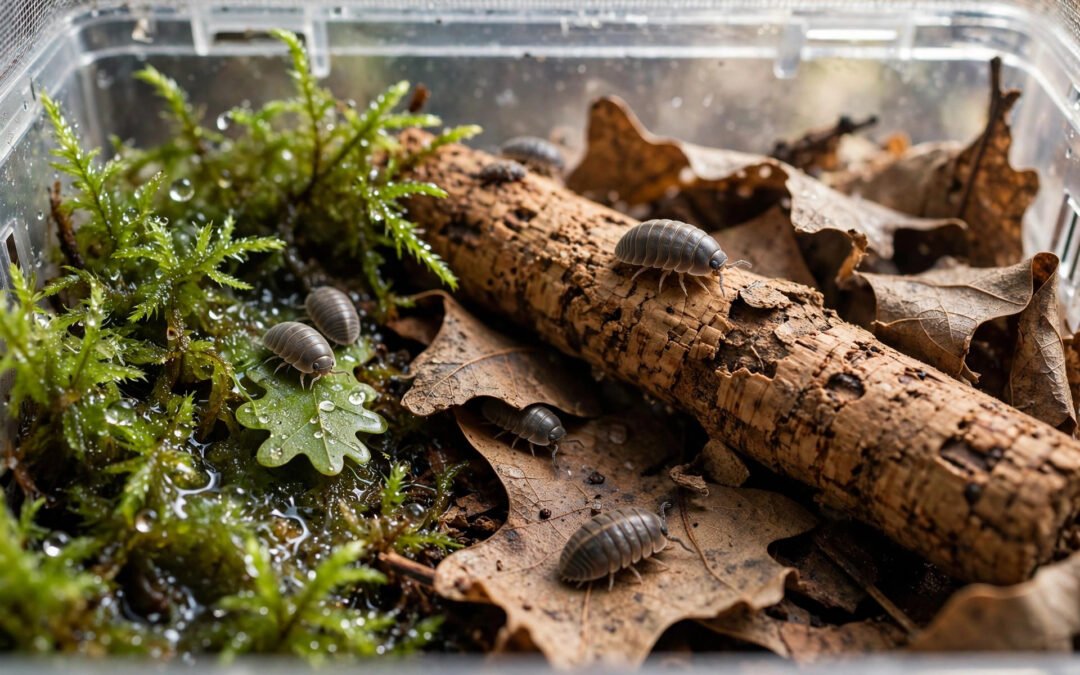
Do Isopods Need Water? The Honest Answer for Beginners
Do isopods need water? Yes — water is the single most important thing in an isopod enclosure. But here is the part that trips up almost every beginner: they do not need it the way a hamster or a dog does. There is no water bottle to hang on the wall and, for most species, no water bowl to fill. Isopods take in water through damp surfaces, moist air, and the food they eat, and the keeper’s real job is keeping part of the enclosure damp at all times — not providing a drink.
Once you understand that distinction, isopod watering stops being confusing. You are not trying to give them a drink. You are maintaining a damp corner they can walk into whenever their bodies need moisture, and a drier corner they can retreat to when they have had enough. Get that gradient right and most of the classic beginner problems — failed moults, colonies that slowly fade, sudden die-offs — become much rarer.
Do Isopods Need Water to Drink?
Isopods are land-dwelling crustaceans, and they never fully left their watery ancestry behind. They breathe through modified gills called pseudotrachea (sometimes called pleopodal lungs) on their undersides, and those gills only work when they stay moist. That is why moisture is not a comfort issue for isopods — it is a breathing issue. An isopod in a bone-dry tub is, quite literally, struggling to breathe. Our guide to how isopods breathe explains the anatomy in more detail.
So how does the water actually get into their bodies? Three ways, and none of them involves lapping from a dish:
- Through damp surfaces. Isopods absorb moisture through their undersides and legs as they walk across damp substrate, wet moss, and dewy leaves.
- Through humid air. Moist air keeps their gills working. This is why a sealed, stuffy tub and a bone-dry tub are both dangerous in different ways — one suffocates them with stale air, the other dries their gills out.
- Through food. Cucumber, courgette, squash, and other moisture-rich vegetables are a genuine water source. A colony eating fresh vegetables is also drinking, in a sense.
You may occasionally see an isopod sitting on a droplet or nosing at a wet leaf. That is normal. It does not mean your colony is desperate for a water dish — it means the moisture system you already have is working.
Do Isopods Need a Water Dish?
For most terrestrial isopods, the honest answer is no, and a water dish can do more harm than good. The risk is drowning, and it is not a theoretical risk. Mancae — the tiny, white newborn isopods — are small enough to drown in a few millimetres of standing water, and even adults can get trapped in a smooth-sided dish they cannot climb out of. A dish also goes stagnant quickly in a warm enclosure, turning into a bacterial soup that the colony walks through.
There is one narrow exception, and it is worth stating plainly so the rule does not sound absolute. If you keep large, hardy species such as Porcellio laevis and you want to offer a drink, a very shallow bottle cap filled with pebbles and just enough water to wet the stones — never a pool — is reasonably safe, because the isopods can stand on the pebbles. But it is optional, not necessary. A colony with a proper moisture gradient will never miss it, and many experienced keepers skip dishes entirely. Beginners should skip them too. Spend the effort on the gradient instead.
One more thing to unlearn: the pet-shop habit of putting a water dish in every animal’s home does not transfer to isopods. They are not miniature mammals. Treat them like the crustaceans they are and the whole setup makes more sense.
Do Isopods Need Water Every Day? Misting vs Pouring
Here is where common advice goes wrong. A lot of care sheets say “mist daily,” and beginners take that to mean spraying the whole tub, every day, until everything glistens. That is one of the fastest routes to mould, mites, and a colony that stops breeding. Daily whole-tub misting is, in my view, the most overrated habit in isopod keeping.
What actually works better is pouring, not misting — a technique this site’s Dwarf Purple guide also recommends. Pour a small amount of water slowly into one corner of the substrate, so it soaks down into the lower layers, and leave the rest of the tub alone. The surface can look dry while the depths stay damp, which is exactly what you want: isopods burrow to the moisture they need, and the dry surface discourages mould.
How often? There is no universal schedule, and anyone selling you one is guessing. Check the damp corner every two or three days with the squeeze test: pick up a pinch of substrate from the damp side and squeeze it. It should clump and feel like a wrung-out sponge — damp, with no water dripping out. If it crumbles dry, pour a little water into that corner. If water drips out, stop watering and let it dry back; you have overdone it. Tropical species such as Cubaris will need that corner topped up more often than a temperate Armadillidium colony, and a ventilated tub in a warm room will dry faster than a lidded tub in a cool one. Watch the substrate, not the calendar.
Misting still has a place: a light mist over the moss corner after a substrate change, or a fine spray on a hot day to raise humidity quickly. Think of misting as a top-up and pouring as the main watering method, not the other way round.
Building a Moisture Gradient: One Damp Side, One Dry Side
The moisture gradient is the single most important structure in an isopod enclosure, and it is simple to build. One side of the tub stays damp; the other side stays dry; the middle is somewhere in between. Your isopods then choose where to sit based on what their bodies need at that moment — after a moult they head for the damp side, and when they want to avoid mould and bacteria they retreat to the dry side. That freedom to choose is doing work no fixed humidity number can do for them.
To set one up, follow these steps:
- Fill the tub with a moisture-holding substrate mix at least a few inches deep, so the lower layers can hold water while the surface dries.
- Pile damp sphagnum moss into one corner. Moss is your moisture battery: it holds a lot of water and releases it slowly.
- Pour water into the moss corner only, until the lower substrate there is damp but not waterlogged.
- Put hides — cork bark, leaf litter — on both sides, so isopods can shelter in either zone.
- Leave the dry side genuinely dry. Resist the urge to mist the whole tub “to be safe.”
Then watch your colony for a week. If every isopod is piled into the damp corner, the dry side is too dry or the whole tub is too dry. If nobody ever visits the dry side and the substrate smells musty, you are overwatering. A healthy colony spreads out, with animals in both zones at different times of day. Our humidity control guide covers measuring and adjusting in more depth, and the ventilation guide explains how airflow and moisture balance each other — too little ventilation and the tub goes stagnant, too much and your damp corner dries out overnight.
What Kind of Water Is Safe for Isopods?
Plain, room-temperature water is almost always fine, with one rule worth following: dechlorinate it if your tap water is heavily chlorinated. Leaving a jug of tap water out overnight lets chlorine gas off, and a cheap aquarium dechlorinator does the same job instantly. Chloramine, used by some water suppliers, does not gas off, so a dechlorinator is the safer bet if you are unsure what your supplier uses.
Avoid water from a salt-based water softener — the salt load is not something you want in a small enclosure — and do not use distilled water as your only water source long term, since it contains no dissolved minerals at all. Bottled spring water is fine but unnecessary for most keepers. And never pour cold water straight from the fridge into a warm enclosure: room temperature avoids shocking the colony.
One underrated detail: the water you use on the substrate matters more than the water you use on the leaves. Substrate water is what the colony lives in, day after day. Food, by contrast, should be rinsed in plain water and nothing else — no soap, no produce wash residue.
Signs Your Isopods Need More Water
Isopods are honest about moisture problems if you know what to look for. Signs the colony needs more water include:
- Every isopod clustered in the damp corner, day after day, with the dry side abandoned.
- Failed or stuck moults, or isopods found dead half out of their old shell — moisture is critical during moulting, and our moulting vs dying guide helps you tell a moulting isopod from a dead one.
- Activity dropping off sharply, with animals staying hidden and barely feeding.
- Substrate that crumbles to dust when squeezed, even in the “damp” corner.
Signs of too much water are just as clear, and beginners miss them more often: a sour or musty smell, white mould spreading across the surface, clouds of tiny mites, substrate that drips when squeezed, and isopods clustering on the lid or the highest, driest bark. If you see the too-much-water signs, stop watering, increase ventilation slightly, and let the tub dry back before you water again. Do not reach for a chemical fix — drying out is the fix.
Do Isopods Need Water Differently by Species?
Yes, and this is where one-size-fits-all advice breaks down. The table below is a starting point — always check the species guide for the exact animal you keep — but it shows why your friend’s watering routine may be wrong for your colony.
| Group | Moisture needs | Watering notes |
|---|---|---|
| Tropical Cubaris (e.g. Rubber Ducky relatives) | High — damp corner always moist | Top up the moss corner often; they tolerate very little drying out. |
| Porcellio laevis (Dairy Cow, Powder Blue/Orange) | Moderate — classic gradient | Hardy and forgiving; a standard damp/dry gradient suits them well. |
| Armadillidium (Zebra, Magic Potion, Panda King) | Moderate to drier | Roll into a ball and wait out dry spells better than most; still need a damp corner, especially for moulting. |
| Tiny species (Dwarf White, Dwarf Purple) | High and constant | Small bodies dry out fast; never let the moss corner dry completely. |
| Arid-adapted species (e.g. Porcellio magnificus) | Lower — mostly dry with a small damp retreat | Overwatering kills these faster than underwatering; keep the damp area small. |
The pattern is simple: small bodies and tropical origins mean more water, larger temperate species mean more tolerance. When in doubt, start with a proper gradient and watch where your animals actually spend their time — they will tell you what they need faster than any chart will.
Water, Moulting, and Breeding
Two moments in an isopod’s life make water non-negotiable. The first is moulting: an isopod shedding its shell needs humidity to split the old shell cleanly and harden the new one. A colony kept too dry during a moulting wave will show stuck moults and deaths that look mysterious until you check the substrate. The second is breeding: mancae are tiny, soft, and lose water far faster than adults, so a colony with a dried-out moss corner often stops producing visible babies even when the adults look fine. If your colony has stopped breeding and you have already checked temperature and food, check the damp corner next — it is a more common culprit than most keepers expect. See our colony not breeding checklist for the full diagnostic order.
Common Watering Mistakes Beginners Make
- Misting the whole tub daily. The surface stays wet, mould moves in, and the lower substrate never gets properly soaked. Pour into one corner instead.
- Adding a deep water dish “just in case.” Mancae drown in it, and it goes stagnant. Skip it.
- Letting the tub dry out over a holiday. Isopods can survive a few days, but a week of dry substrate in a warm room can wipe out a small colony. Before a trip, soak the moss corner well and reduce ventilation slightly.
- Watering on a schedule instead of by feel. “Every Tuesday” ignores seasons, room temperature, and ventilation changes. The squeeze test beats the calendar.
- Only wetting the food. A damp cucumber slice is not a substitute for damp substrate. The colony lives in the substrate — that is where the water has to be.
- Chasing a hygrometer number. A hygrometer reading is a useful check, but it measures air, not substrate, and cheap meters can be off by 10% or more. The squeeze test and the animals’ behaviour tell you more than a number on a dial.
A Simple Weekly Watering Routine
Put it together and the routine is short enough to stick to. Every two or three days, squeeze-test the damp corner and pour a little water in if it crumbles dry. Once a week, lift a hide and check that the lower substrate in the damp corner is moist, not soggy, and that the dry side is still dry. Once a month, check that your moss has not compacted into a solid mat — fluff or replace it if it has, since compacted moss stops holding water properly. That is the whole routine. No gadgets, no daily spraying ritual, no dish to clean.
Frequently Asked Questions
Do isopods need water if they have moist food?
Moist food helps, but it is not enough on its own. Isopods need damp substrate for breathing and moulting, not just for eating. Keep the gradient going even when you are feeding fresh vegetables.
Can isopods drown?
Yes, especially mancae and small species, in standing water as shallow as a few millimetres. That is why deep water dishes are a bad idea and why substrate should be damp, never waterlogged.
Do isopods need water in winter?
Yes, but usually less of it. Cooler rooms and slower evaporation mean the damp corner stays moist longer, so check before you water rather than watering on your summer schedule.
Is tap water safe for isopods?
Usually yes if you let it stand overnight or use a dechlorinator, and it is at room temperature. Avoid softened water and do not rely on distilled water alone.
Do isopods drink from mist droplets?
They take in moisture from droplets on leaves and moss, but most of their water comes from damp surfaces and humid air. Misting is a supplement to a damp substrate, not a replacement for it.
References
Reptilian Arts, “Isopods Care” — humidity, misting frequency, and the no-water-dish position for tropical species. Furry Critter, “Isopod Moisture Gradient” — gradient mechanics, capillary spread, and the 12–24 hour establishment time. Crawler Island, “Isopod Care Basics” — the moist-side/dry-side rule and misting only the damp corner. Isopod Care Hub, beginner care guide and lighting guide for the wider setup context.
Note: every colony is a little different. Use this guide as your starting point, watch where your isopods spend their time, and adjust the damp corner until the colony spreads out and moults cleanly. That behaviour is the best moisture meter you will ever own.
Do Isopods Drink Water
Yes, isopods do drink water, just not by lapping it up the way a dog does. They take in water through the food they eat and through the underside of their body, and they absorb moisture from damp substrate and from fine mist droplets on leaves and bark. That is why a healthy enclosure always has a moist side: it is how they drink, and how their gills stay wet enough for breathing. You will sometimes see a thirsty isopod sitting right on a droplet. They do not need a dish of open water to drink from. Misting and a damp corner do the job.