
Isopods vs Millipedes: Which Pet Is Right for You?
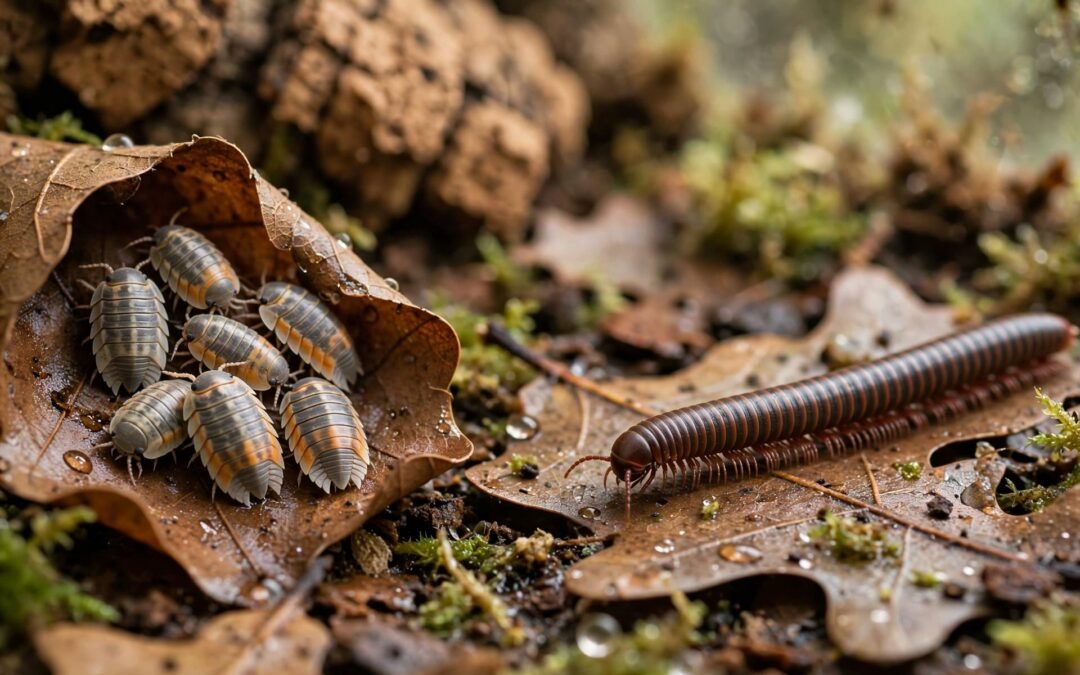
If you have ever lifted a log in the garden and found a grey pillbug curled into a ball, and then, a few inches away, a long many-legged millipede sliding through the leaf litter, you have met both animals in the wild. They look like cousins. They eat the same rotting leaves, hide in the same damp places, and both end up on “easiest pet” lists. And yet they are not the same animal at all — one is a land crustacean, closer to a shrimp than to an insect, and the other is a myriapod with hundreds of legs and a chemical defence system. That difference decides almost everything about keeping them.
So, isopods vs millipedes — which one should you actually bring home? The honest answer is that both are excellent beginner pets, but they reward different kinds of keepers. A millipede is one long-lived animal you can hold and watch grow for years. An isopod colony is a living, self-renewing ecosystem you mostly watch rather than handle. Pick the one that matches how you actually want to spend your time, not the one that looks cutest in a shop photo.
Isopods vs Millipedes at a Glance
| Isopods | Millipedes | |
|---|---|---|
| What they are | Land crustaceans (related to shrimp and crabs) | Myriapods (their own group, neither insect nor crustacean) |
| Size | Most pet species 5–20 mm; largest ~30 mm | Pet species 10–30 cm; Giant African up to 30 cm |
| Lifespan | 1–3 years per animal; the colony renews itself | 5–10 years per animal |
| How many you keep | A colony — start with 10–20 | One, or a small group of 2–4 |
| Handling | Gentle, brief; cannot bite or sting | Gentle, brief; wash hands after — some secrete defensive chemicals |
| Setup cost | Low — a ventilated tub, substrate, leaf litter | Low–moderate — deeper substrate, taller tub |
| Monthly cost | Very low — leaves, veggie scraps, occasional calcium | Low — leaves, fruit and veg, calcium |
| Daily time | Minutes — a glance and a mist when needed | Minutes — a glance, food top-up weekly |
| Best for | Watching a colony grow, breeding, bioactive tanks | One long-lived pet you can hold and name |
First, They Are Not the Same Animal
Beginners often lump isopods and millipedes together because both are small, slow, and found under logs. The confusion is understandable, but the biology matters for care. Isopods breathe through gills on their undersides — that is why moisture is life-or-death for them and why our guide to how isopods breathe keeps coming back to the moisture gradient. Millipedes breathe through tiny holes along their bodies called spiracles, so they tolerate drier air a little better, though the pet species still need damp substrate.
Millipedes are also not centipedes, and this is the mix-up that causes real trouble. Centipedes are fast, predatory, and venomous — they should never go in a pet enclosure or a bioactive terrarium. Millipedes are slow detritivores that eat dead leaves. If a shop ever sells you a “millipede” that runs fast and has one pair of legs per body segment, walk away: that is a centipede.
One more identification trap: a pillbug curled into a ball is not a millipede. Pillbugs are isopods (Armadillidium species) that roll up as a defence. A curled millipede looks more like a loose spiral. If you are buying, always buy by the scientific name, not by a common name on a tub label.
Isopods vs Millipedes: Lifespan and Commitment
This is the biggest real difference between the two, and the one most buyers get backwards. An individual isopod lives a short life — most pet species manage one to three years, with a few large Porcellio living a little longer. That sounds like a drawback until you remember you are not keeping one isopod. You are keeping a colony. Individuals die, mancae are born, and the colony goes on for years without you buying anything new. Our lifespan guide by species has the numbers for the common pet species.
A millipede is the opposite deal. You buy one animal, and that animal is with you for a long time. A Giant African millipede (Archispirostreptus gigas) commonly lives 7–10 years in captivity, and keepers report individuals passing ten. A Florida Ivory millipede (Chicobolus spinigerus) lives around 5–7 years. That is a genuine commitment — closer to a hamster than to a houseplant. If you want a pet you will still have in five years, and you want to know it as an individual, the millipede wins this round outright. If you want a project that renews itself and never leaves you with an empty tank, the isopod colony wins.
Here is the opinion nobody in the hobby likes to say out loud: the “short lifespan” of isopods is wildly overrated as a reason not to keep them. People mourn a single isopod that dies at eighteen months and ignore the forty mancae hiding under the bark. A colony is not a pet with a short life. It is a pet with a permanent population. Judge the lifespan question by the colony, not the individual.
Isopods vs Millipedes: Cost of Getting Started
Both are cheap pets, and both are dramatically cheaper than a reptile or a mammal — but the money goes to different places. An isopod starter colony of ten to twenty animals costs roughly $10–$40 for common species like Dairy Cows or Powder Oranges, and the setup is a ventilated tub, substrate, leaf litter, and a piece of cork bark. Many keepers start for under $50 all-in. Our full price guide breaks down real seller prices species by species, including the hidden costs beginners forget.
A millipede costs more per animal — a Florida Ivory typically sells for $15–$30, a Giant African for $40–$80 or more — but you only need one or two, so the animal bill is similar. The setup costs a little more because millipedes need deeper substrate to burrow in (10–15 cm at least) and a taller, sturdier tub with a genuinely escape-proof lid. Millipedes are excellent climbers and surprising escape artists, so a loose lid that works fine for isopods will not do here. Budget $60–$100 for a proper first millipede setup.
Running costs are a wash. Both eat leaf litter, rotting wood, fruit and vegetable scraps, and both need a calcium source. Neither needs heating in a normal heated home, and neither needs UVB lighting. If money is the deciding factor, isopods edge it — but only by a small margin, and only because a colony replaces itself for free.
Isopods vs Millipedes: Handling and Safety
Isopods cannot bite, sting, or hurt you in any way. The worst an isopod can do is curl into a ball and play dead, which is honestly part of the charm. Handling is safe for children and for the animal, as long as it is brief, gentle, and hands are damp rather than dry — our handling guide covers the technique. The real risk in handling isopods is to the isopods, not to you: a fall from a table or a squeeze from an excited child can kill a small animal.
Millipedes are also gentle and do not bite, but they carry a defence you have to respect. When startled, many millipedes secrete chemicals from glands along their bodies. Giant millipedes typically release benzoquinones, which stain skin brown and irritate eyes and mucous membranes. Some flat-backed North American species — the ones with bright warning colours — can release hydrogen cyanide. It is a tiny amount, and it is not dangerous to a healthy adult who washes their hands, but it is a real chemical, not a myth, and it is the one genuine safety difference between the two pets.
The practical rules are simple: handle millipedes over a table, never over a hard floor; keep handling sessions short; never handle one and then rub your eyes; wash your hands with soap afterwards, every time, without exception. Children can handle a millipede, but an adult should be present and the hand-washing rule should be non-negotiable. If that sounds like too much fuss for a family pet, that alone is a good reason to pick isopods.
Isopods vs Millipedes: Daily Care and Difficulty
Day to day, the workload is nearly identical: check the moisture, top up food once or twice a week, remove anything mouldy, and leave them alone. Both are nocturnal, both spend most of the day hidden, and both are happiest when you resist the urge to rearrange their home every weekend. If you want an honest difficulty rating, isopods are a 2 out of 10 and millipedes are a 3 out of 10 — the extra point is the deeper substrate, the escape-proof lid, and the hand-washing.
The care differs in the details. Isopods need a moisture gradient — one damp end and one dry end — and the species you choose decides how wet that damp end should be. A Dairy Cow colony wants it genuinely damp; a Yellow Ghost wants it nearly dry. Millipedes are more forgiving about the exact humidity number but less forgiving about substrate depth: they burrow to moult, and a shallow tub means a millipede moulting on the surface, which is when it is most vulnerable. If you keep millipedes, the substrate is not decoration. It is the whole system.
Feeding is where the two overlap most. Both are detritivores, both eat leaf litter and rotting hardwood, and both enjoy the same vegetable scraps — carrot, courgette, cucumber, sweet potato. Our isopod feeding guide applies almost word for word to millipedes, with two changes: millipedes eat more fruit (banana and mango are favourites), and they need their calcium as powdered cuttlebone or calcium carbonate mixed into the substrate, not just left on the surface.
Best Beginner Species on Each Side
For isopods, the beginner shortlist is well established on this site: Dairy Cows (Porcellio laevis ‘Dairy Cow’) for a fast-breeding, forgiving colony; Zebra isopods (Armadillidium maculatum) for a pretty, rolling species; Powder Oranges (Porcellionides pruinosus) for a small, prolific colony that thrives in warm rooms. Our best beginner species guide compares them properly. Avoid Cubaris species — including the famous Rubber Ducky — as a first isopod. They are slow, expensive, and unforgiving, and they are the single most common beginner regret in the hobby.
For millipedes, the beginner shortlist is shorter: the Florida Ivory millipede (Chicobolus spinigerus) is the classic first millipede — hardy, calm, a good size at 10–12 cm, and widely available. The Giant African millipede (Archispirostreptus gigas) is the showpiece, but it is bigger, pricier, and needs a bigger tub, so it is better as a second millipede than a first. The Bumblebee millipede (Anadenobolus monilicornis) is small, colourful, and popular, but it is a tropical species that wants steady warmth and humidity, so it suits a keeper who already has the basics down.
One honest warning about buying millipedes: always buy captive-bred from a seller in your own country. In the United States, importing giant millipedes from abroad needs a federal permit, and sellers who skip that step are not doing you a favour. The same rule applies to isopods, though enforcement is lighter — buy local, buy captive-bred, and never release a pet isopod or millipede into the wild.
Isopods vs Millipedes for Kids and Classrooms
Both animals appear on “best classroom pet” lists, and both deserve to be there — but for different reasons. Isopods are the better classroom animal. A colony gives thirty children something to observe every day: mancae appear, isopods moult, the population visibly grows. Nothing needs to be taken out of the tub for the lesson to work, which matters when the animal is 8 mm long and the class is thirty strong. The colony also survives a school holiday with a good watering before the break, which a single pet sometimes does not.
Millipedes are the better one-child pet. A single animal that walks across a hand, curls around a finger, and is still there next year builds a different kind of attachment. For a child who wants “my pet” rather than “our colony”, the millipede is the right call. The hand-washing rule is the price of that attachment, and most children over eight can manage it reliably. Under eight, isopods are the safer pick — no chemicals, no hand-washing lecture, nothing to drop from a great height.
Can You Keep Isopods and Millipedes Together?
Yes — and this is where the comparison gets interesting, because the honest answer is “it depends on the species”. In a large, well-established bioactive enclosure, isopods and millipedes occupy slightly different niches: isopods work the surface and the leaf litter, millipedes work deeper in the substrate. Many keepers run both together without problems, and our bioactive cleanup crew guide covers the general setup.
But there is a real risk that most comparison articles skip. Hungry Porcellio species — Dairy Cows especially — are opportunistic feeders. A moulting millipede is soft, slow, and stuck underground for weeks, and there are credible keeper reports of Porcellio nibbling moulting millipedes and eating millipede eggs. The safer combinations are Armadillidium, Cubaris, and Oniscus species, which are less protein-hungry, kept with millipedes in a large enclosure with plenty of leaf litter and protein available elsewhere. If breeding millipedes is your goal, do not mix them at all — give the millipedes their own tub and keep the isopods as a separate colony. Our springtails vs isopods guide explains why springtails, not millipedes, are the standard partner for an isopod colony.
Isopods vs Millipedes as a Bioactive Cleanup Crew
If the question is not “which pet” but “which cleanup crew for my reptile tank”, the answer is clearer: isopods win, and it is not close. Isopods are smaller, breed faster, process a wider range of waste, and come in far more varieties, so you can match the species to the tank’s humidity. Millipedes are larger, slower to reproduce, and can be disruptive in a small enclosure — a 25 cm millipede bulldozing through a planted tank is a real thing. Millipedes also secrete defensive chemicals, which is fine in their own tub and less fine in a tank shared with a frog that might try to eat one.
Millipedes do have one cleanup-crew advantage: they process large, tough leaf litter that small isopods ignore, and their burrowing aerates deep substrate better than any isopod. In a very large bioactive setup — a big planted vivarium with a deep substrate layer — a few millipedes alongside isopods and springtails can genuinely help. But for a standard reptile tank, isopods plus springtails remain the right crew.
The Verdict: Which One Should You Choose?
Choose an isopod colony if you want the cheapest start, a self-renewing pet that never leaves an empty tank, a colony you can watch grow and breed, a bioactive cleanup crew, or a classroom animal that thirty children can observe without handling. Choose isopods if you like the idea of collecting — because once you have one species, the morphs and colours are genuinely addictive, and that is half the hobby.
Choose a millipede if you want one pet you can hold, name, and still have in five or ten years; if you want an animal big enough to watch properly without a magnifying glass; or if you want the calmest possible handling experience — a millipede walking across your hand is one of the most relaxing things in the invertebrate hobby. Choose a millipede if the idea of a colony feels like too many animals and you would rather care for one.
And if you genuinely cannot decide, there is a third answer that most articles will not give you: get the isopods first. They are cheaper, they teach you the moisture gradient and the leaf-litter routine that millipedes also need, and six months later, when your colony is thriving, add a Florida Ivory millipede in its own tub. You will have learned the hobby on the forgiving animal and spent your real money on the long-lived one. That is the path most experienced keepers actually took, whether they admit it or not.
Frequently Asked Questions
Are isopods or millipedes easier to keep?
Isopods are slightly easier. Both need a ventilated tub, damp substrate, leaf litter, and weekly food, but millipedes need deeper substrate, a genuinely escape-proof lid, and hand-washing after handling. The difference is small — a 2 out of 10 versus a 3 out of 10.
Do millipedes bite or are they poisonous?
Millipedes do not bite. Some species secrete defensive chemicals when startled — giant millipedes release benzoquinones that stain skin, and some flat-backed species can release hydrogen cyanide. Wash your hands with soap after handling, and never rub your eyes before washing.
Can isopods and millipedes live together?
Yes, in a large bioactive enclosure, but it depends on the isopod species. Armadillidium, Cubaris, and Oniscus are low-risk partners. Hungry Porcellio species, especially Dairy Cows, may nibble moulting millipedes or eat millipede eggs. If you want to breed millipedes, keep them in their own tub.
Which lives longer, an isopod or a millipede?
A millipede, by a wide margin. Individual isopods live 1–3 years, while pet millipedes live 5–10 years. The isopod colony renews itself through breeding, so the colony as a whole can last indefinitely.
Are isopods or millipedes better for a bioactive terrarium?
Isopods are the better cleanup crew: smaller, faster-breeding, and available in far more species to match your tank’s humidity. Millipedes can help in very large setups by processing tough leaf litter and aerating deep substrate, but they are a supplement, not a replacement.
Can you keep a millipede as a first pet for a child?
Yes, for a child over eight who can follow the hand-washing rule. For younger children, an isopod colony is the safer first pet — no defensive chemicals, nothing to drop, and the colony survives a forgotten watering better than a single animal.
References
What Pet Should I Get — Isopods vs Millipede comparison (cost, lifespan and kid-friendliness figures). The Tye-Dyed Iguana — Isopods vs Millipedes cleanup crew showdown. Arachnoboards — Millipedes or roly pollies keeper discussion (lifespans, cyanide secretion, moulting behaviour). Insektenliebe — Isopods as Pets: Getting Started, Care, and Responsibility. Isopod Care Hub — How Long Do Isopods Live, Isopod Feeding Guide, How to Handle Isopods, How Much Do Isopods Cost.