
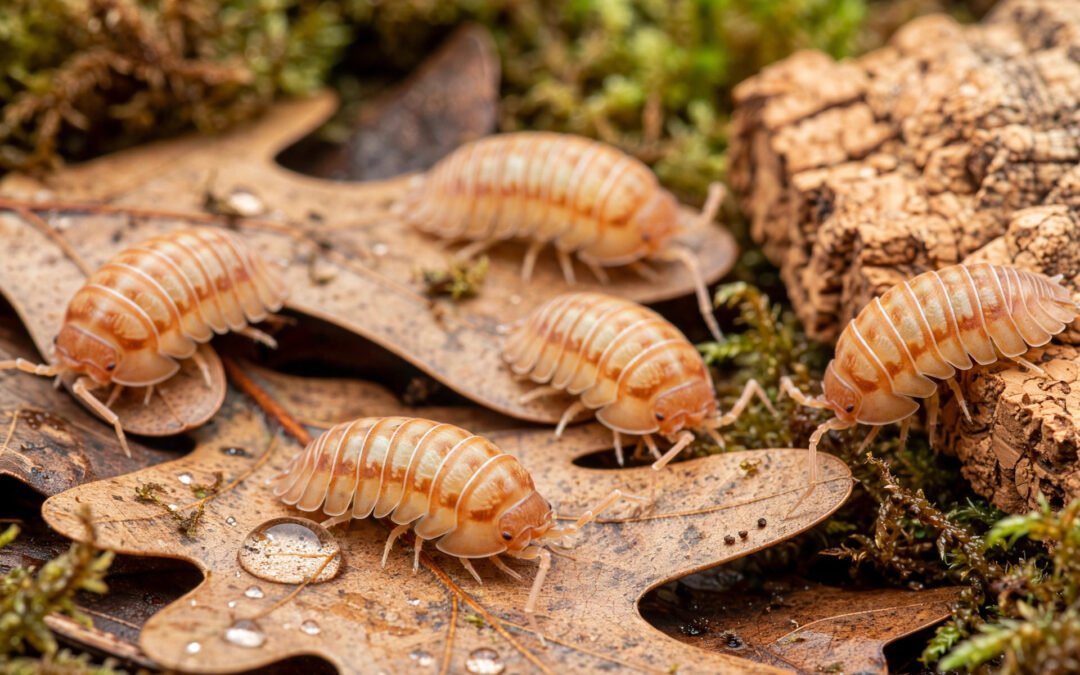
Armadillidium Nasatum Care: The Complete Beginner’s Guide
Armadillidium nasatum care is easy once you accept one counterintuitive fact: this is a warmth-loving isopod that wants airflow and a moisture gradient, not a wet box. Keep a starter group of 10–15 animals in a ventilated tub at 19–25°C, with one-third of the substrate damp and the rest progressively drier, feed leaf litter and rotting wood with a little vegetable and protein, and always keep cuttlebone available. Do that, leave the colony alone, and you get one of the most forgiving pill woodlice in the hobby — hardy, fast-breeding animals that roll into a ball, come in a soft peach morph, and work as well in a bioactive vivarium as they do in a shoebox tub. Treat them like a tropical Cubaris and the colony will mould, stall, and die. This guide covers identification, the full setup, the temperature disagreement between sources, the morphs worth your money, and the mistakes that actually kill colonies.
Armadillidium Nasatum Care at a Glance
| Care point | What nasatum needs |
|---|---|
| Scientific name | Armadillidium nasatum Budde-Lund, 1885 — family Armadillidiidae |
| Common name | Nosy pill woodlouse, nosy roly-poly |
| Origin | Southwest Europe, probably northern Italy; spread worldwide by human transport |
| Adult size | 1.2–2.1 cm; most adults sit around 1.5 cm |
| Lifespan | 1–3 years in good captive conditions |
| Difficulty | Beginner — one of the easiest Armadillidium species to keep |
| Temperature | 19–25°C (66–77°F); tolerates 18–29°C briefly, but sustained heat above 27°C is dangerous |
| Humidity | 50–70% overall, with a moisture gradient — one-third damp, the rest progressively drier |
| Enclosure | 30 × 20 × 15 cm or larger for a starter group; add floor space as numbers rise |
| Substrate | 5–8 cm of pesticide-free topsoil, crushed hardwood leaves and soft rotten wood |
| Diet | Leaf litter and rotting wood always available; vegetables 2–3 times a week; protein once a week; calcium always available |
| Breeding | Prolific — 1–3 broods per breeding season; young reach breeding age at about 8 months |
| Behaviour | Active, gregarious, rolls into a ball that never quite closes; more visible on humid evenings |
What Is Armadillidium Nasatum?
Armadillidium nasatum is a medium-sized pill woodlouse from southwest Europe, probably centred on northern Italy. It is one of the most successful isopods on the planet: stones, plants and soil moved by people have carried it across Europe, to North America, and as far as Uruguay. In Britain it has lived wild in southern England and south Wales for well over a century, turning up in old quarries, along railway lines, on coastal grassland and in garden centres. That history tells you most of what you need to know about its care. This is not a fragile rainforest specialist. It is a tough, adaptable animal from warm, disturbed, open ground — and it is far more forgiving of a beginner’s mistakes than the expensive Cubaris species that get all the attention.
The wild type is grey-brown with longitudinal mottling and a pale stripe running down the full length of the body. Adults reach 1.2–2.1 cm, though most of the animals you will see for sale sit around 1.5 cm. Two features identify it. First, the “nose”: a squarish, rectangular plate that stands up at the front of the head between the antennae, which is where the common name “nosy pill woodlouse” comes from. It is not the easiest thing to spot from above, so photograph the head from the front before you buy if you want to be sure of what you are getting. Second, the ball it rolls into never quite closes. Armadillidium vulgare seals itself into a near-perfect sphere; nasatum leaves a small gap. That imperfect ball is a reliable field mark once you know to look for it, and it is the quickest way to separate a nasatum from a vulgare in a mixed tub.
One spelling warning before you shop: you will see A. nasutum on listings and care sheets. That spelling is wrong. The accepted name is Armadillidium nasatum, described by Budde-Lund in 1885. A seller who cannot spell the animal’s name is not automatically selling the wrong animal, but it is a small red flag for a shop that copies care sheets instead of keeping the species — and with this species, the care sheet is where the real trouble starts, as I explain below.
Is Armadillidium Nasatum a Good Beginner Isopod?
Yes — and in my opinion it is underrated as a first Armadillidium. Beginners are usually steered toward Armadillidium vulgare or the Zebra isopod, and both are fine choices. But nasatum has three advantages over them. It breeds faster than Zebra isopods, it costs less than almost any named morph in the genus, and it tolerates a wider range of conditions than the fussy species that beginners are warned away from. If you are choosing your first pill woodlouse, our guide to the best isopod species for beginners puts nasatum in the same easy tier as Dairy Cow and Powder Blue isopods, and that is the right place for it.
There are two people who should skip it. If you want a display animal that sits out in the open all day, nasatum will disappoint you — like most isopods it is shy, mostly active at night, and happiest under cork bark. And if you want a big, impressive showpiece species, this is the wrong animal at 1.5 cm; the Porcellio expansus care guide covers an animal twice its size. For everyone else — a first colony, a bioactive cleanup crew, a breeding project, a child’s first pet isopod — nasatum is one of the safest buys in the hobby.
Armadillidium Nasatum Care: Enclosure Setup
Start a group of 10–15 animals in a smooth-sided, tightly lidded tub of at least 30 × 20 × 15 cm — a shoebox-sized container is a solid place to start. Add floor space as numbers rise, or split the colony across two tubs. Nasatum likes to hang out together, so there is no need to give a starter group tonnes of space, but floor area matters more than height: these animals live on and in the substrate, not on the walls.
Ventilation is the single most important structural choice, and it is where most beginners go wrong with this species. Drill fine cross-ventilation holes on the sides and lid, or use a mesh-vented lid, and make sure air actually moves. Then cover the vents with fine mesh, because the mancae — the tiny white newborns — can walk straight out through coarse mesh. A sealed tub with a wet substrate is the fastest route to a dead nasatum colony: the animals need airflow as much as they need moisture, and a stagnant, humid box grows mould, mites and bacteria while the isopods climb the walls trying to escape it. If condensation is sitting on the walls for days, you have too little airflow, not too little water.
Decorate simply. A generous layer of safe deciduous leaf litter across the whole surface, a piece or two of cork bark for hiding, and a patch of sphagnum moss on the moist end only. That is the whole furnishing list. Nasatum does not need plants, water dishes, or elaborate hides — it needs leaf litter to eat, bark to hide under, and a damp corner to retreat to. Keep the enclosure out of direct sunlight: a sunny windowsill turns a small tub into a greenhouse and will cook the colony in an afternoon. Our full isopod enclosure setup guide walks through tub choice and ventilation in more detail if you want it.
Substrate and the Moisture Gradient
Lay down 5–8 cm of pesticide-free topsoil mixed with crushed hardwood leaves and soft rotten wood, then cover the surface generously with dry deciduous leaf litter. That substrate is not just bedding — it is the colony’s food, its humidity buffer and its nursery, all at once. If you want a tested recipe with exact ratios, our best substrate mix for isopods guide gives one that works for nasatum unchanged.
The moisture gradient is the whole secret of Armadillidium nasatum care, and it is the thing most generic care sheets get wrong. Keep about one-third of the substrate damp at depth and let the surface become progressively drier toward the main vents. The colony must be able to move between moisture levels at all times: adults spend much of their time on the dry end, while newborn mancae — which dry out far faster than adults — live in the damp leaf litter around the moist refuge. Pour water into the damp corner instead of spraying the whole enclosure. Pouring puts water where it belongs, at depth, without soaking the dry end or the leaf litter the animals eat.
Here is the opinion that matters most in this guide: daily whole-tub misting is overrated, and for this species it is actively harmful. Seller pages that tell you to “mist regularly and keep humidity high” are copying generic isopod advice onto an animal that wants the opposite — warmth and airflow with a dependable moist retreat, not a uniformly wet enclosure. The two main ways nasatum colonies fail are drying out the newborns and sealing a wet box. Misting every surface every day causes the second failure while doing nothing for the first, because mist wets the surface and evaporates, while the damp corner at depth is what the mancae actually need. Pour into the corner once or twice a week, check that the deep substrate there stays dark and squeezable, and leave the spray bottle in the cupboard. Our isopod humidity control guide explains the squeeze test and the gradient setup in detail.
Avoid fertilised compost, cedar and other aromatic woods, resinous conifer litter, and any collected material exposed to pesticides or road pollution. These are not minor preferences — cedar oils and pesticide residues kill isopods outright. Oak, beech and other deciduous leaves, collected away from roads and baked or frozen to kill hitchhikers, are the safe staple.
Armadillidium Nasatum Care: Temperature and Humidity
The honest answer on temperature is that the sources disagree, and you should know that before you trust any single number. Terrarium Tribe quotes 18–29°C. The Herpeton Academy caresheet recommends 19–25°C for routine care, with a cool end of 17–21°C and nights of 16–21°C. Geckonia lists 20–25°C. PostPods’ genus guide gives 18–24°C for Armadillidium generally. The overlap — 19–25°C — is the safe target, and it is ordinary room temperature in most homes for most of the year, which is why this species needs no special heating in a normal heated room.
Two points on which the sources agree are worth more than the exact range. First, nasatum is a warmth-loving species that stays active near the upper part of its range — it does noticeably better warm than cold, and a colony kept at 16°C all winter will breed slowly or not at all. Second, sustained temperatures above roughly 27°C sharply increase the drying risk, and a hot tub dries from the surface down, killing the mancae first. If you need supplemental heat, apply it to one side of the tub above substrate level, regulate it with a thermostat, and never put a heat mat beneath the moist corner — heating the damp end cooks the refuge the colony depends on. Keep the tub out of direct sun and away from radiators.
For humidity, aim for 50–70% overall with the gradient described above: damp at depth on one-third of the tub, dry surface everywhere else, and a humid retreat of sphagnum moss on the moist end. Do not chase a hygrometer number. The squeeze test — a handful of substrate from the damp corner should hold together and release a drop or two when squeezed, while substrate from the dry end should crumble — tells you more than any dial. No water dish is needed. Persistent lid condensation, mould spreading across the dry end, or animals climbing the walls in a crowd are all signals to check ventilation, heat and water volume in that order.
Feeding Armadillidium Nasatum
Feeding is the easiest part of Armadillidium nasatum care. Nasatum is not a picky eater, and that is part of what makes it such a good bioactive custodian. Leaf litter and decaying hardwood are the core diet and should always be available — they are the food the colony lives on between your feedings, not a garnish. On top of that, offer a little carrot, squash or sweet potato two or three times a week, and a small protein portion once a week. Fish flakes are the easiest protein and the most underrated food in the hobby: a pinch of cheap fish flakes once a week does more for breeding than any boutique isopod blend, and nasatum takes it readily. Our protein sources for isopods guide ranks the options if you want to vary it.
Calcium is non-negotiable. Like all Armadillidium, nasatum needs a constant calcium source for its exoskeleton and for clean moults — cuttlebone, limestone or clean crushed eggshell, available at all times, not offered once in a while. Our calcium for isopods guide covers sources and schedules. Remove moist leftovers after 24 hours: rotting vegetables grow mould and attract fungus gnats, and a tub full of mouldy food is a tub full of problems. Our full isopod feeding guide has the safe-vegetable list and the preparation steps.
One warning about colour: Dalmatian and Peach animals need no special diet to keep their colours, and carotenoid-rich food is not a substitute for genetics. Sellers who push “colour-enhancing” food for these morphs are selling you a story. The spots and the peach colour are inherited, not fed — buy from a breeder who labels the line honestly instead of paying for food that cannot do what the label promises.
Breeding Armadillidium Nasatum
Breeding is where Armadillidium nasatum care rewards patience. Nasatum is a reasonably prolific breeder, and a healthy colony will populate a new setup without much interference from you. Females carry their eggs and embryos inside a fluid-filled pouch on the underside of the body, the marsupium, and release them as miniature mancae — there are no exposed eggs for you to incubate, and brooding females should be left completely undisturbed. Females produce one to three broods per breeding season, and the young reach breeding age at about eight months. That is slower than the weedy Porcellio species, which is why a nasatum colony takes a little patience to establish, but once it is going it is steady rather than explosive.
Warmth and steady access to the moist end support breeding. If you want to maximise the breeding rate and the survival of the young, raise the temperature slightly and deepen the damp refuge — but never flood the tub to do it. Keep fine leaf particles around the damp shelter for the newborns, because mancae feed on soft, fine detritus before they can tackle whole leaves. And when you split the colony, transfer all age groups together: a split that takes only adults leaves the mancae behind, and a split that takes only mancae leaves the colony without breeders.
The most common breeding complaint is also the most misunderstood: “the babies appeared, then disappeared.” In almost every case the mancae dried out, because the damp refuge was too small, too shallow, or too far from where the adults spend their time. Expand the damp, leaf-covered refuge, check where your vents sit relative to it, and the next brood will survive. If the colony still is not breeding after a few months, work through our isopod colony not breeding checklist — temperature, moisture, protein and overcrowding, in that order — and our isopod breeding basics for beginners guide for the full timeline.
Morphs and Colours: Peach, Pearl, Whiteout and Dalmatian
A study of the species found six “pure breeding” colour morphs, but the hobby really trades in four. They are all the same species, so the care is identical — the differences are colour, price and availability.
| Morph | Look | Availability | Honest verdict |
|---|---|---|---|
| Wild type | Grey-brown with longitudinal mottling and a pale stripe | Common and cheap | The real animal at the lowest price — the best first colony |
| Peach | Soft peach-orange, the orange expression of the species | Widely available | Beautiful and affordable, but the premium buys colour, not easier care |
| Pearl / Dalmatian | Clear white shell with subtle black flecks | Regularly available | Striking, but check the label — see the Dalmatian trap below |
| Whiteout | Albino — completely white bodies with white eyes | Less common, pricier | Collector’s morph; buy it as a second colony, not your first |
The Dalmatian name needs a warning of its own, because it is used for two different animals. “Dalmatian” is a spotted captive morph of Armadillidium nasatum — it is not a species or a subspecies, and the spots are inherited, not fed. But the same name is also used for Porcellio laevis ‘Dalmatian’, a spotted form of a much larger, faster-breeding species covered in our smooth and Dalmatian isopod guide. A listing that just says “Dalmatian isopods” tells you nothing about which animal you are buying. Check the Latin name on the listing, check the head shape, and check the price — nasatum Dalmatian and laevis Dalmatian are different animals with different care, different sizes and different breeding speeds. If a seller cannot tell you which one they are selling, do not buy from them.
My opinion, stated plainly: buy the wild type first. The Peach morph is lovely and it is one of the most affordable coloured isopods in the hobby, so there is no shame in buying it — but the premium buys you a colour, and nothing about the care gets easier. If the colony crashes, and first colonies sometimes do, you have lost the most expensive animals in the tub. Start with wild type, learn the gradient, and buy Peach or Whiteout once you have a colony that has bred.
Armadillidium Nasatum vs Armadillidium Vulgare
Most keepers choosing a first pill woodlouse end up comparing nasatum with its famous cousin, the common pill woodlouse Armadillidium vulgare — the species behind the Magic Potion isopod guide and the Zebra isopod care guide (Zebra is A. maculatum, a close relative). Here is how they compare.
| Trait | A. nasatum | A. vulgare |
|---|---|---|
| Size | 1.2–2.1 cm | Up to 1.8 cm, usually a little stockier |
| Identification | Rectangular “nose” plate; ball never quite closes | No nose plate; ball seals into a near-perfect sphere |
| Temperature | 19–25°C; warmth-loving | Cooler-tolerant; happy at 15–25°C |
| Moisture | One-third damp, strong airflow, drier overall | Tolerates damper setups; more forgiving of wet tubs |
| Breeding | Prolific; 1–3 broods a season, breeding at ~8 months | Prolific; similar brood numbers, slightly slower to mature |
| Morphs | Peach, Pearl/Dalmatian, Whiteout | Magic Potion, plus many local forms |
| Best for | Warm rooms, bioactive vivariums, colour morphs on a budget | Cooler rooms, first-time keepers who mist too much |
The practical difference is small but real: vulgare forgives a wet tub better, nasatum forgives a warm room better. If your room runs warm and you tend to underwater rather than overwater, nasatum is the better first Armadillidium. If your room runs cool and you love the spray bottle, vulgare will punish you less.
Armadillidium Nasatum as a Bioactive Cleanup Crew
Nasatum is a strong bioactive cleanup crew, and the evidence for it is better than the usual shop claim. A study on isopod crowding found that the growth rate of Armadillidium nasatum was positively affected by the presence of large animals — a very handy trait when you are trying to populate a vivarium, because it means the colony keeps growing alongside the reptile or amphibian it is cleaning up after instead of stalling under the disturbance. They handle a wide range of terrarium environments, from humid tropical to semi-arid setups, and they coexist with frogs and reptiles without drama.
There are two limits. First, at around 1.5 cm they can become a snack for larger vivarium animals — but their easy care and fairly prolific breeding help them keep up and maintain a stable population, so a colony that is established before the vertebrate goes in will usually hold its numbers. Second, do not house different isopod species together in the same bioactive setup: one species will outcompete the other, and you will end up with a single-species tub that you did not plan. Pick nasatum or another species, not both. Our bioactive terrarium cleanup crew setup guide covers the full build if you are setting one up from scratch.
Common Problems and How to Fix Them
Good Armadillidium nasatum care means catching problems early, while they are still fixable. Most of the symptoms below share two root causes — a gradient that has gone wrong, or food left too long — so check those first before assuming disease.
| Symptom | Most likely cause | Fix |
|---|---|---|
| Mancae appear, then disappear | Damp refuge too small or too dry | Expand the damp, leaf-covered refuge; check vent placement relative to it |
| Animals stay rolled up or crowd one corner | Temperature or moisture extreme at one end of the gradient | Measure heat at both ends; check the damp corner is actually damp at depth |
| Poor moults, stuck sheds, deaths after moulting | Low moisture or no calcium | Restore moisture in the damp corner and calcium access — without flooding the tub |
| Mould spreading across the dry end | Too much water, too little airflow | Stop misting, increase ventilation, remove mouldy food, let the dry end dry |
| Animals climbing the walls in a crowd | Stagnant air, excess heat or excess water | Check ventilation, heat and water volume in that order |
| Flies, mites or mould on food | Rich food left too long | Remove leftovers after 24 hours; reduce protein and fresh food until it clears |
| Tiny white animals escaping the tub | Coarse mesh on vents | Cover every vent with fine mesh — mancae walk through coarse mesh |
| Colony stalls, no breeding for months | Too cool, too dry, or no protein | Warm the room end to 19–25°C, deepen the damp corner, add weekly protein |
Two of these deserve emphasis because beginners misread them. A colony that stays rolled up is not “sleeping” — rolled-up animals that never unroll are telling you the gradient is wrong at one end or the other, so measure instead of waiting. And a failed moult is almost never a disease: it is a moisture or calcium problem, and both are fixable in a day. Our isopod molting vs dying guide explains how to tell a moulting animal from a dying one, which saves a lot of unnecessary panic.
Buying Armadillidium Nasatum: What to Pay and What to Check
The last part of Armadillidium nasatum care is buying well. Wild type nasatum is one of the cheapest isopods in the hobby, and Peach is one of the most affordable coloured morphs — that is part of the appeal. A starter group of 10–15 animals is the right size: fewer than ten and the colony takes a long time to establish; more than fifteen and you are paying for animals you do not need. Expect Peach to cost more than wild type, Pearl/Dalmatian more again, and Whiteout the most — and treat any listing that prices wild type like a rare morph as a seller to avoid.
Before you buy, check four things. First, the Latin name on the listing — Armadillidium nasatum, spelled correctly, not “nasutum” and not just “Dalmatian”. Second, the head shape in the seller’s photo: the rectangular nose plate should be visible from the front. Third, whether the animals are captive-bred — wild-collected stock can carry mites and parasites, and it should be quarantined for 60 days with separate tools and no shared leaf-litter containers, as our quarantining new isopods guide explains. Fourth, the seller’s care advice: if their care sheet tells you to mist daily and keep humidity high, they are copying generic advice onto a species that wants a gradient and airflow, and you should trust their animals less than their words.
Do not release surplus animals or used substrate outdoors. Nasatum’s history is a history of human-assisted spread — it has already colonised three continents by hitching rides on stones, plants and soil — and releasing it where it does not belong is how local isopod populations get displaced. Rehome surplus animals through the hobby instead.
Frequently Asked Questions
These are the questions new keepers ask most about Armadillidium nasatum care, answered in brief.
How big do Armadillidium nasatum get?
Adults reach 1.2–2.1 cm, with most animals sitting around 1.5 cm. They are a medium-sized isopod — smaller and slimmer than a Porcellio laevis, a little longer than a Zebra isopod, and noticeably smaller than the giant Porcellio species.
Do Armadillidium nasatum need high humidity?
No. They need 50–70% humidity with a moisture gradient: about one-third of the substrate damp at depth and the rest progressively drier, with good ventilation. A uniformly wet, sealed tub is the fastest way to kill this species. Pour water into the damp corner instead of misting the whole enclosure.
How long do Armadillidium nasatum live?
About 1–3 years in good captive conditions. Lifespan depends on temperature and moisture: animals kept warm and dry age faster, while animals kept at the cool end of the range with a proper gradient tend to live longer.
Are Armadillidium nasatum good for beginners?
Yes — they are one of the easiest Armadillidium species to keep. They tolerate a wide temperature range, breed readily, eat almost anything, and cost very little. The only skill they truly demand is the moisture gradient: one damp corner, the rest dry, and airflow. Learn that and the species takes care of the rest.
What is the difference between Armadillidium nasatum and Armadillidium vulgare?
Nasatum has a rectangular “nose” plate on its head and rolls into a ball that never quite closes; vulgare has no nose plate and seals into a near-perfect sphere. Nasatum is also more warmth-loving and prefers a drier, better-ventilated setup, while vulgare tolerates cooler and damper conditions.
How fast do Armadillidium nasatum breed?
They are prolific breeders. Females produce one to three broods per breeding season, and the young reach breeding age at about eight months. A starter group of 10–15 will usually show mancae within a few months if the temperature is 19–25°C and the damp refuge is deep enough for the newborns to survive.
References
Herpeton Academy — Nosy Pill Woodlouse (Armadillidium nasatum) caresheet, academy.herpeton.net. Terrarium Tribe — Armadillidium nasatum: A Real “Peach” of an Isopod, terrariumtribe.com. PostPods — Armadillidium Isopods Care Guide, postpods.co.uk. Geckonia — Armadillidium nasatum care and terrarium guide, geckonia.eu. British Myriapod and Isopod Group — identification and distribution notes, bmig.org.uk. GBIF — Armadillidium nasatum species page, gbif.org.