
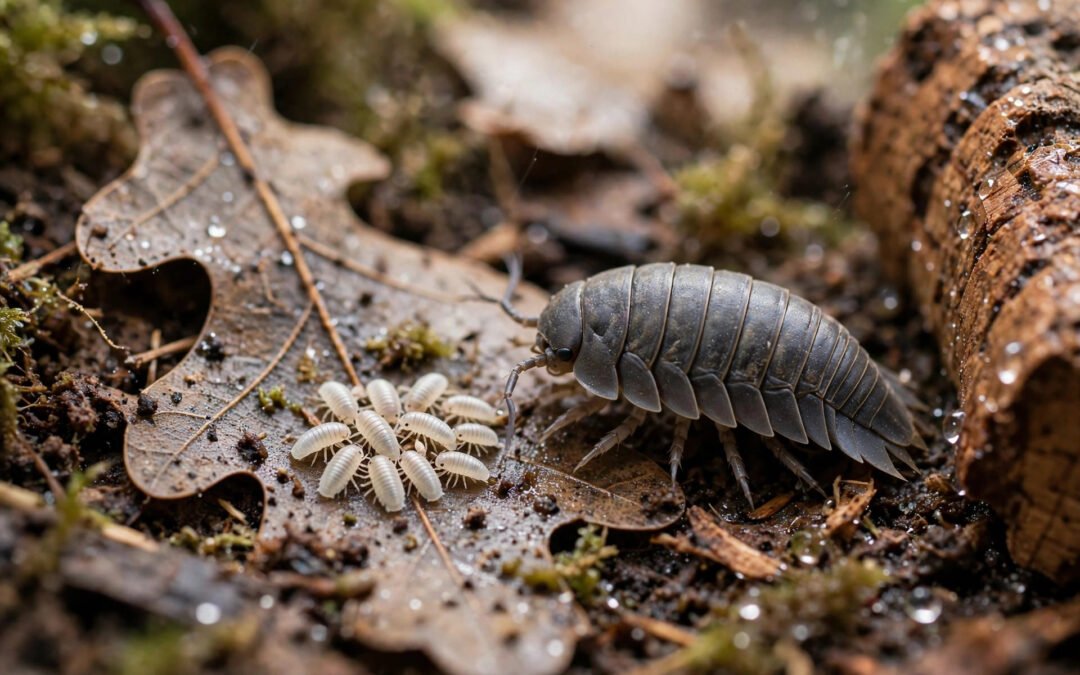
Isopod Life Cycle: From Mancae to Adult
An isopod never lays an egg in the soil, never has a larva, and never looks like anything but a tiny isopod — even on the day it is born. The whole isopod life cycle runs egg, manca, juvenile, adult, and it all happens inside one plastic tub if you keep the damp corner damp. A female carries her eggs in a fluid-filled pouch under her body, the young hatch inside it, and what walks out is a pale miniature with six legs instead of seven. From there it is moult after moult until the animal colours up, grows its last pair of legs, and starts the cycle again. How long that takes is where the arguments start: one website says twelve weeks, another says a year, and both are measuring something real. This guide walks the full cycle stage by stage, with an honest timeline, what to do at each stage, and how to tell a baby isopod from the springtails living next to it.
The Isopod Life Cycle at a Glance
Every pet isopod follows the same five stages. The timings below are typical for a warm room (20–24°C) with food and moisture available; cold, dry, or hungry colonies run slower.
| Stage | What happens | Typical duration |
|---|---|---|
| 1. Courtship and mating | Male finds a receptive female; mating happens, often more than once | Days |
| 2. Eggs in the marsupium | Female broods fertilised eggs in a fluid-filled pouch under her body | 3–7 weeks (often 40–50 days) |
| 3. Mancae | Six-legged, pale babies emerge and hide in the damp corner | First few weeks of life |
| 4. Juveniles | Moulting in two halves, growing the seventh leg pair, colouring up | 2–10 months, depending on species |
| 5. Breeding adults | Sexually mature animals that breed across several seasons | 1–5 years of adult life |
The important thing to notice is what is missing: there is no caterpillar stage, no cocoon, no egg buried in the substrate. Isopods are crustaceans — closer to crabs and shrimp than to insects — and like other peracarid crustaceans they practise direct development. The baby that leaves its mother is already an isopod, just small, soft, and short of one pair of legs.
Stage 1: Courtship and Mating in the Isopod Life Cycle
The isopod life cycle starts the way most animal stories start: a male and a female. In the wild, breeding picks up in spring; in a heated room with steady food and moisture, it barely stops all year. Conditions matter far more than the calendar, which is why a colony kept warm and fed can produce brood after brood while the same species outdoors manages one or two a season.
Males find receptive females by short-range chemical cues. In the common pill woodlouse, Armadillidium vulgare, researchers found males were most drawn to females just showing the white calcium plates of an approaching moult — the female is about to shed, and that is when mating happens. Two details from the research are worth knowing, because both change how you read your own colony:
- Both sexes mate with multiple partners. There is no pair bond and no monogamy, whatever some care sheets claim. One popular page states that isopods “mate only once in their lifetime” — that is simply wrong, and it is a good reminder to check a source that contradicts itself in three paragraphs.
- Females store sperm. A female can hold sperm from several males and use it to fertilise eggs later — in the pill woodlouse, for up to a year, carrying it into the next breeding cycle. That means the male you see courting a female today may not be the father of her next brood. If you are breeding for a particular colour or morph, that is a real problem: a stored-sperm brood can throw the “wrong” colours months after you separated the parents.
Stage 2: Eggs in the Marsupium — the Isopod Life Cycle’s Portable Nursery
After mating, the female produces eggs — but she does not lay them anywhere. They pass into the marsupium, a fluid-filled pouch on the underside of her thorax, formed by overlapping plates called oostegites. There the eggs stay moist, oxygenated, and protected: effectively a portable nursery that frees terrestrial isopods from ever needing to return to water to breed. It is the single most important structure in the whole isopod life cycle, and the reason a land crustacean can raise young in a dry room.
A fertilised egg is tiny — about 0.7 mm across in Porcellio scaber, the common rough woodlouse — and in that species the developing embryos show as yellowish through the pouch wall on the female’s underside. That is how you spot a gravid female without touching her: flip a piece of bark gently, look underneath, and look for a pale, full-looking pouch between her legs. In many species the eggs are visible as a cream or yellow bulge. She will often tuck herself away in a burrow or under cover during this time, and she will eat less and move less. Leave her alone. A gravid female that is picked up, flipped over, and photographed for a closer look is a female under stress, and stress is one of the quieter ways a brood gets dropped.
Brooding takes a few weeks to a couple of months depending on species and temperature — 40 to 50 days is the figure most keepers quote, and warmer conditions speed it up. When the eggs hatch, the young can linger in the pouch for a few more days before emerging. In scientific terms, the first stage inside the pouch is the marsupial manca: a newly hatched young still living in the brood pouch, with the second manca stage being the one that usually walks out into the world.
Stage 3: Mancae — Six-Legged Babies in the Isopod Life Cycle
What emerges from the marsupium is called a manca (plural: mancae). It looks like a miniature adult with one telltale difference: a manca has only six pairs of legs. Its first moult adds its seventh leg-bearing segment, and the seventh and final pair of legs grows in over its first three moults. A single brood can number anything from a dozen to around a hundred young in the larger species — bigger females carry more. Claims of 200 to 300 young per brood circulate online, but they are not well documented for the common pet species, so treat them as unproven.
A fresh manca is about the size of a grain of salt, pale, soft, and almost translucent. It dries out fast, so it stays hidden in the burrow or among leaf litter, in the dampest part of the enclosure. This is the stage most beginners never see, because they look in the wrong place at the wrong time. Lift a piece of cork bark in the damp corner in the evening and you will often find them: tiny white commas clustered where the substrate is darkest and wettest. Our colony not breeding troubleshooting guide covers the night-lift test in detail — it is the fastest way to find out whether your colony is breeding at all.
Is that a manca, a springtail, or a mite?
New keepers constantly mistake the small things in their tubs for each other. Three quick checks sort them out:
- Mancae walk. They have visibly segmented, armoured bodies and two pairs of antennae. They move at a steady crawl and never jump.
- Springtails jump. They are thinner, softer, and unarmoured, and when disturbed they flick themselves into the air with a tail-like spring. They are harmless cleanup crew, not baby isopods.
- Soil mites are round, fast-moving dots with eight legs and no visible segments. A manca, even a tiny one, is clearly segmented when you look with a hand lens.
If it has plates and it walks, it is a manca. If it jumps, it is a springtail. Learning that difference in week one saves a lot of false alarms.
What mancae need from you
Very little — but the little they need is non-negotiable. Mancae die of drying out long before they die of hunger, so the damp corner is everything. Pour water into the substrate on the moist side rather than misting the whole tub: daily whole-tub misting is one of the most overrated habits in the hobby, and it soaks the dry side that adults need, while pouring keeps a true moisture gradient. Fine food helps too — crumbled leaf litter, a pinch of powdered fish flakes, soft vegetable — and calcium sources like cuttlebone should always be available, because every moult builds a new shell.
Should you separate mancae into their own tub? For most species, no — and this is an opinion worth stating plainly, because the advice to separate them is everywhere. Adults rarely eat mancae when food is plentiful, and a separate tub is usually drier, colder, and more neglected than the main colony. The real killer of mancae is a dry corner, not hungry adults. Separate them only if the colony is badly overcrowded or if they share a tub with a genuinely predatory tankmate.
Stage 4: Juveniles — Moulting Their Way Up
Once a manca has its seventh leg pair it counts as a juvenile, and from here the isopod life cycle is a long series of moults. Isopods moult in two halves — the back half of the exoskeleton first, then the front half usually one to three days later — so a half-pale animal is mid-moult, not sick. This is the single most misunderstood sight in isopod keeping, and our moulting vs dying guide exists because keepers keep throwing away healthy animals that are simply halfway through a shed.
With each moult the exoskeleton hardens a little more, the animal grows, and its adult colours come in. A juvenile Zebra isopod starts grey and earns its stripes over weeks; a juvenile Panda King starts pale and its black bands sharpen with age. Juveniles also eat the shed half of their old exoskeleton — that is not a disgusting habit, it is recycling, and it is how they reclaim the calcium for the next shell. Never remove a shed skin from the tub thinking you are tidying up.
Growing juveniles are the hungriest animals in the colony. This is the stage where protein matters most: fish flakes, dried shrimp, and other protein foods support fast growth, while leaf litter and vegetables are the everyday base. A juvenile that moults cleanly, colours up, and keeps growing is a juvenile that has enough protein and calcium. One that stalls, stays pale, or gets stuck halfway out of a shed is usually short of one of the two — or the air is too dry. Moisture and moulting are the same problem: isopods breathe through gills that must stay wet, as our guide to how isopods breathe explains, and a dry moult is a stuck moult.
Stage 5: Adults and Breeding Again in the Isopod Life Cycle
Adulthood in isopods is not marked by a final moult — they keep moulting all their lives — but by sexual maturity and full size and colour. Once mature, they begin the cycle over again, and adults go on reproducing across several seasons. A healthy colony is therefore not a set of animals all the same age; it is overlapping generations, with mancae, juveniles, and breeding adults all present at once.
Telling males from females gets easier as animals mature. In most species the males are slightly smaller and flatter, and the sex is confirmed by the modified pleopods (the small appendages under the rear of the body) that appear after several moults. Our guide to sexing isopods walks through the technique with a clear tub and a hand lens — it is a skill worth learning before you try to breed a slow species, because a tub of six “females” that are actually all males will never produce a manca.
Adults also do better in company than alone. Research on the rough woodlouse found that grouping cuts each animal’s water loss by more than half in a large group, which fits their naturally gregarious, group-living nature. A single isopod in a tub is not just lonely — it is measurably drier. That is one more reason colonies beat solo pets for this animal.
Isopod Life Cycle Timeline: How Long Does Each Stage Take?
This is the table the top-ranking guides do not have, and it is the reason so many keepers feel misled. “How long until adults?” has no single answer, because a Powder Blue and a Rubber Ducky live on different clocks. The figures below combine published research with keeper experience; treat the months as typical for a warm, well-fed colony, and expect slower results in a cold room.
| Species | Egg to manca | Manca to breeding adult | Brood size | Adult lifespan |
|---|---|---|---|---|
| Powder Blue / Powder Orange (Porcellionides pruinosus) | 3–5 weeks | 2–3 months | 20–60 | 1–2 years |
| Dwarf White (Trichorhina tomentosa) | 3–4 weeks | About 2 months | 10–30 | 1–2 years |
| Dairy Cow (Porcellio laevis) | 4–6 weeks | 3–4 months | 40–100 | 2–3 years |
| Zebra (Armadillidium maculatum) | 4–6 weeks | 4–6 months | 20–50 | 2–3 years |
| Common pill woodlouse (Armadillidium vulgare) | 5–7 weeks | About 12 months in captivity (25 months wild) | 20–80 | Up to 5 years |
| Rough woodlouse (Porcellio scaber) | 4–6 weeks | About 12–15 months | 20–80 | Up to 30 months |
| Cubaris species (Rubber Ducky, Panda King, Pak Chong) | 6–8 weeks | 12–18 months | 10–30 | 3–5 years |
Two things stand out. First, the fast species are fast: a Powder Blue colony can go from first mancae to a second generation inside a single season, which is why they are the default cleanup crew and the default first colony. Second, the slow species are genuinely slow. Buying six juvenile Rubber Duckies and waiting for babies is a year-long exercise in patience — and that is why buying adults to skip the wait is one of the most underrated moves in the hobby for Cubaris. A year of waiting is real time, and an adult starter group is often the difference between a colony and a tub of ornaments.
Why Some Sources Say 12 Weeks and Others Say a Year
If you have ever Googled this topic, you have seen the contradiction: one page says isopods take twelve weeks to reach adulthood, the next says one year, and a third says the entire life cycle takes two to three months. All three can be defended, because they are measuring different things:
- Different species. Twelve weeks is about right for a Powder Blue. A year is about right for a pill woodlouse. A page that gives one number without naming a species is not wrong — it is incomplete.
- Different definitions of “adult”. Some sources count an animal as adult when it has all seven leg pairs and adult colouring; others count it only when it is breeding. A juvenile can look adult months before it produces its first brood.
- Wild versus captive. The classic field data (Sutton and colleagues) put Porcellio scaber at about 15 months to breeding age and Armadillidium vulgare at about 25 months — in the wild, with winters, predators, and patchy food. In a warm tub with constant food, the same animals mature far faster. Neither number is a lie; they describe different worlds.
- Temperature and food. Warmth speeds the whole isopod life cycle up, and so does a protein-rich diet. A colony kept at 18°C on leaf litter alone will mature noticeably slower than one kept at 23°C with fish flakes on offer. Our temperature guide gives the safe ranges species by species — warmer is faster, but only inside the range, and overheating kills faster than cold slows things down.
So the honest answer to “how long does it take?” is: two to three months for the fast pet species, around a year for the slow ones, and the exact figure depends on species, temperature, and food. Anyone who gives you one number for all isopods is selling certainty they do not have.
Isopod Life Cycle: What to Do at Each Stage
Knowing the stages is useful; knowing what to change at each stage is what keeps a colony alive. A short checklist:
- Courtship and mating: nothing to do. Keep conditions steady. If you want more broods, the lever is temperature and food, not handling.
- Gravid female spotted: do not pick her up to look at the pouch. Keep the damp corner damp, keep food available, and let her hide. A dropped brood is usually a stressed brood.
- First mancae seen: check the damp corner is genuinely damp all the way down, not just misted on top. Offer fine food — crumbled leaves, powdered fish flakes — near the damp side. Do not move them.
- Juveniles moulting: leave shed skins in the tub, keep calcium available, and do not panic at half-pale animals. A stuck moult means the air is too dry, not that the animal is dying.
- First breeding adults: congratulations — and check your sex ratio. If one sex dominates, add a few animals of the other sex from another culture rather than waiting. Inbreeding in a closed tub is real over many generations, so fresh blood every year or two is cheap insurance.
- All stages, always: a moisture gradient, leaf litter, calcium, and protein. The isopod life cycle does not need gadgets. It needs those four things, kept steady.
When Mancae Never Appear in the Isopod Life Cycle
A colony with no babies is the most common complaint in the hobby, and the isopod life cycle usually stalls at the same few points. Work through them in order:
- Too dry. The commonest cause. Eggs and mancae need moisture; a tub with no true damp corner will have adults that look fine and zero babies. Pour water into the moist side until the lower substrate is dark, and check it stays that way.
- Too cold. Below about 18°C most species slow to a crawl. Tropical species in a cold room may not breed at all in winter — see our winter behaviour guide for what dormancy really looks like.
- Single-sex or all-juvenile culture. A tub bought as six juveniles may be six males, or six animals months from maturity. Wait, or add adults.
- Stored sperm, wrong colours. The reverse problem: babies appear, but in colours you did not expect. A female can carry stored sperm for up to a year, so a new pairing does not guarantee new parentage.
- Stress and disturbance. Daily digging through the tub to look for babies is the surest way to stop them appearing. Check once a week, in the evening, under one piece of bark.
- Age. Very old females slow down and stop. If a colony is all old adults and no juveniles, it is time to add young blood.
Our breeding basics guide and the colony not breeding checklist go deeper on each of these, in likelihood order.
When Your Colony Becomes Self-Sustaining
There is a moment in every successful colony when you stop counting animals and start noticing that the numbers take care of themselves. New mancae appear faster than old adults age out, juveniles replace the breeders, and the population quietly holds steady. For Dwarf Whites and Powder Blues that moment can come within a few months of starting. For Cubaris it can take well over a year — and that wait is the honest price of keeping the slow, spectacular species.
The most underrated fact in this whole subject is that mancae are the colony’s early-warning system. Adults are tough and will look fine for weeks in a tub that is slowly failing; mancae are not. If the tiny white babies vanish from the damp corner, the moisture gradient is failing before the adults show any stress at all. Check the damp corner first, fix it, and the mancae come back. That is the isopod life cycle doing its job — telling you the truth about your setup, one tiny white animal at a time.
Frequently Asked Questions
How long does it take for isopods to become adults?
It depends on the species. Fast species like Powder Blues and Dwarf Whites reach breeding age in about 2–3 months in a warm, well-fed colony. Medium species like Dairy Cows and Zebras take 3–6 months. Slow species like the common pill woodlouse take around a year in captivity, and Cubaris species such as Rubber Duckies take 12–18 months. Temperature and food move the number in both directions.
What is a manca?
A manca is a newly emerged baby isopod. It looks like a miniature adult but has only six pairs of legs; the seventh pair grows in over its first three moults. Mancae are pale, soft, about the size of a grain of salt, and stay hidden in the dampest part of the enclosure until they harden up.
Do isopods lay eggs?
Not in the soil. The female carries her fertilised eggs in a fluid-filled pouch called the marsupium on her underside until they hatch, then releases live young. You will not usually find isopod eggs in an enclosure — if you find small white eggs in the substrate, they belong to something else.
How many babies do isopods have at once?
It varies by species and the size of the female — larger females carry more. A brood can range from a dozen or so up to around a hundred in the larger species like Dairy Cows. Small species and young females have smaller broods.
Do baby isopods need to be separated from adults?
Usually not. Adults rarely eat mancae when food is plentiful, and a separate tub is often drier and more neglected than the main colony. Keep the damp corner damp, offer fine food, and leave them where they are. Separate them only if the colony is badly overcrowded or shares a tub with a predatory tankmate.
Why can’t I see any baby isopods in my colony?
Mancae are tiny, pale, and hide in the damp corner under bark or leaf litter — most keepers look in the wrong place, in daylight, when the babies are sheltering. Lift a piece of cork bark on the moist side in the evening. If there are still none after weeks, the usual causes are a dry substrate, a cold room, a single-sex culture, or animals that are still juveniles.
References
PostPods, “The Life Cycle of an Isopod, Explained” (postpods.co.uk) — courtship, marsupium, mancae, sperm storage up to a year in Armadillidium vulgare, grouping reducing water loss. Sutton et al., “Life Histories of Terrestrial Isopods” via scaber.org — breeding age about 15 months in Porcellio scaber and 25 months in Armadillidium vulgare in the wild; maximum lifespans 30 and 41 months. Boyko, “Isopoda and Tanaidacea” — manca I–III staging, direct development, biphasic moulting. AnimalFact, “Isopod Life Cycle” infographic — 40–50 day brooding, 45–55 day manca stage, about three months juvenile to adult. Moreau et al. 2002 — sperm storage in terrestrial isopods. ReptileKnowledge, “How long does it take for isopods to become adults?” — cited as an example of contradictory figures (12 weeks versus one year) and the incorrect “mate for life” claim.
Related reading on this site: our guide to the types of isopods will help you pick a species whose timeline suits you, and the beginner FAQ answers the other first-month questions in one place.