
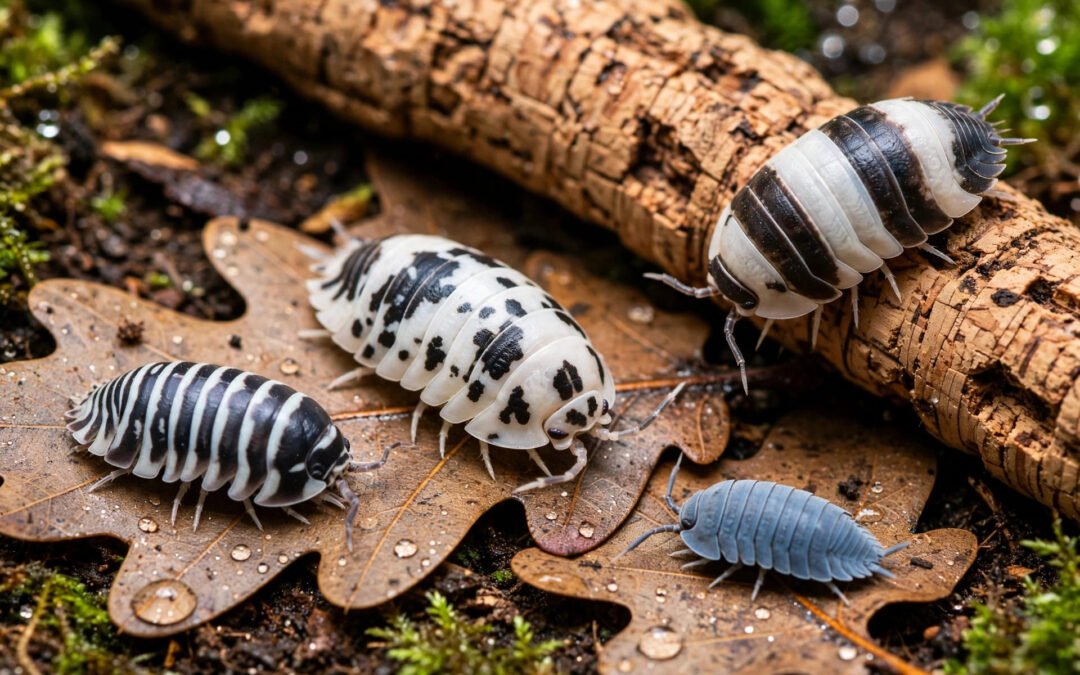
Types of Isopods: 12 Popular Pet Species Explained
There are around 10,000 described types of isopods in the world, and several thousand of them live on land. Only about a dozen dominate the pet trade. In fact, that is good news for a beginner, because the choice is much smaller than it first looks. In short, this guide explains the 12 most popular pet isopod species. It covers what each one actually needs and how hard it is to keep. In addition, it covers what it costs and which one you should buy first.
The short answer: start with a Powder Orange, a Dairy Cow or a Zebra. They are cheap, forgiving and fast to breed. Save the Cubaris and the big Spanish Porcellio for your second or third colony, after you have kept a hardy species alive for six to twelve months. In fact, price is a surprisingly honest guide to difficulty in this hobby. The animals that cost $10 for ten are the ones that forgive your mistakes. In contrast, the ones that cost $50 for five are the ones that punish them.
Species, Morphs and Locales: What the Names Actually Mean
Half the confusion beginners feel about types of isopods is not about the animals at all — it is about the names on the seller’s listing. Three words do most of the damage, so learn them before you spend anything.
A species is a real biological animal with a two-part Latin name, like Porcellio laevis. In contrast, a morph is a colour or pattern variant bred from one species — Magic Potion is not a species, it is a selectively bred colour morph of Armadillidium vulgare. Finally, a locale is where a wild population comes from, such as ‘Montenegro’ for the Clown isopod or ‘La Sénia’ for a Porcellio expansus line. In addition, sellers mix all three together on one listing, which is how a beginner ends up buying a ‘Dalmatian’ and discovering later that the name covers at least five different animals.
The rule that saves you money is simple: buy by scientific name. For instance, if a listing gives you only a trade name and no Latin name, ask the seller before you pay. A good seller answers in one message. On the other hand, a seller who cannot name the species is selling you a surprise, and surprises in this hobby usually cost more than the isopods did.
The 12 Types of Isopods at a Glance
Here is the whole guide on one screen. Difficulty is judged the way keepers actually experience it: how much the animal forgives, how fast it breeds, and how much it costs to lose.
| Type | Scientific name | Adult size | Difficulty | Breeding speed | Best for |
|---|---|---|---|---|---|
| Powder Orange / Powder Blue | Porcellionides pruinosus | 10–12 mm | Beginner | Very fast | First colony, cleanup crew |
| Dairy Cow | Porcellio laevis | 15–20 mm | Beginner | Very fast | First colony, display, feeders |
| Zebra | Armadillidium maculatum | 14–18 mm | Beginner | Slow | Display, drier tanks |
| Magic Potion | Armadillidium vulgare ‘Magic Potion’ | Up to 18 mm | Beginner | Moderate | Display, rolling pill bugs |
| Dwarf White | Trichorhina tomentosa | 2–4 mm | Beginner | Very fast | Tropical cleanup crew |
| Panda King | Cubaris sp. ‘Panda King’ | 10–14 mm | Intermediate | Slow | First Cubaris, display |
| Clown | Armadillidium klugii ‘Clown’ | Up to 18 mm | Intermediate | Slow | Display, collectors |
| Little Sea | Cubaris murina | 10–12 mm | Intermediate | Moderate | First Cubaris, tropical crew |
| Giant Canyon | Porcellio dilatatus ‘Giant Canyon’ | 15–20 mm | Intermediate | Moderate | Arid tanks, display |
| Common Shiny Woodlouse | Oniscus asellus | Up to 16 mm | Intermediate | Moderate | Wild-collected start, cool rooms |
| Hoffmannsegg’s Isopod | Porcellio hoffmannseggii | Up to 28 mm | Advanced | Slow | Display, experienced keepers |
| Brickwork Isopod | Porcellio spinicornis | Up to 17 mm | Advanced | Slow | Display, limestone setups |
Beginner Types of Isopods
These five forgive the mistakes every beginner makes: a missed misting, a warm week, a tub that stays too dry at one end. They are also the cheapest animals in the hobby, which is not a coincidence — easy animals breed fast, and fast-breeding animals are cheap.
1. Powder Orange and Powder Blue — Porcellionides pruinosus
The Powder isopods are the single best first isopod in the hobby, and the most underrated animal on this list. For example, Powder Orange and Powder Blue are the same species in two colours — buy whichever is cheaper, because the care is identical. Adults reach only 10–12 mm. They breed at a speed that borders on absurd: a warm colony started with 10–15 animals can reach several hundred in three or four months. In addition, they tolerate almost any humidity as long as one end of the tub stays damp.
Keep them at 20–27°C with a moisture gradient and a third of the floor damp, and they will do the rest. They are the best all-round cleanup crew in the hobby and the standard recommendation for a first colony. However, the honest downside is that they are small, plain and everywhere — they will turn up in your other cultures if you are careless, and they will never impress anyone at a glance. That is exactly why they are the right first buy: you are buying a colony that survives your learning curve, not a photograph. Read our full Powder Orange isopod care guide or the Powder Blue isopod care guide for the complete setup.
2. Dairy Cow — Porcellio laevis ‘Dairy Cow’
The Dairy Cow is the golden retriever of the isopod world: big, bold, black-and-white, always out in the open, and almost impossible to kill by accident. Adults reach 15–20 mm, and they breed as fast as Powders. They are the easiest isopod to actually watch. In fact, that matters more than beginners expect, because a colony you can see is a colony whose problems you spot early.
Keep them at 20–26°C with a 60–75% humidity gradient, and feed protein. This is the one non-negotiable with Dairy Cows: they are protein-hungry, and an underfed colony will chew on soft plants, shed skins and eventually each other. For example, fish flakes twice a week cost almost nothing and prevent almost every Dairy Cow problem a beginner will meet. Do not put them in a tank with small or delicate animals — they outcompete other isopods and can nip a resting gecko. Our full Dairy Cow isopod care guide covers the feeding schedule in detail.
3. Zebra — Armadillidium maculatum
The Zebra is the prettiest beginner isopod and the slowest breeder on the beginner list — both facts matter. Its black body with white bands is the pattern every non-keeper recognises, and it rolls into a perfect ball when disturbed. It lives happily at room temperature (18–26°C). In addition, it prefers a drier tub, around 50–70% humidity. Keep a third to half of the floor damp.
Buy Zebras as a display colony, not as a cleanup crew: they breed slowly, so a starter group of ten takes months to become a colony you can see working. That slowness is the trade for the looks, and it is also why Zebras cost more than Powders — roughly $30–38 for 8–10 animals. However, one warning from experience: Zebras die if a tub stays too wet. A drier Armadillidium tub is not neglect, it is the correct setup. Read our full Zebra isopod care guide before you buy.
4. Magic Potion — Armadillidium vulgare ‘Magic Potion’
Magic Potion is a selectively bred colour morph of the common pill bug: milky white with soft yellow patches and black flecks, no two animals quite alike. It is the same hardy animal as the grey pill bug underneath. That is why it belongs on the beginner list at all. However, the price is not beginner-level, roughly $25–60 for 10–12 animals. That price buys looks, not easier care.
Keep Magic Potions like other Armadillidium: room temperature, a drier tub, leaf litter always available, and never a permanently wet substrate. They eat live plants and seeds if they get the chance, so keep them out of planted display tanks you care about. In addition, check the name on the listing: A. granulatum and A. depressum with the same white-and-yellow look are also sold as ‘Magic Potion’ in the UK and US. Same care, different animal — buy by scientific name. Our full Magic Potion isopod guide explains the lookalikes.
5. Dwarf White — Trichorhina tomentosa
Dwarf Whites are the oddest animal on the beginner list and the most useful. At 2–4 mm they are barely visible. They are all female — every single animal can breed, with no males needed. In addition, they are the standard cleanup crew for tropical tanks. They suit dart frogs and small delicate animals that a bigger isopod might bother.
The catch is that they need soil that is always damp at 72–82°F, which is a tropical setup, not a room-temperature one. Consequently, in the right tank they breed explosively and will overrun other cultures; in a dry tub they simply vanish. Buy them for a job, not for display — you will almost never see them, and that is fine, because their job is to be invisible. Our Dwarf White isopod guide covers the tropical setup they need.
Intermediate Types of Isopods
These five reward a keeper who has already kept a hardy species alive for a year. However, they are not hard in the way a tropical Cubaris is hard — they are slower, pricier, and less forgiving of a dry week. That is a fair trade for animals this good-looking, but it is a bad first purchase.
6. Panda King — Cubaris sp. ‘Panda King’
The Panda King is the easy end of the Cubaris world, and the correct first Cubaris for most keepers. Black-and-white panda colouring, a proper rolling ball, and — by Cubaris standards — forgiving. For example, it needs warmer, more humid conditions than a beginner Armadillidium (steady warmth around 21–26°C with a damp end that never dries), and it breeds slowly, so a starter group takes months to establish.
Expect to pay roughly $25–80 for 10–15 animals, and expect to wait: first babies often take months, not weeks. In fact, that wait is the single biggest adjustment for a keeper coming from Powders or Dairy Cows, where everything happens fast. Do not buy Panda Kings as your first isopod — buy them as your second species, after a hardy colony has taught you the moisture gradient. Our full Panda King isopod guide covers the setup.
7. Clown — Armadillidium klugii ‘Clown’
The Clown isopod is a Balkan endemic from the eastern Adriatic coast, Croatia to Corfu, and it is spotted rather than banded — bright yellow-white spots on a dark body, which is how you tell it from a Zebra at a glance. However, sellers mix up ‘Clown’ and ‘Montenegro’ constantly; Montenegro is a locality label for the same animal, not a separate species.
Care is classic Armadillidium: room temperature, a drier tub, leaf litter, and patience, because it breeds slowly like most of its genus. In short, it is a display animal and a collector’s animal — buy it because you want that specific pattern, not because you need a cleanup crew. Our Clown isopod guide has the full care sheet.
8. Little Sea — Cubaris murina
Cubaris murina, sold as Little Sea, is the easiest Cubaris after the Panda King — and the one most beginners have already met without knowing it, because its pink Papaya line is sold everywhere. For example, it needs steady warmth (21–27°C) and a moss refuge that never dries, and it settles more slowly than a Porcellio. It also eats moss and soft plants, so do not expect your terrarium planting to survive untouched.
The honest verdict: Little Sea is a good first Cubaris and a decent tropical cleanup crew, but it is not a beginner’s first isopod. For instance, a keeper who has run Powders for a year will find it easy; a keeper on day one will find its slowness worrying and its humidity needs fiddly. Our full Cubaris murina care guide covers the Little Sea, Papaya and Glacier lines.
9. Giant Canyon — Porcellio dilatatus ‘Giant Canyon’
Giant Canyon is the isopod for the arid tank. At 15–20 mm it is a big, handsome animal that suits drier setups — but read that sentence carefully, because it is the most misread line in isopod keeping. However, it tolerates dry air, not dry soil. Giant Canyons burrow down to damp ground, so they need 3–5 inches (8–12 cm) of substrate kept damp at the bottom under a third to half of the floor. A shallow dry tub kills them; a deep tub with a damp bottom suits them perfectly.
Broods are small, around 23 young, so colonies build slowly despite a good breeding score. For example, pair them with Powders in bearded dragon and uromastyx tanks, where they handle the dry air and the Powders handle the damp pockets. Our full Giant Canyon isopod care guide explains the substrate setup.
10. Common Shiny Woodlouse — Oniscus asellus
Oniscus asellus is the flat, glossy woodlouse most readers in Europe and North America have lifted a log to find. It cannot roll into a ball — that single fact identifies it instantly — and it likes it cool, around 15–22°C, which makes it one of the few pet isopods that genuinely prefers a cool room to a warm one.
It is intermediate only because most specimens are wild-collected, and wild animals need a 60-day quarantine and carry the usual risks of parasites and pesticides. Therefore, never release pet-store or captive animals back into the wild, and never collect from sprayed gardens. If you want a native species with a story, this is the one — just quarantine it properly first. Our full Oniscus asellus care guide covers wild collection and quarantine.
Advanced Types of Isopods
These two are beautiful, slow and expensive to lose. They belong at the end of the list because they punish the exact mistakes beginners make: too much heat, too much misting, too little patience. In short, keep a hardy species for a year first, then come back for these.
11. Hoffmannsegg’s Isopod — Porcellio hoffmannseggii
Porcellio hoffmannseggii is one of the largest pet isopods in the hobby, reaching up to 28 mm, with a vivid orange-red colour that photographs like nothing else on this list. For instance, it comes from Mediterranean Spain, and its care reflects that origin: moderate humidity (60–75%) with genuinely good ventilation, which is a combination beginners find hard to hold — most beginners either seal the tub and get mould, or ventilate it and dry it out.
It breeds slowly, eats well (fish flakes and protein are appreciated), and rewards a keeper who can keep a tub stable for months at a time. It is a display animal first and a cleanup crew second. Our full Hoffmannsegg’s isopod care guide covers the ventilation setup that makes or breaks this species.
12. Brickwork Isopod — Porcellio spinicornis
Porcellio spinicornis, the Brickwork or Painted Woodlouse, is a dark animal with yellow spots and pale edges that looks like brickwork — hence the name. For example, it is a limestone specialist: in the wild it lives on walls and rocks, and in captivity it needs limestone or cuttlebone in the tub at all times, not as decoration but as husbandry. Without a calcium source it moults badly, and a bad moult in a slow-breeding species is a colony-level problem.
It is slow to breed, often wild-collected, and it eats slowly — overfeeding is the classic beginner mistake with this species, because uneaten food moulds before a slow colony finishes it. Therefore, feed little and often. Our full Porcellio spinicornis care guide has the feeding and limestone details.
One more name belongs in this section even though it is not one of the twelve: the Rubber Ducky isopod. It is the most photographed isopod in the hobby and the most overrated first buy — roughly $40–75 for five to ten animals, a breeding score of about 3 out of 10, and first babies that often take three to six months. In addition, it needs steady tropical humidity and warmth, and it costs a lot to lose. Admire it, and buy it as your third colony, not your first.
Types of Isopods by Job: Pet, Cleanup Crew or Display?
Most beginners choose by looks. In contrast, experienced keepers choose by job, and the job decides the species. Decide which of these three you want before you buy, because the best display isopod is often a poor cleanup crew and the best cleanup crew is often invisible.
For a pet in its own tub: you want an animal you can see and that forgives you. Dairy Cows, Zebras, Magic Potions and Panda Kings are all good pets. Dwarf Whites are a bad pet — you will almost never see them.
As a cleanup crew in a bioactive tank: match the crew to the enclosure’s humidity first, then to the size of the animal. For example, Powders are the all-rounder and suit almost every setup. Dwarf Whites suit small, delicate animals like dart frogs. Giant Canyons plus Powders handle arid tanks. Dairy Cows suit only large, thick-scaled reptiles — never small frogs or geckos, which a hungry Dairy Cow can nip. Our isopods for crested gecko tanks guide and our bioactive cleanup crew setup guide match species to specific pets.
For a display colony: you want pattern, size and behaviour. Zebras, Magic Potions, Clowns, Panda Kings and Hoffmannsegg’s are display animals. Armadillidium and Cubaris roll into balls, which is the single most entertaining behaviour in the hobby and the reason display keepers pay more for them.
Whatever the job, keep one species per tub. For example, every mixed tub in the hobby ends the same way: the fastest breeder takes over, and the slower species quietly disappears. Therefore, if you want two species, buy two tubs.
Trade-Name Traps: Same Name, Different Animal
Trade names are the hobby’s biggest trap, and the table below is the part of this guide most likely to save you real money. For instance, the same name can cover several animals with different care — and the care differs enough to kill a colony.
| Name on the listing | What it can be | Why it matters |
|---|---|---|
| Dalmatian | Porcellio scaber, Venezillo parvus, Armadillidium nasatum, a Porcellionides pruinosus line, or the Dairy Cow in parts of Europe | Five animals, three humidity ranges, two sizes |
| Lava | Usually Porcellio scaber ‘Lava’, a cheap beginner morph; also Ardentiella sp. ‘Lava’, an intermediate exotic | Beginner price for one, exotic care for the other |
| Magic Potion | Armadillidium vulgare; also A. granulatum and A. depressum with the same look | Same care, different species — and different prices |
| Giant Orange | Porcellio laevis or Porcellio scaber | Two species, two sizes, two temperaments |
| Panda | The Dairy Cow in German listings; elsewhere, usually short for Panda King | A $10 animal or a $50 animal |
| Clown / Montenegro | Armadillidium klugii — the same animal; Montenegro is a locality label | Do not buy both thinking they are different |
None of this is the seller’s fault, exactly — trade names grew organically, and the hobby has never standardised them. However, it is your money, so the fix is yours: ask for the scientific name, check it against a care guide before you pay, and walk away from any listing that will not give you one.
Which Type of Isopod Should You Buy First?
If you want a single answer: buy ten Powder Oranges. For example, they cost about $10–30, they breed fast enough that your mistakes get replaced, they work in almost any setup, and they teach you the moisture gradient — the one skill every other species on this list depends on. Therefore, start with one species in one tub, and do not add a second species until the first one is breeding.
If you want a pet you can actually watch, buy Dairy Cows instead. For a display animal, buy Zebras — if you are willing to wait for it to breed. With a tropical bioactive tank and a delicate pet, buy Dwarf Whites. Finally, if you are already reaching for the Rubber Ducky listing, ask yourself one question: have you kept a hardy species alive for a year? If the answer is no, buy the Powders first and the Ducky second. The Ducky will still be there in a year. Your first colony might not be.
In conclusion, for the full first-tub setup, read our isopod care guide for beginners and our best isopod species for beginners guide, and set the tub up with our best substrate mix for isopods before the animals arrive.
Types of Isopods: Frequently Asked Questions
How many types of isopods are there?
Around 10,000 species have been described worldwide, and several thousand of them live on land. In fact, only about a dozen species dominate the pet trade, and this guide covers those twelve — the ones a beginner can actually buy from a breeder.
What is the easiest type of isopod for beginners?
Porcellionides pruinosus, sold as Powder Orange and Powder Blue, is the easiest isopod for most beginners. For example, it breeds fast, tolerates almost any humidity as long as one end of the tub stays damp, and costs about $10–30 for ten animals. Dairy Cows are the easiest isopod you can actually watch.
What is the difference between a species, a morph and a locale?
A species is a real biological animal with a Latin name, like Porcellio laevis. In contrast, a morph is a colour variant bred from one species, like Magic Potion from Armadillidium vulgare. Finally, a locale is where a wild population comes from, like Montenegro for the Clown isopod. However, sellers mix all three on one listing, so always buy by scientific name.
Can different types of isopods live together in one tub?
Technically yes, practically no. In fact, the fastest breeder takes over and the slower species disappears — usually within months. Keep one species per tub, and buy a second tub if you want a second species. Our Powder Blue and Powder Orange cohabitation guide explains the one common exception, and why even that pairing needs care.
Are isopods insects?
No. Isopods are crustaceans — closer cousins of lobsters, crabs and shrimp than of any beetle. For instance, they breathe through gills, which is why moisture matters so much to them: a land isopod with dry gills cannot breathe. Our guide to how isopods breathe explains the mechanism.
How much do pet isopods cost?
Common species cost about $10–30 for ten animals in the US. Zebras run about $30–38 for 8–10, Magic Potions about $25–60 for 10–12, Panda Kings about $25–80 for 10–15, and Rubber Duckies about $40–75 for five to ten. However, prices vary by seller and season, and overnight live-animal shipping often costs more than a group of common isopods.
References
PostPops, ‘A New Collector’s Guide to Keeping Isopods’ (postpods.co.uk) — difficulty tiers, species list, Panda King as first Cubaris. VivKeeper, ‘Best Isopods for Beginners and Clean-Up Crews’ (vivkeeper.com) — beginner ranking, breeding scores, price ranges, trade-name confusion table, cleanup crew matching by pet. Reality Pathing, ‘Types of Common Pet Isopods and Their Traits’ (realitypathing.com) — seven-species overview, trait lists. XYZ Reptiles, ‘Types of Isopods for Beginners to Advanced Keepers’ (xyzreptiles.com) — feeder, pet and gardener groupings. The Tyed Dyed Iguana, ‘Pet Isopods: Lifespan, Setup, Breeding, and Care Guide’ (thetyedyediguana.com) — beginner, intermediate and collector tiers. PostPods, ‘Keeping Isopods: A UK Beginner’s Guide’ (postpods.co.uk) — genus-by-genus breakdown, pill-bug terminology. Isopod Care Hub species guides linked throughout this article.